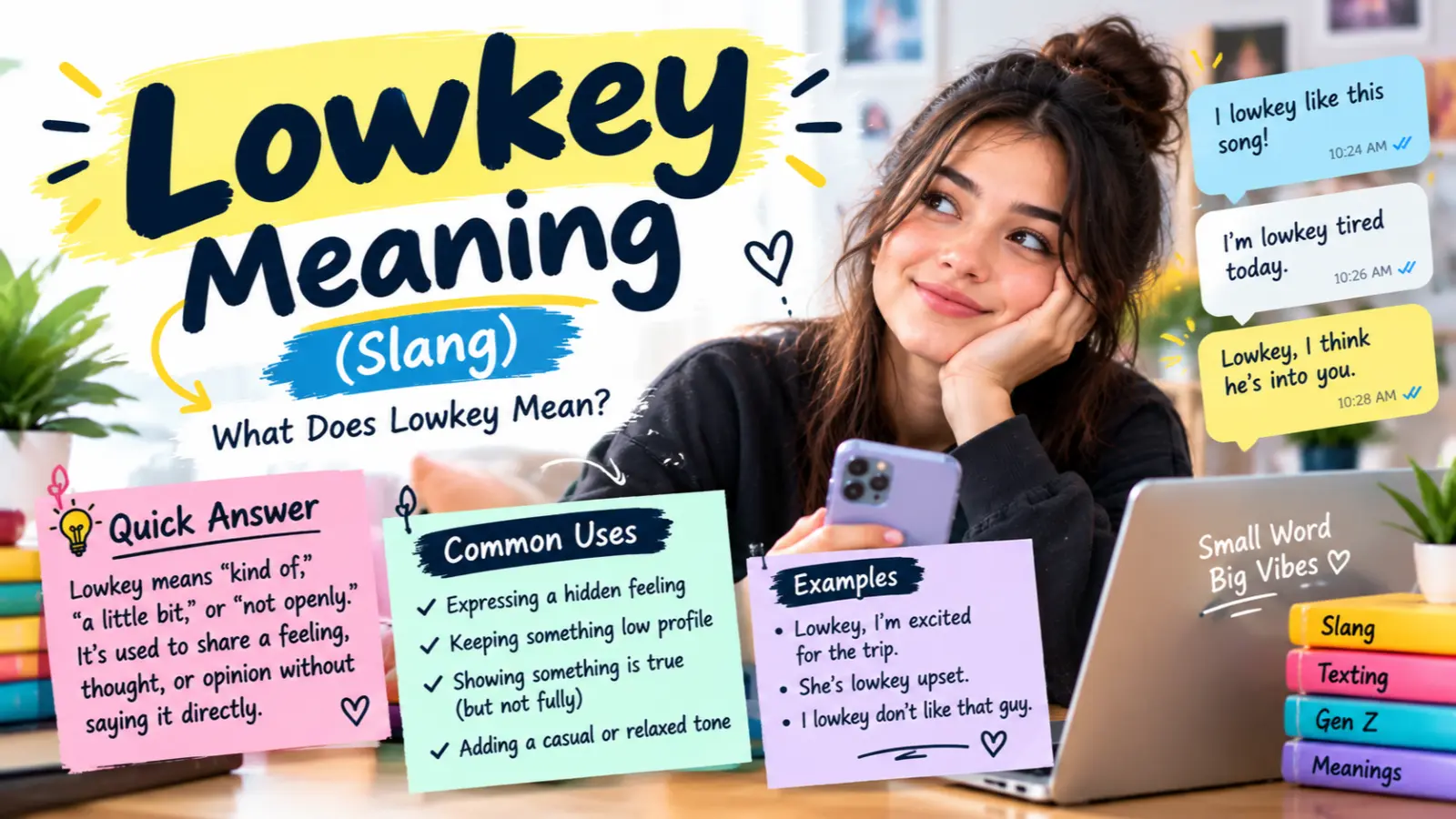
Quick answer: Lowkey means quietly, secretly, or ‘kind of’ — it softens whatever comes next. “I lowkey love this song” = I secretly really like it. Born in hip-hop culture and now everywhere on TikTok and in texts, it’s the go-to word for opinions you feel strongly but say softly.
| Term | Full Form / Meaning | Tone | Used On |
|---|---|---|---|
| Lowkey | Quietly / secretly / ‘kind of’ (adverb) | Soft, understated, casual | TikTok, texting, X, Instagram |
What Does Lowkey Mean in Slang?
In modern slang, lowkey is an adverb with two overlapping jobs:
- “Kind of / somewhat” — a softener. “I’m lowkey tired” doesn’t mean you’re a little tired; it usually means you’re quite tired but saying it casually. Lowkey downplays the intensity of the delivery, not necessarily the feeling.
- “Secretly / quietly” — a confidentiality marker. “I lowkey want to quit my job” = I’m not announcing it, but it’s true. It frames the statement as a confession.
Often it does both at once: “I lowkey love him” = I really do (softener) and I’m admitting it quietly (confession). That double duty is exactly why the word stuck around — few other words do both jobs in six letters.
Is Lowkey Positive or Negative?
Trick question — lowkey is neutral; the word after it decides. “Lowkey the best day ever” is glowing. “Lowkey annoyed right now” is not. Lowkey itself is just the wrapping paper.
What it does add is a specific social signal: self-awareness. Saying “I lowkey think I’m right” tells people you know you might sound arrogant, so you’re cushioning it. It’s the linguistic equivalent of a shrug — and that’s why it thrives in group chats, where nobody wants to sound like they’re trying too hard.
Where Did Lowkey Come From?
Lowkey started as hip-hop slang in the 2010s, all over rap lyrics where artists used it to describe keeping things quiet or understated — keeping it “lowkey” versus flashy. The mainstream caught on through memes and then TikTok, where “I lowkey…” became a confessional caption format.
Its antonym highkey (“openly, very much”) was coined right alongside it as the mirror image — you rarely see one discussed without the other. Even dictionaries caught up: Cambridge Dictionary now lists the slang adverb use of low-key as expressing an opinion without wanting to emphasize it too much. From rap verses to dictionary entries in about a decade — not bad.
How Is Lowkey Used in Real Chats?
Lowkey doing its two jobs:
- Softened opinion: “This movie is lowkey a masterpiece 🎬”
- Quiet confession: “I lowkey want to text him first 👀”
- Understated feeling: “I’m lowkey stressed about tomorrow”
- Secret like: “I lowkey love pineapple on pizza, don’t judge 🍕”
- Casual hype: “She lowkey carried the whole group project”
- Gentle shade: “That take was lowkey terrible 😂” — softened, but make no mistake
Lowkey vs Highkey: What’s the Difference?
They’re mirror images. Lowkey = quietly, secretly, kind of. “I lowkey agree” (I agree but I’m chill about it). Highkey = openly, very much, no shame. “I highkey agree” (I agree and I want everyone to know).
The fun part is the irony: people often use “lowkey” for feelings that are actually strong (“I lowkey LOVE this”) — the understatement is the joke. Highkey has no such irony; it means exactly what it says, loudly. Use lowkey for confessions, highkey for declarations.
And if someone’s being dramatic instead of understated, that’s ISTG territory — Dictionary.com’s low-key entry covers the official definition.
How Do You Reply to Lowkey?
Someone just soft-launched an opinion at you. Easy replies:
- “Lowkey same 😌” — agreement in the same register. The classic.
- “Highkey agree actually” — upgrading their soft take to a loud one. Playful escalation.
- “Say it louder 😂” — when their “lowkey” opinion is obviously strong.
- Just engage normally — lowkey doesn’t demand a special reply; react to the actual opinion underneath.
Lowkey love learning slang? Check tuff meaning next.
Synonyms and Antonyms for Lowkey
Synonyms (3–5):
- Kinda / sorta — the softener job, minus the style
- Secretly — the confession job, spelled out
- On the DL (“down low”) — the older cousin
- TBH-adjacent — similar confessional energy
Antonyms (2–3):
- Highkey — the official mirror opposite
- Openly / loudly — no softening at all
- Definitely — full-commitment energy
Lowkey FAQs
What does lowkey mean in slang?
It means quietly, secretly, or “kind of” — it softens a statement or frames it as a confession.
What does “I lowkey love you” mean?
It means “I really like/love you” said softly — often with a hint of shy confession.
Is lowkey a bad word?
No, it’s completely neutral. The word after it decides whether the sentence is positive or negative.
What’s the difference between lowkey and highkey?
Lowkey = quietly/secretly/kind of. Highkey = openly/very much. They’re opposites.
Where did lowkey come from?
2010s hip-hop slang, mainstreamed through memes and TikTok; now recognized by major dictionaries.
What does ‘lowkey highkey’ mean together?
It’s a playful contradiction — “I lowkey highkey love this” means “I quietly really love this, and I’m done hiding it.” Internet poetry.
Is lowkey still popular in 2026?
Very. A decade after going mainstream it’s still a top-tier softener in texts, captions, and comments — it earned its permanent spot.
Quick Recap
- Lowkey = quietly, secretly, or ‘kind of’ — a softener and a confession in one.
- It’s neutral; the word after it sets the mood.
- Born in 2010s hip-hop, raised by TikTok, adopted by dictionaries.
- Highkey is its loud mirror opposite.
- Reply with “lowkey same” — or just engage with the real opinion underneath.
Read More Articles
🔮Tuff Meaning in Slang: What Does ‘Tuff’ Really Mean?
🔮What Does ‘Cooked’ Mean in Slang? Meaning, Examples & How to Reply

Hi, I’m Mia Walker, a Content Research Writer at Hublioo.com with 3+ years of experience in creating educational language content.
I enjoy breaking down complex words, internet slang, abbreviations, and everyday expressions into clear, practical explanations that anyone can understand.
My focus is on delivering original, easy-to-read, and well-organized content that helps readers expand their vocabulary and use English with greater confidence.