
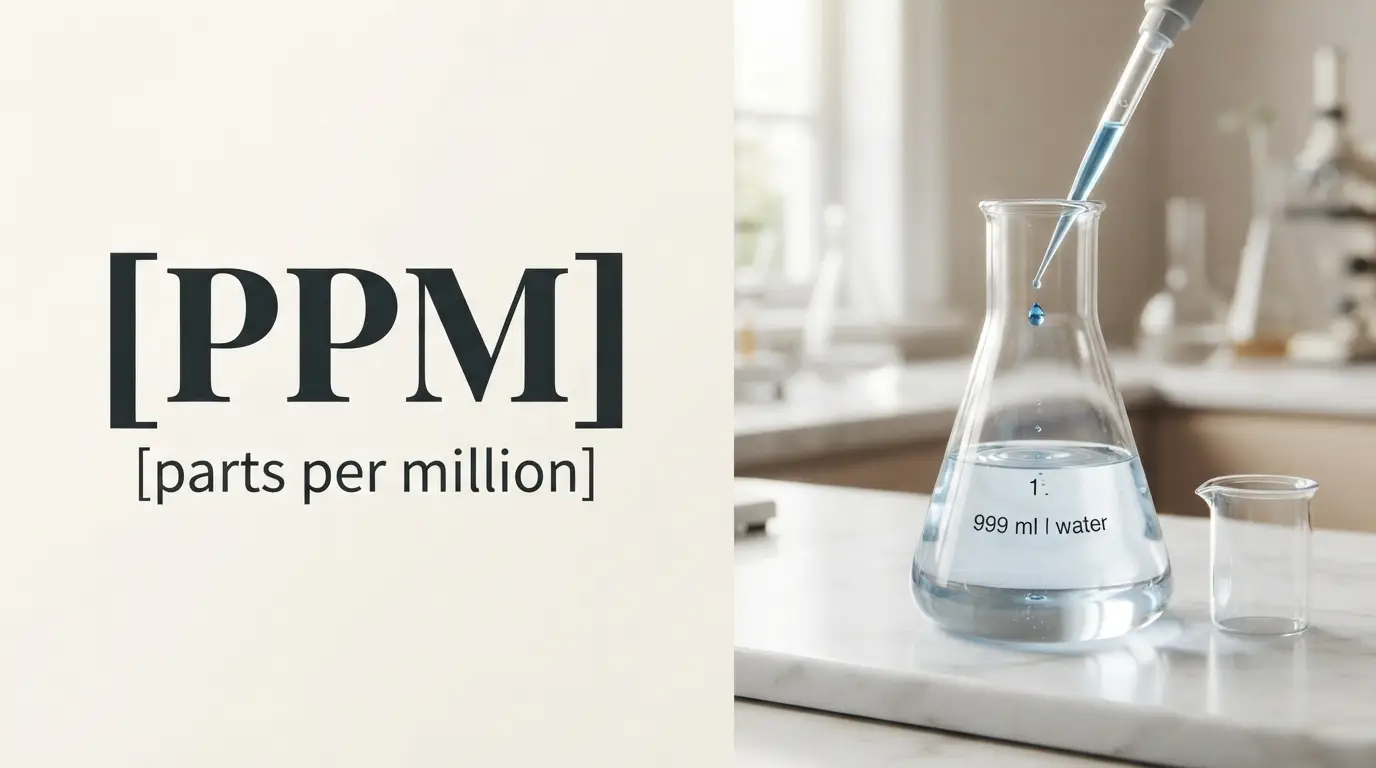
Quick Answer: PPM stands for “parts per million.” It’s a way to describe tiny concentrations: 1 ppm = 1 part out of 1,000,000 parts (or 0.0001%). You’ll see it in water-quality reports, air-pollution data, and chemistry. In electronics, PPM can instead mean pulse position modulation - a signaling method.
| Aspect | Term | Full form | What it is | Key conversion | Seen in |
|---|---|---|---|---|---|
| Aspect | Detail | ||||
| Term | PPM | ||||
| Full form | Parts per million | ||||
| What it is | A ratio for very small concentrations: 1 ppm = 1 in 1,000,000 | ||||
| Key conversion | 1% = 10,000 ppm; 1 ppm = 0.0001% | ||||
| Seen in | Water testing, air quality, chemistry, environmental science; electronics (different meaning) |
What Does PPM Stand For?
PPM = parts per million. It’s the go-to unit when percentages get silly - try writing “0.0001%” on a water report fifty times and you’ll see why scientists prefer “1 ppm.” The idea is beautifully simple:
- 1 ppm = 1 part in 1,000,000 (like 1 grain of distinct sand in a jar of a million)
- 10 ppm = 10 parts in 1,000,000
- 1,000 ppm = 1,000 parts in 1,000,000
The U.S. EPA uses ppm routinely for air, water, and environmental measurements, and NIST defines it as 10⁻⁶. Bigger number = more of the substance relative to the whole - but “more” here still means tiny.
How Did PPM Become a Measurement Unit?
PPM wasn’t decreed by one person - it emerged from necessity. As industrial chemistry, environmental regulation, and public-health testing grew through the 20th century, scientists kept hitting the same problem: the concentrations that mattered (pollutants, contaminants, additives) were far too small for percentages to express elegantly.
The “parts-per” family solved it as a system: percent (parts per hundred) for everyday amounts, ppm (parts per million) for trace amounts, and ppb (parts per billion) for ultra-trace amounts. Regulatory bodies like the U.S. EPA cemented ppm into law and practice - once it’s in the regulations, it’s in the textbooks, the lab reports, and the news forever.
Where Do You See PPM in Everyday Life?
PPM hides in plain sight more than you’d think:
- Water reports: “2 ppm of X” on your municipal water-quality report - that’s the concentration per million parts of water.
- Air quality: gases like carbon monoxide measured in ppm by volume; EPA standards use ppm for several pollutants.
- Pools and spas: chlorine levels are tracked in ppm - the reason test strips exist.
- Food and agriculture: trace residues and additives measured in ppm.
- Manufacturing: defect rates (“50 ppm defects” = 50 bad parts per million made) - a quality-control staple.
Important nuance: a higher ppm isn’t automatically dangerous. Safety depends on the substance, exposure, and the legal limit - 10 ppm of one chemical is trivial, 10 ppm of another is an emergency. Always compare against the relevant standard, not your gut.
How Do You Convert PPM to Percent?
The only conversion you need to memorize: 1% = 10,000 ppm.
- PPM → percent: divide by 10,000. (250 ppm ÷ 10,000 = 0.025%)
- Percent → PPM: multiply by 10,000. (2% × 10,000 = 20,000 ppm; 0.02% × 10,000 = 200 ppm)
Quick-reference ladder:
- 1 ppm = 0.0001% - extremely small
- 100 ppm = 0.01% - small
- 1,000 ppm = 0.1% - one-tenth of one percent
- 10,000 ppm = 1%
- 1,000,000 ppm = 100% (the whole thing)
PPM vs Percent: When Do You Use Which?
Both describe proportions - they just operate at different scales:
- Percent (parts per hundred): everyday amounts - sale discounts, battery levels, test scores.
- PPM (parts per million): trace amounts - contaminants, pollutants, defect rates.
The rule of thumb: if the amount is comfortably above 1%, use percent; if it’s far below 1%, use ppm. Writing “0.0003%” invites misread decimals; “3 ppm” is instantly clear. It’s a communication choice as much as a math one - ppm exists to keep tiny numbers human-readable.
PPM vs PPB: What’s the Difference?
Meet ppm’s smaller sibling:
- PPM = parts per million (1 in 1,000,000; 10⁻⁶)
- PPB = parts per billion (1 in 1,000,000,000; 10⁻⁹)
1 ppm = 1,000 ppb. Scientists reach for ppb when even ppm feels chunky - ultra-trace contaminants, for instance. Same family, finer grain. If ppm is counting grains of sand in a jar, ppb is counting them in a sandbox.
Does PPM Always Mean Parts Per Million?
Almost always in science - but not in electronics. In electronics and communications, PPM = pulse position modulation, a signaling technique where information is encoded in the timing of pulses. You’ll meet it in radio-control systems, signal processing, and engineering courses.
The context test is instant: words like water, air, concentration, chemical, pollutant → parts per million. Words like signal, pulse, transmitter, modulation, waveform → pulse position modulation. When in doubt, the surrounding vocabulary never lies.
Is PPM Formal or Informal?
PPM is fully formal - it’s standard scientific and regulatory terminology, at home in lab reports, EPA documents, academic papers, and quality-control specs. There’s nothing slangy about it.
The one caution: ppm is a ratio, not a unit with built-in dimensions. Whether it means by mass, by volume, or by mole depends on the field - and in water work, 1 ppm ≈ 1 mg/L only for dilute solutions. In formal writing, specify the basis when it matters (“3 ppm by volume”) and you’ll sound like a pro. For more everyday abbreviations, see our guides to ML and ETA.
Frequently Asked Questions About PPM Meaning
What does PPM stand for?
PPM most commonly stands for parts per million - one part per one million parts total. In electronics, it can mean pulse position modulation.
What does 1 ppm mean?
1 ppm = 1 part in 1,000,000, or 0.0001%. Picture one distinct grain among a million grains of sand.
How do you convert ppm to percent?
Divide by 10,000: 250 ppm = 0.025%. To go the other way, multiply percent by 10,000: 2% = 20,000 ppm.
Is 1 ppm a lot?
Usually it’s a very small proportion - but whether it matters depends on the substance, exposure, and safety standards. Compare against the relevant limit, not your instincts.
What does ppm mean in water testing?
In water testing, ppm describes a substance’s concentration in water. For dilute solutions, 1 ppm is often treated as approximately 1 mg/L, but check the measurement basis.
What’s the difference between ppm and ppb?
PPM = parts per million; PPB = parts per billion. PPB is 1,000× smaller - used for even tinier trace amounts. (1 ppm = 1,000 ppb.)
Key Takeaways
- PPM = parts per million - 1 ppm is 1 part in 1,000,000, or 0.0001%.
- Use ppm for trace amounts (pollutants, contaminants, defect rates); percent for everyday amounts.
- Master conversion: 1% = 10,000 ppm - divide or multiply by 10,000.
- Higher ppm ≠ automatically dangerous - safety depends on the substance and the standard.
- PPB (parts per billion) is ppm’s finer-grained sibling: 1 ppm = 1,000 ppb.
- In electronics, PPM can mean pulse position modulation - context (signals vs. substances) decides.
Explore More Meanings
- ML Meaning: Machine Learning Explained
- ETA Meaning: Texting, Travel & Work Guide
- BSN Meaning: Bachelor of Science in Nursing
Read More Articles
🔮EFN Meaning: Texting Slang & Finance Term Explained (2026)
🔮ML Meaning: Machine Learning Explained in Simple Words (2026)
🔮8647 Meaning: The Political Number Code Everyone’s Asking About (2026)

Hi, I’m Claire Morgan, a Senior Language Content Specialist at Hublioo.com. I have 5+ years of experience creating clear and easy-to-understand content about word meanings, slang, acronyms, phrases, and modern English usage. My goal is to simplify complex language and help readers understand words with confidence through accurate, well-researched, and reader-friendly explanations.