
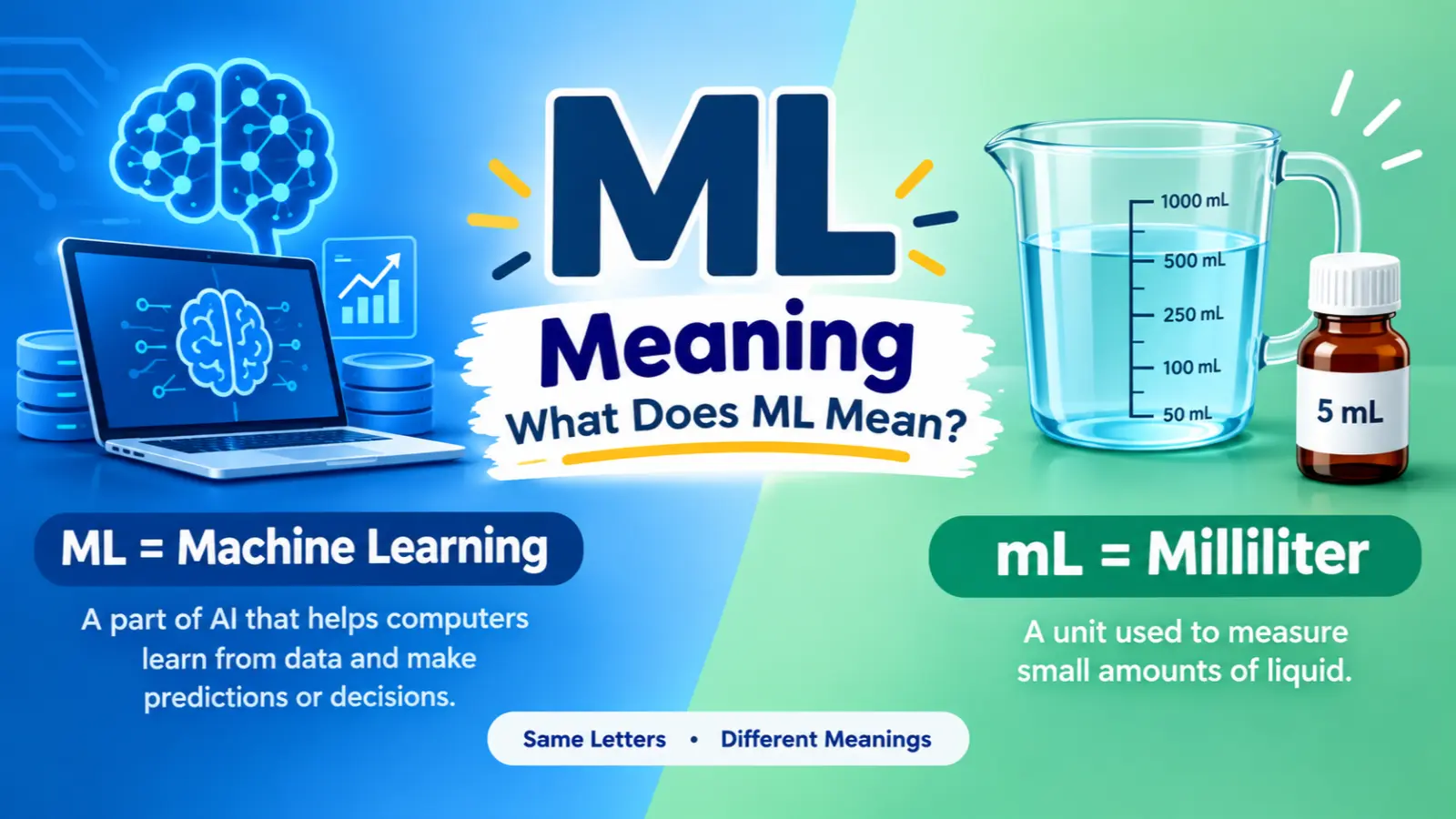
ML usually means “Machine Learning” in technology. It is a type of artificial intelligence (AI) that helps computers learn patterns from data and use them to make predictions or decisions.
However, mL can also mean milliliter, a unit used to measure liquid. The correct ML meaning depends on the context.
If you saw “ML” online, in a text message, at work, or in a technology article, this guide will help you understand exactly what it means.
ML Meaning in Simple Words
The most common ML meaning today is Machine Learning.
Machine Learning is a technology that allows computers to learn from data instead of being given instructions for every possible situation.
For example, think about your email spam filter. It can learn from many previous emails and identify patterns that are common in spam messages. When a new email arrives, the system can use those patterns to decide whether the message may be spam.
In simple terms:
ML = Machine Learning = Computers learning from data.
What Does ML Mean in Technology?
In technology, ML stands for Machine Learning.
Machine Learning is a branch of artificial intelligence. It allows computer systems to find patterns in data and use those patterns to produce predictions, recommendations, or decisions.
You may already use ML every day without realizing it.
For example, when a streaming service recommends a movie based on what you watched before, machine learning may be part of that process.
Online stores can also use ML to recommend products. Email services can use it to detect spam, while financial systems can use machine learning to identify unusual activity.
Machine learning is now used across many areas of modern technology.
How Does Machine Learning Work?
Machine Learning may sound complicated, but the basic idea is simple.
Data → Learning → Prediction
First, a computer system receives data. The data could contain text, numbers, pictures, sounds, or other information.
Next, a machine learning algorithm looks for patterns in that data. During training, the system learns how different pieces of information are related.
Finally, the trained model can use what it learned when it receives new data.
For example, imagine you want a computer to recognize pictures of dogs.
You could give it many pictures labeled as dogs and many pictures that are not dogs. The model studies those examples and learns useful patterns.
Later, when it sees a new picture, it can make a prediction about whether the picture contains a dog.
The system is not thinking like a person. It is using mathematical patterns learned from data.
ML Examples in Everyday Life
You do not need to be a programmer to see ML in action.
Machine Learning can be used in many everyday services and apps.
Email: Spam filters can learn patterns associated with unwanted messages.
Shopping: Online stores can recommend products based on browsing or buying behavior.
Entertainment: Streaming platforms can suggest movies, shows, or music based on previous activity.
Maps: Navigation systems can use data and machine learning techniques to help estimate traffic and travel times.
Voice tools: Some speech and language systems use machine learning to understand spoken words.
Security: Financial systems can use ML to identify unusual transaction patterns.
These examples show why ML has become an important part of modern technology.
What Is the Difference Between ML and AI?
ML and AI are closely related, but they do not mean exactly the same thing.
AI means Artificial Intelligence.
ML means Machine Learning.
Artificial intelligence is the broader field. Machine learning is one of the main approaches used to create AI systems.
A simple way to remember the difference is:
AI is the bigger field. ML is one way to build intelligent computer systems.
Deep learning is also related. It is a type of machine learning that uses neural networks with multiple layers.
Because these terms are closely connected, people sometimes use AI and ML as if they were identical. In technical discussions, however, the distinction is useful.
What Does mL Mean?
The meaning changes when you see mL in a measurement.
mL means milliliter.
A milliliter is a unit used to measure volume, especially small amounts of liquid.
For example, you may see mL on:
- Medicine bottles
- Drink containers
- Food labels
- Cooking recipes
- Laboratory equipment
For example:
5 mL = five milliliters
100 mL = one hundred milliliters
500 mL = half a liter
1,000 mL = one liter
One milliliter is also equal to one cubic centimeter.
So if someone says, “Add 20 mL of water,” they are talking about a volume measurement, not Machine Learning.
ML vs mL: What Is the Difference?
The easiest way to understand the difference is to look at the context.
| Term | Meaning | Example |
|---|---|---|
| ML | Machine Learning | ML helps computers learn from data. |
| mL | Milliliter | Add 10 mL of water. |
Capitalization also gives you an important clue.
When discussing AI, computers, software, data, algorithms, or technology, ML usually means Machine Learning.
When discussing liquid, medicine, recipes, bottles, or volume, mL means milliliter.
How to Know What ML Means
If you are unsure about the meaning of ML, look at the words around it.
If you see words like AI, data, computer, model, algorithm, software, training, or technology, ML probably means Machine Learning.
For example:
“I’m learning ML for my computer science course.”
Here, ML means Machine Learning.
But if you see words such as water, medicine, liquid, bottle, liter, or recipe, the abbreviation probably refers to milliliters.
For example:
“Take 5 mL of the liquid.”
Here, mL means milliliters.
Context usually makes the meaning clear.
Why Is Machine Learning Important?
Machine Learning is important because computers can process huge amounts of information very quickly.
Instead of creating a separate rule for every possible situation, developers can sometimes train a model using large amounts of data.
The trained model can then identify patterns in new information.
ML is used in areas such as recommendations, fraud detection, image recognition, language processing, search technology, and many other applications.
However, machine learning is not perfect. The quality of its results can depend on the quality of the data used to train the system.
Good data can help produce useful results, while incomplete or poor-quality data can create problems.
Common Mistakes About ML Meaning
One common mistake is thinking that ML always means Machine Learning.
That is not true.
In technology, ML usually means Machine Learning. But in measurements, mL means milliliter.
Another common mistake is saying that ML and AI are exactly the same. They are related, but AI is the broader term and machine learning is one approach within AI.
It is also important to pay attention to capitalization when writing measurements. mL is commonly used for milliliter.
Finally, remember that abbreviations can have different meanings in casual conversations. If you see ML in a text message or social media post, the surrounding words can help you understand what the writer means.
Frequently Asked Questions About ML Meaning
What does ML stand for?
ML most commonly stands for Machine Learning in technology. In measurement contexts, mL means milliliter.
What is ML in simple words?
ML, or Machine Learning, is a technology that helps computers learn patterns from data and use those patterns to make predictions or decisions.
Is ML the same as AI?
No. AI is the broader field of Artificial Intelligence, while Machine Learning is one important approach used within AI.
What does mL mean on a bottle?
mL means milliliter. It is a unit used to measure volume. For example, 500 mL is half a liter.
What is a simple example of Machine Learning?
A spam filter is a simple example. It can learn patterns from previous messages and use those patterns to help identify unwanted emails.
Why is ML used in technology?
ML can help computers find patterns in large amounts of data and use those patterns for tasks such as predictions, recommendations, classification, and automation.
Conclusion:
The most common ML meaning in technology is Machine Learning.
It is a part of artificial intelligence that helps computers learn patterns from data and use them to make predictions or decisions.
You can find Machine Learning in many everyday technologies, including spam filters, product recommendations, entertainment services, language tools, and fraud detection systems.
However, mL has a completely different meaning. In recipes, medicine, bottles, and other measurement situations, mL means milliliter, a unit of volume.
The easiest way to understand ML is to check the context. If the topic is computers, AI, or data, ML probably means Machine Learning. If the topic is liquid or measurement, mL means milliliter.

Hi, I’m Mia Walker, a Content Research Writer at Hublioo.com with 3+ years of experience in creating educational language content.
I enjoy breaking down complex words, internet slang, abbreviations, and everyday expressions into clear, practical explanations that anyone can understand.
My focus is on delivering original, easy-to-read, and well-organized content that helps readers expand their vocabulary and use English with greater confidence.