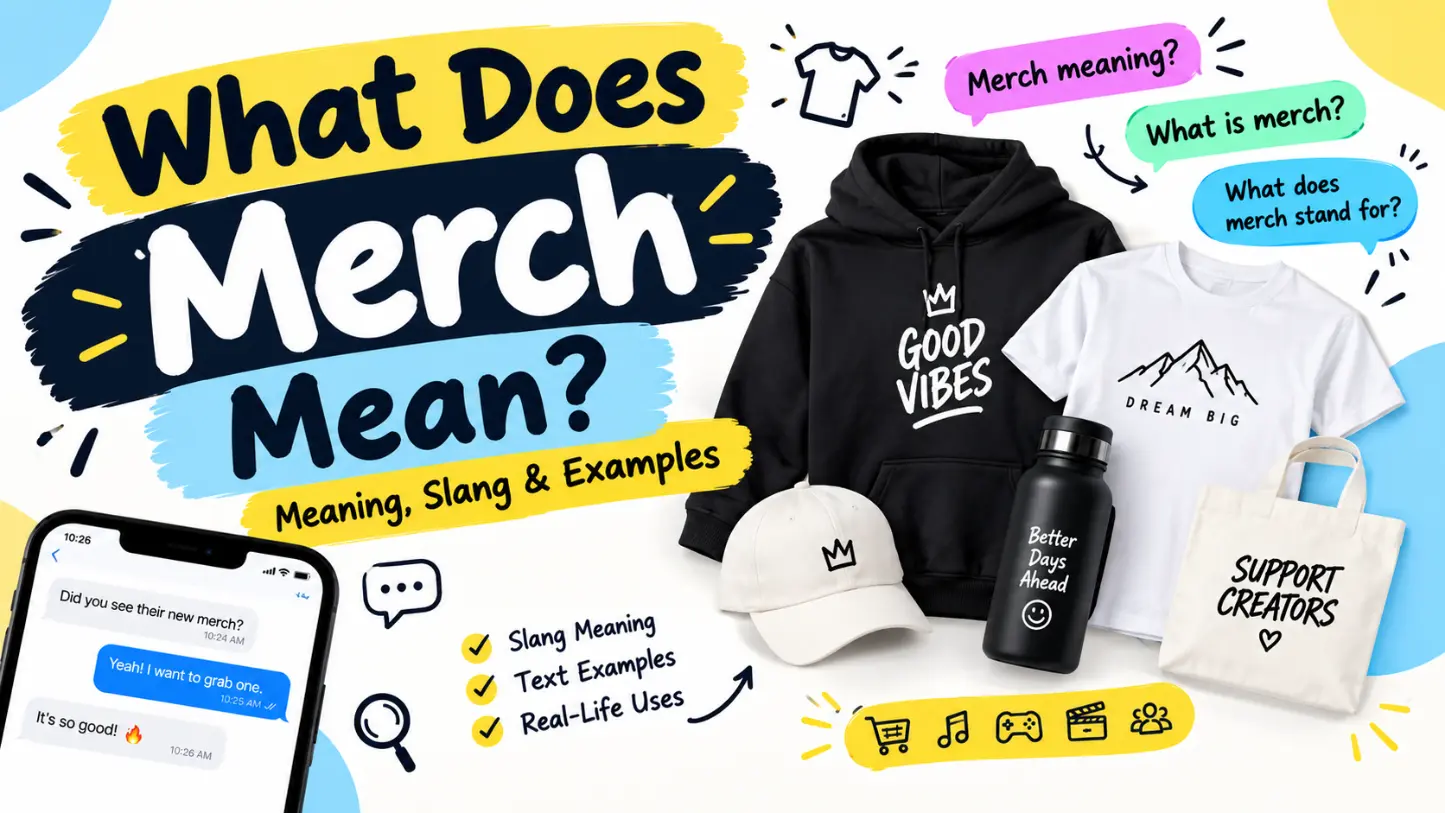
Quick Answer: Merch is short for merchandise — products sold in connection with an artist, creator, brand, team, game, or event. T-shirts, hoodies, posters, and mugs at a concert are all merch. It’s casual commerce vocabulary now, not a secret slang meaning.
| Quick Fact | Detail |
|---|---|
| Term | Merch |
| Full form | Merchandise |
| Core meaning | Branded products sold by artists, creators, teams & brands |
| Tone | Casual, enthusiastic, commercial |
| Used on | Concerts, YouTube, Twitch, sports, fandoms, online stores |
Merch is short for merchandise – branded products like T-shirts, hoodies, and posters sold by artists, YouTubers, and brands. If a creator says new merch drop, they mean new products for sale.
– Part of speech: Noun (slang)
– Meaning: Short for merchandise; branded products for sale
– Origin: Clipped from merchandise
– Usage: Creator economy, concerts, online stores
– Example: “I bought merch at the concert last night.”
What Does “Merch” Stand For?
Merch = merchandise. That’s it — no hidden meaning, no acronym. It’s a clipping: English speakers chopped “merchandise” down to its punchiest syllable, the way “advertisement” became “ad” and “influenza” became “flu.”
But “merch” carries a narrower, cooler sense than the full word. “Merchandise” could mean anything a store sells; “merch” specifically means products tied to an identity — a band, a YouTuber, a sports team, a game, a brand. Nobody calls groceries “merch.” A tote bag with your favorite streamer’s logo? That’s merch.
Is “Merch” Slang?
It’s informal, but barely slang anymore. “Merch” started as music-scene shorthand — band merch tables are as old as touring itself — then exploded with the creator economy. When YouTubers, Twitch streamers, and TikTokers all started selling branded products, “merch” went mainstream.
Today it’s standard commercial vocabulary: artists announce “merch drops,” stores have “merch” sections, and marketing teams plan “merch strategies” without irony. Using it in business contexts is completely normal now. The only place it still feels slangy is formal writing — a financial report would say “branded merchandise revenue,” not “merch money.”
Where Did “Merch” Come From?
The clipping emerged from music culture, where selling T-shirts and posters at shows has been essential income since the 1960s–70s. “Band merch” and the “merch table” (later “merch booth”) were touring staples long before the internet.
Two waves made it universal:
- Hip-hop streetwear (1990s–2000s): artists turned merch into fashion — tour tees became coveted streetwear, blurring the line between souvenir and style.
- The creator economy (2010s–2020s): YouTubers and streamers made merch a primary revenue stream, and “new merch drop!” became a standard content event. Platforms even built merch integrations directly into channels.
In 2026, “merch” is simply what branded products are called across music, gaming, sports, and creator culture — a rare slang term that grew up into legitimate commerce vocabulary (see Wikipedia on merchandising).
What Counts as Merch?
If it carries the brand and fans buy it to show affiliation, it’s merch. The classic categories:
- Music merch: tour T-shirts, hoodies, vinyl bundles, posters, hats. The concert tee is the original merch.
- Creator merch: YouTuber hoodies, streamer jerseys, TikToker phone cases — often sold through dedicated merch stores.
- Gaming merch: figurines, apparel, posters, and collectibles tied to games and esports teams.
- Sports merch: jerseys, caps, scarves — the multi-billion-dollar engine of fandom.
- Movie/TV merch: Funko-style figures, apparel, and collectibles from franchises.
The unifying logic: merch monetizes belonging. Buying it says “I’m part of this.” That’s why limited “drops” work so well — scarcity plus identity is a powerful combination. (And if you’re wondering about the materials, much affordable merch — bags, wallets, jackets — is made from PU leather rather than genuine hide.)
How Do You Use “Merch” in a Sentence?
- “I bought so much merch at the concert — two shirts and a poster.”
- “Her new merch drop sold out in an hour.”
- “The band’s merch table had the coolest designs.”
- “He makes more from merch than from streaming revenue.”
- “Are you getting the limited-edition merch?”
In texts, it’s usually casual and enthusiastic:
- Friend: “Did you see the new merch??”
- You: “The hoodie!! I need it 😭”
“Merch” vs. “Merchandise”: What’s the Difference?
- Merchandise = the formal, general term. Anything sold in commerce. Used in business, legal, and retail contexts. (“The store’s merchandise includes…”)
- Merch = the casual, specific term. Branded, identity-linked products. Used by fans, creators, and in marketing. (“New merch just dropped!”)
They’re interchangeable in casual speech, but each has a home turf. A quarterly report discusses “merchandise revenue”; a YouTuber announces “new merch.” Using “merchandise” with friends sounds stiff; using “merch” in a contract sounds unprofessional. Match the word to the room.
Is “Merch” Only for Musicians?
Not anymore — that ship sailed a decade ago. Today’s merch universe includes:
- Creators: YouTubers, streamers, podcasters, TikTokers — merch is often their biggest income source.
- Gamers & esports: team jerseys, in-game-inspired apparel.
- Brands: even non-entertainment companies sell “merch” (think Duolingo’s plush owls).
- Causes & events: charity merch, conference swag, festival gear.
The common thread isn’t music — it’s community. Any group with loyal followers can have merch. If people want to wear their affiliation, someone will sell them the shirt. Texting a friend “wbu, are you copping the drop?” is peak 2026 fandom communication.
Frequently Asked Questions
What does “merch” mean in slang?
It’s short for “merchandise” — branded products sold by artists, creators, teams, or brands. It’s more “casual commercial term” than true slang at this point; the music and creator industries use it as standard vocabulary.
What is an example of merch?
A band’s tour T-shirt, a YouTuber’s hoodie, a sports team’s jersey, a streamer’s mug — any product carrying a creator’s or brand’s identity, sold to fans.
Why is it called a “merch drop”?
Borrowed from streetwear/sneaker culture, where limited products “drop” (release) at a specific time. The drop model creates urgency and hype — fans buy fast before items sell out.
Do creators make money from merch?
Often more than from content itself. For mid-size creators, merch margins typically beat ad revenue per fan — which is why “check out my merch” is a staple call-to-action.
Is “merch” the same as “swag”?
Close but different: merch is sold to fans; swag (stuff we all get) is usually given away free as promotion. A free tote at a conference is swag; the $40 hoodie on the creator’s store is merch.
Key Takeaways
- Merch = merchandise: branded products tied to an artist, creator, team, or brand.
- It grew from music touring culture through streetwear into the creator economy.
- Merch is casual and fan-facing; merchandise is formal and commercial.
- Merch monetizes belonging — fans buy it to show affiliation.
- It’s not just music anymore: creators, gamers, brands, and causes all sell merch.
Read More Articles
🔮Brick and Mortar Meaning: Definition, Examples & Business Guide
🔮Intricate Meaning: Definition, Intricate vs Complex & Beautiful Examples

Hi, I’m Claire Morgan, a Senior Language Content Specialist at Hublioo.com. I have 5+ years of experience creating clear and easy-to-understand content about word meanings, slang, acronyms, phrases, and modern English usage. My goal is to simplify complex language and help readers understand words with confidence through accurate, well-researched, and reader-friendly explanations.