Quick answer: Brick-and-mortar describes a business with a physical store or office customers can walk into — a bakery, clothing shop, or bank branch — as opposed to an online-only business. The term took off in the late-1990s dot-com era, and today most successful retailers blend both models.
| Element | Detail |
|---|---|
| Term | Brick-and-mortar |
| Simple meaning | Business with a physical location |
| Tone | Business-neutral, slightly nostalgic |
| Origin | Late-1990s dot-com era; literal building materials |
| Opposite | Online-only / e-commerce |
| Hybrid | Click-and-mortar (omnichannel) |
| Examples | Bakeries, Apple Store, bank branches |
What Does “Brick and Mortar” Mean?
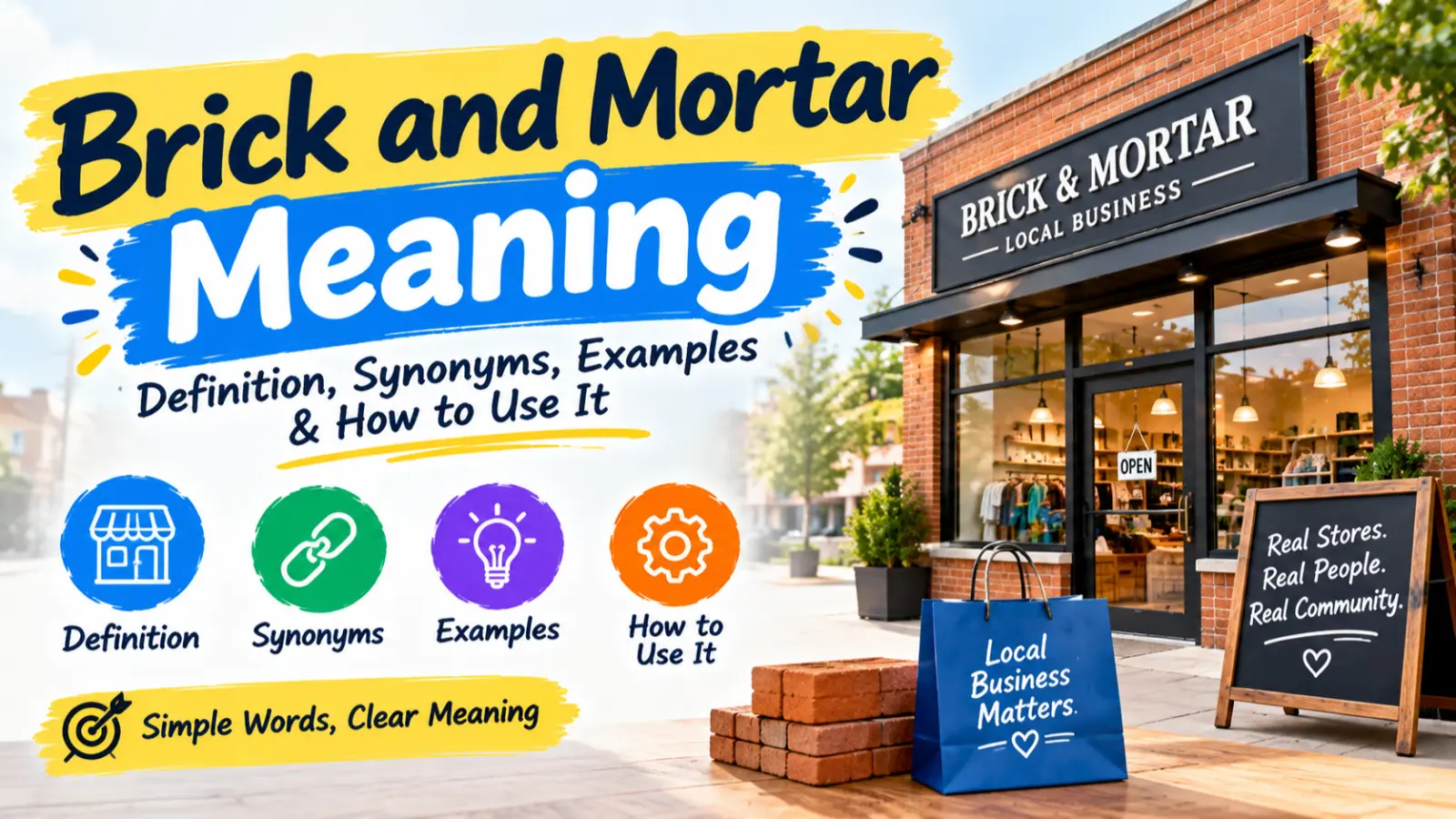
Brick-and-mortar (also written “brick and mortar”) describes a business with a physical store or office customers can walk into — as opposed to one that exists only online. Your corner bakery, the Apple Store, a dentist’s clinic: all brick-and-mortar.
The phrase is almost always used in contrast to e-commerce. Nobody calls a shop “brick-and-mortar” unless online alternatives exist — it’s a retronym, a word invented because the internet made the old thing need a name.
What Does Brick-and-Mortar Mean in Business?
In business writing, “brick-and-mortar” is shorthand for the entire physical-retail model: rent, foot traffic, shelves, staff, and all. Analysts track “brick-and-mortar sales” separately from online sales, and “brick-and-mortar vs. e-commerce” is one of retail’s defining rivalries.
The model has real strengths the internet can’t copy: try-before-you-buy, instant gratification (walk out with it today), and human service. That’s why even digital giants opened physical stores — Amazon’s bookstores and Whole Foods being the famous examples of clicks buying bricks.
Brick-and-Mortar: Hyphens, Plurals, and Usage
As an adjective before a noun, hyphenate it: “a brick-and-mortar store.” As a noun phrase, hyphens are optional: “their business is brick and mortar.” It’s invariable — no plural form (“brick-and-mortars” will get you corrected). Related term: click-and-mortar for the hybrid model.
Common mistake: writing “bricks and mortar” (plural “bricks”). The business term is always singular “brick.” Also note: “mortar” here is the binding paste for bricks — the phrase is literal building materials turned business metaphor.
Where Did the Phrase “Brick and Mortar” Come From?
The words are literal: bricks and mortar are what physical buildings are made of. As a business term, it took off in the late 1990s during the dot-com boom, when “clicks vs. bricks” became the shorthand for the old economy versus the new one.
Before e-commerce, nobody needed the phrase — every store was brick-and-mortar by default. The internet didn’t just create online shopping; it retroactively named everything else.
What Are Examples of Brick-and-Mortar Businesses?
Clear examples across categories:
- Retail: “Nike’s flagship store is brick-and-mortar, though most sales happen online.”
- Food: “The bakery started as an Instagram page and opened a brick-and-mortar shop last year.”
- Services: “Banks are closing brick-and-mortar branches as apps take over.”
- Business news: “Brick-and-mortar retailers reported stronger holiday foot traffic.”
- Hybrid: “Warby Parker began online, then expanded into brick-and-mortar locations.”
Brick-and-Mortar vs. Online Business: What’s the Difference?
Brick-and-mortar = physical presence: rent, staff, inventory on shelves, customers walk in. Online/e-commerce = digital storefront: websites, warehouses, shipping. The hybrid — physical stores plus online sales — is called click-and-mortar or omnichannel, and it’s where most big retailers landed.
Neither model “won.” Online dominates for convenience and price comparison; physical dominates for experience, urgency, and trust — which is why a bona fide luxury brand still wants you to walk into the boutique.
What Are Synonyms for “Brick-and-Mortar”?
Synonyms:
- Physical store — the plain modern equivalent
- Storefront — emphasizes the street-facing shop
- High-street shop — the British-flavored version
- Bricks-and-clicks / click-and-mortar — the hybrid model
Antonyms: online store, e-commerce, pure-play (a business that operates only online).
Is “Brick-and-Mortar” Formal? Tone and Register
It’s business-neutral — standard in journalism, retail analysis, and everyday conversation alike. “Do they have a brick-and-mortar location?” is perfectly natural spoken English in 2026.
Tone check: neutral, slightly nostalgic. The phrase can carry a faint old-school warmth, the way “vinyl record” does — it names the original in a world of alternatives.
Brick-and-Mortar or Online: How Do You Choose?
Shopping? Choose brick-and-mortar when you need to touch, try, or take it home today (clothes, furniture, urgent gifts); choose online for price comparison and rare items. Starting a business? The 2026 consensus is hybrid: an online presence for reach, a physical spot for trust and experience.
The phrase survives because the distinction still matters — customers genuinely think in these two categories, and smart businesses speak both languages.
Further Reading
FAQs
What does brick and mortar mean in simple words?
A business with a real physical store or office you can visit — like a bakery, clothing shop, or bank branch — as opposed to an online-only business.
Is brick and mortar the same as a physical store?
Essentially, yes. “Brick-and-mortar” is the business-world term for a physical store, usually used when contrasting with online shopping.
What is an example of a brick-and-mortar business?
Starbucks cafés, Zara stores, your local pharmacy — any business operating from a physical location.
What is the opposite of brick-and-mortar?
An online-only or e-commerce business, like an Amazon-only seller. The hybrid of both is called “click-and-mortar.”
Why is it called brick and mortar?
Bricks and mortar are literal building materials. The phrase took off in the late-1990s dot-com era to distinguish physical stores from new online shops.
Are brick-and-mortar stores dying?
No — they’re adapting. Many now blend with online (buy online, pick up in store), and experience-focused physical retail is growing in 2026.
Key Takeaways
- Brick-and-mortar = a business with a physical location customers can visit.
- Coined in the late-1990s dot-com era; a retronym created by e-commerce.
- Strengths: try-before-you-buy, instant pickup, human service, trust.
- Opposite: online-only/e-commerce; hybrid: click-and-mortar (omnichannel).
- In 2026 the winning model is usually both — physical presence plus digital reach.
Read More Articles
🔮Intricate Meaning: Definition, Intricate vs Complex & Beautiful Examples
🔮Benevolent Meaning: Definition, Examples, Synonyms & Usage
🔮Condescending Meaning: Definition, Examples & Signs to Spot

Hi, I’m Claire Morgan, a Senior Language Content Specialist at Hublioo.com. I have 5+ years of experience creating clear and easy-to-understand content about word meanings, slang, acronyms, phrases, and modern English usage. My goal is to simplify complex language and help readers understand words with confidence through accurate, well-researched, and reader-friendly explanations.