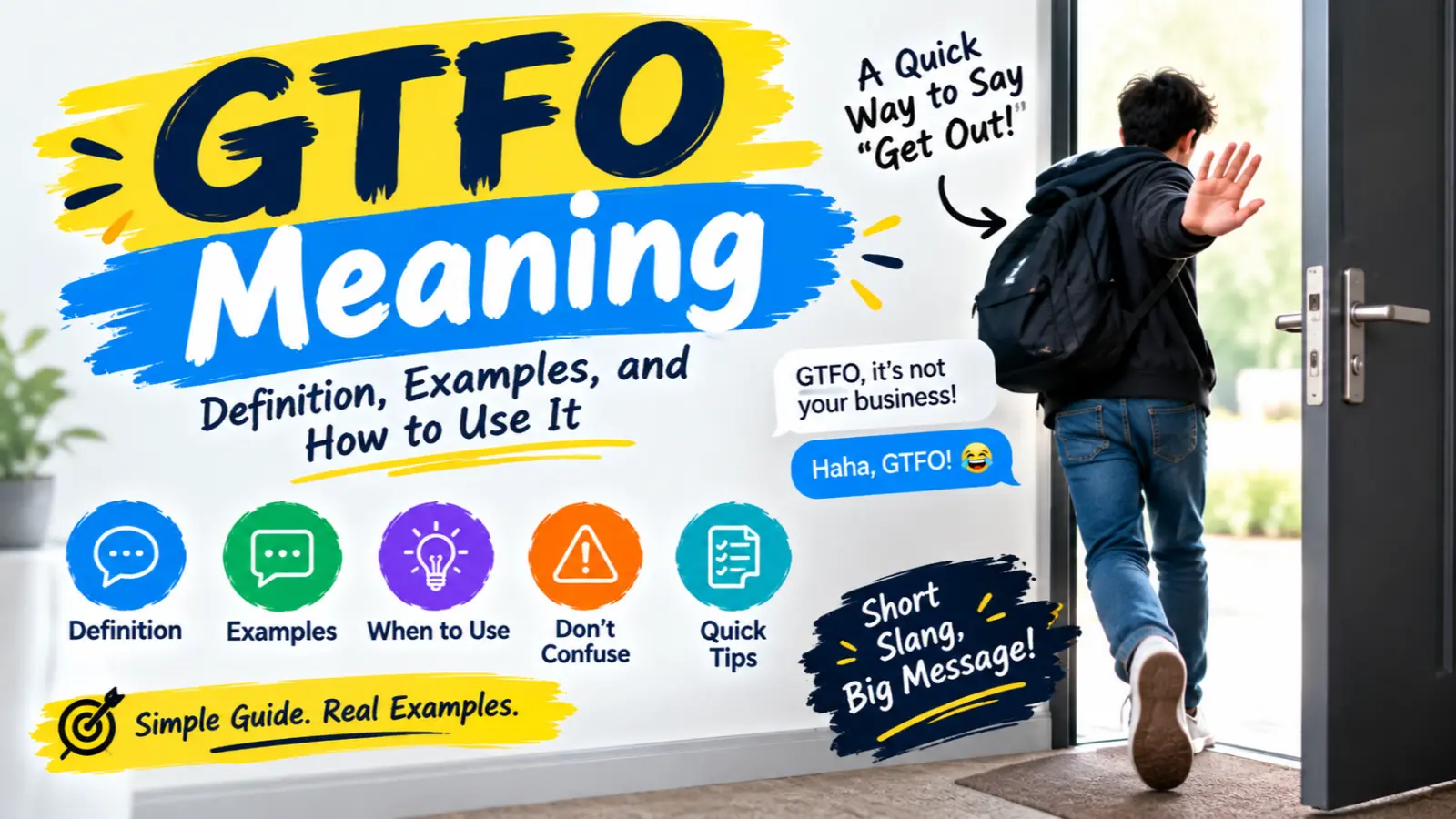
Quick answer: GTFO stands for “get the f*** out” — vulgar slang for telling someone to leave. But online it is just as often a playful shout of disbelief, like “No way!” or “You’re kidding!” Tone, emojis, and your relationship decide which one it is. Keep it far away from work, school, and strangers. GTFO is the nuclear option; HN (“hell no”) handles everyday refusal.
| Term | Full form | Tone | Used on |
|---|---|---|---|
| GTFO | “Get the f*** out” | Vulgar; angry to playful | Texting, gaming, memes, social media |
| GTFOH | “Get the f*** outta here” | Vulgar; usually playful disbelief | Reactions, comments |
| GTF | Shorter variant | Vulgar; dismissive | Quick chats |
What Does GTFO Mean?
GTFO = “get the f*** out.” At face value it is a blunt, profane order to leave — the texting-age descendant of slamming a door in someone’s face. The abbreviation exists because typing the whole phrase is slower and, frankly, because the letters soften the blow just enough for casual use. (Wiktionary’s GTFO entry documents both the literal and interjection senses.)
But GTFO grew a second life online. Somewhere along the way, gamers and group chats started using it as an exclamation of shock: “GTFO, you actually met him?!” Here it means something like “No way!”, “Shut up!” (the friendly kind), or “I don’t believe it!” — the profanity converted into emphasis rather than insult.
So the word has two gears: literal (leave!) and expressive (no way!). Everything about using it correctly comes down to knowing which gear you are in.
Is GTFO Rude?
Tone check: yes, by default — with a big playful exception.
- Rude: Directed at someone seriously — “GTFO of my room” — it is aggressive, disrespectful, and escalatory. Said to a stranger, a coworker, or anyone upset, it will land as hostility.
- Playful: Between close friends reacting to wild news — “GTFO 😂 you did NOT” — it reads as affectionate disbelief. The laughing emoji does heavy lifting here.
The rule of thumb: if you have to ask whether it is okay here, it is not. GTFO is never appropriate in formal emails, schoolwork, job interviews, customer service, or first impressions. Unlike milder slang such as chisme, there is no professional-safe version of this one.
How Is GTFO Used in Texting and Memes?
GTFO thrives where typing is fast and tone is loose:
- Texting: “GTFO, that actually happened?” — disbelief between friends.
- Gaming: Typed after an unbelievable play — or shouted at a griefer to leave the lobby (the literal gear).
- Memes: Captioned on reaction images expressing shock — the “GTFO” is the whole joke.
- Comments: “GTFOH with this take” — dismissing an opinion aggressively.
- Group chats: “Bro GTFO 😭” — playful, usually with crying-laughing emojis softening it.
Notice how punctuation and emoji flip the meaning: “GTFO.” (period, no emoji) reads cold and serious; “GTFO!! 😂” reads like a friend losing it laughing. In text, you do not get vocal tone — so these tiny signals carry the entire message.
What Are Some Real Examples of GTFO?
Side-by-side, so you can feel the difference:
- Playful: “I just got the job!” → “GTFO!! Congrats!! 🎉” (joyful disbelief)
- Playful: “He texted me back after 3 years” → “GTFO 😂 what did he even say” (gossipy shock)
- Serious: “GTFO of my DMs.” (genuine boundary — blunt by design)
- Serious: “I said GTFO.” (argument — this is a fight now)
- Dismissive: “GTFOH with that opinion.” (contempt for the take, not always the person)
- Self-directed joke: “I just failed the test I studied for. GTFO.” (venting at the universe)
When Is GTFO Playful vs. Serious?
Read these signals before you react to one — or send one:
- Playful signs: laughing/crying emojis, exclamation marks, close-friend context, reacting to news rather than to you.
- Serious signs: no emoji, periods, all-caps rage, directed at a person (“GTFO of my…”), mid-argument timing.
- The relationship test: close friends get the benefit of the doubt; acquaintances do not. If a stranger sends you GTFO, assume hostility.
Misreading this is the classic GTFO mistake: laughing off a serious one escalates a fight, while taking offense at a playful one kills the joke. When in doubt, ask — “haha wait, are you mad?” costs nothing.
Where Did GTFO Come From?
GTFO is early-internet vintage — it was circulating in chatrooms, forums, and gaming lobbies by the late 1990s and early 2000s, part of the first great wave of acronym slang (LOL, BRB, WTF). “Get the f*** out” itself is much older as spoken profanity; the internet just compressed it.
Gaming culture spread it widest: telling opponents to GTFO of a server was standard trash talk. Memes and reaction images then carried the playful disbelief sense into mainstream group chats, where most young people meet it today. Variants like GTFOH (“get the f*** outta here”) lean even harder into the “no way!” meaning.
What Can You Say Instead of GTFO?
For each gear, a cleaner option:
- Instead of “leave!”: “Please leave,” “I need some space,” “Go away” (still blunt, but not profane).
- Instead of “no way!”: “No way!”, “You’re kidding!”, “Shut up!” (playful), “Are you serious?!”, “I can’t believe it!”
- Instead of dismissive GTFOH: “I disagree,” “That’s a terrible take,” “Hard pass.”
The “no way!” replacements keep 100% of the energy with 0% of the HR risk. In any mixed or professional company, they are strictly better choices.
When Should You Never Use GTFO?
A hard no-fly list:
- Work: emails, Slack, meetings, interviews — instant professionalism damage.
- School: assignments, teachers, class chats.
- Customer service: in either direction.
- Strangers and acquaintances: you have not earned the playful reading.
- Anyone upset: it will be heard at maximum hostility.
- Public posts tied to your real name: the internet remembers.
If the setting needs politeness, even the playful sense is off-limits — profanity does not become professional just because you meant it fondly. Tone misfires happen with milder words too: even calling something a pet peeve can sting if the moment is wrong.
FAQ About GTFO
What does GTFO mean in text?
GTFO stands for “get the f*** out.” In texts it either orders someone to leave or — more commonly among friends — expresses shocked disbelief like “No way!”
Is GTFO a bad word?
Yes, it is vulgar slang because of the profanity in the full phrase. It can be used playfully between close friends, but it is never appropriate in formal or professional settings.
What does GTFOH mean?
“Get the f*** outta here” — a variant that leans even more toward the playful “I don’t believe it!” meaning.
How do you reply to GTFO?
If it is playful, laugh along or double down (“I KNOW right?!”). If it is serious, take the boundary seriously — apologize or disengage rather than escalating.
Is GTFO still used in 2026?
Yes — it remains common in gaming, group chats, and meme culture, especially in the playful-disbelief sense.
What is a polite alternative to GTFO?
For “leave”: “Please give me some space.” For “no way!”: “You’re kidding!” or “No way!” Both keep the meaning without the profanity.
Key Takeaways
- GTFO = “get the f*** out” — vulgar slang with two gears: literal (“leave!”) and playful (“no way!”).
- Context is everything: emojis, punctuation, and your relationship decide which gear you are hearing.
- It is never appropriate at work, school, with strangers, or around anyone upset.
- Clean alternatives exist for both meanings — “no way!” keeps the energy without the risk.
- If you receive a serious GTFO, treat it as a real boundary, not banter.
Read More Articles
🔮Tempo vs Fever: 2026 Series Recap, Scores & Head-to-Head Stats
🔮Elite Meaning: Definition, Examples, Synonyms & How to Use It

Hi, I’m Mia Walker, a Content Research Writer at Hublioo.com with 3+ years of experience in creating educational language content.
I enjoy breaking down complex words, internet slang, abbreviations, and everyday expressions into clear, practical explanations that anyone can understand.
My focus is on delivering original, easy-to-read, and well-organized content that helps readers expand their vocabulary and use English with greater confidence.