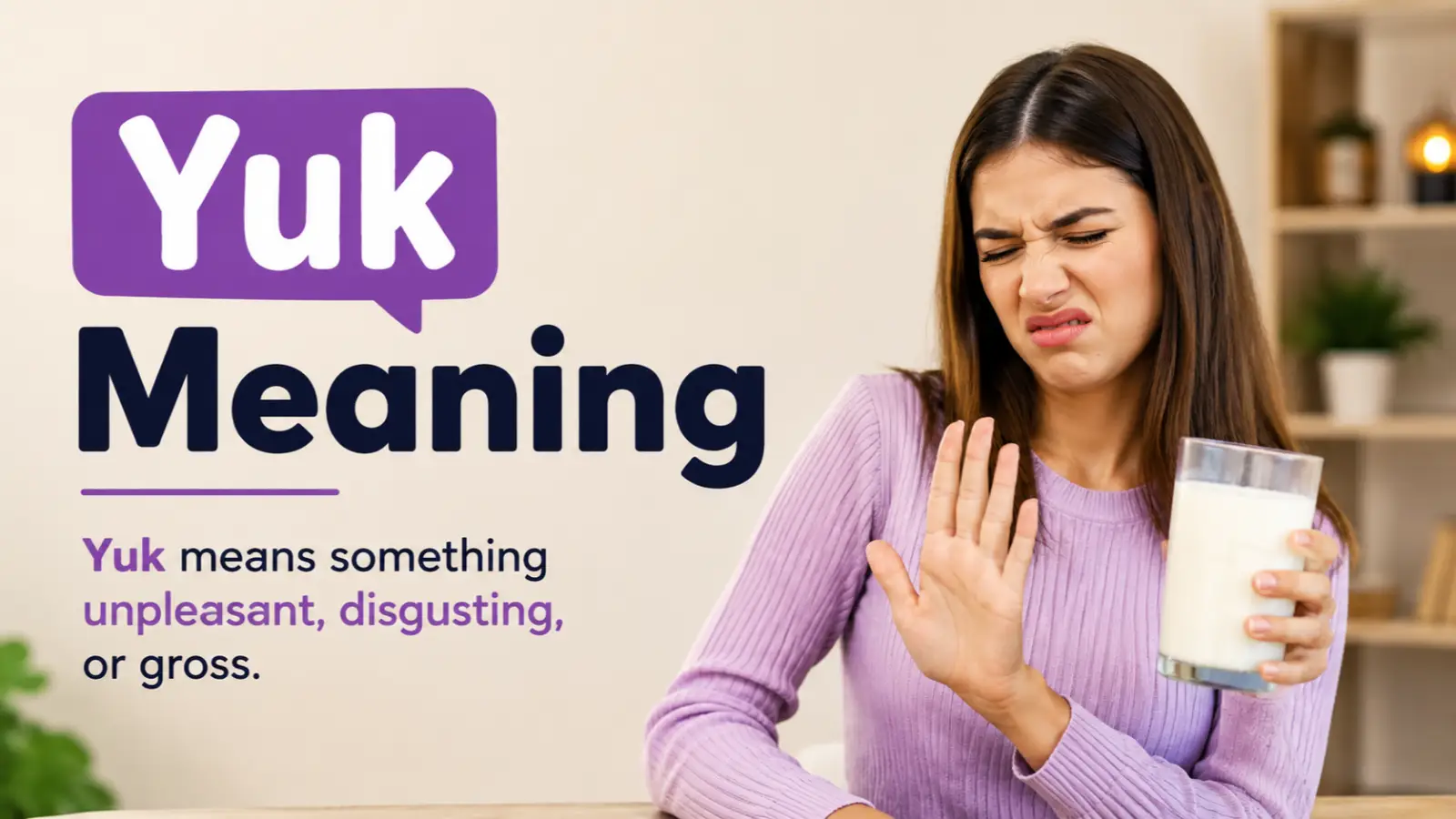
Quick answer: Yuk is an expression of disgust — a respelled “yuck,” like “ew” or “gross.” “Yuk, there’s a hair in my soup 🤢.” But it’s also slang for a big laugh (from comedy clubs like Yuk Yuk’s) and occasional textspeak. Same three letters, totally different vibes — context tells you which.
| Term | Full Form / Meaning | Tone | Used On |
|---|---|---|---|
| Yuk | Disgust (‘yuck’) / a hearty laugh | Negative (disgust) or joyful (laugh) | Texting, comedy, casual speech |
What Does Yuk Mean?
Yuk has two distinct lives:
- 1. Disgust (most common). “Yuk” is an informal variant of “yuck” — the sound of revulsion in word form. “Yuk, that smells awful.” It works exactly like “ew,” “gross,” or “ick”: a gut-level “get that away from me.”
- 2. A hearty laugh. In comedy slang, a “yuk” is a big laugh — “the comedian got huge yuks.” Dictionaries list this sense too: Merriam-Webster defines yuk as a loud laugh, and “to yuk it up” means to laugh hard or ham it up.
Which one you’re reading is obvious from context: disgust-yuk reacts to something gross (“yuk, a spider!”), while laugh-yuk describes comedy (“that set got yuks all night”). They almost never appear in the same sentence — the universe is kind that way.
Is Yuk Negative?
Depends which yuk showed up. Disgust-yuk: yes, negative — it’s a rejection noise, roughly as negative as “ew.” It’s not profane or aggressive, though; it’s the polite end of disgust. Toddlers say yuk. Grandmas say yuk. It’s a family-friendly “nope.”
Laugh-yuk: gloriously positive — a yuk in comedy is what every performer wants: audible, involuntary joy. Getting yuks is the job. So the word contains multitudes: revulsion and delight, three letters apart. English is wonderful.
For stronger reactions, see ISTG meaning — Merriam-Webster’s yuk entry covers the laugh sense officially.
How Is Yuk Used in Real Chats?
Both yuks, in the wild:
- Disgust: “Yuk, there’s a hair in my soup 🤢”
- Smell: “Yuk, what IS that smell?? 🤢”
- Food: “You put ketchup on STEAK? Yuk. 😂”
- Comedy review: “The opener got some yuks, but the headliner killed 🎤”
- Playful: “Yuk it up, guys, show’s starting 😂” — “laugh it up” energy
- Kid-speak: “Yukky! I don’t like broccoli!” — where “yucky” lives
Where Did Yuk Come From?
The disgust sense is onomatopoeia all the way down: “yuk”/“yuck” imitates the sound of revulsion, the noise your face makes before your brain catches up. Variant spellings (yuk, yuck, yecch) have floated around English for generations — disgust is universal, spelling is negotiable.
The laugh sense has a showbiz pedigree. Toronto’s famous Yuk Yuk’s comedy clubs (founded 1976) baked the word into comedy culture, and “yuk it up” — to laugh heartily, to ham it up for laughs — has been in the performer’s vocabulary for decades. Merriam-Webster’s entry for “yuk” covers the laugh sense officially. Same letters, two etymologies, zero confusion in practice.
How Do You Reply to Yuk?
Match the yuk:
- Disgust-yuk: agree (“Ikr 🤢”), escalate (“RIGHT?? Get it away”), or laugh (“😂 dramatic but fair”).
- Laugh-yuk: “haha” suffices — or better, join in: “😂😂 okay that got me.”
- Kid saying “yucky”: the only correct reply is taking the broccoli away. Negotiations have concluded.
Disgusted? You’re allowed to be cooked about it 😂.
Synonyms and Antonyms for Yuk
Synonyms (disgust sense):
- Yuck — the standard spelling
- Ew / eww — the Gen Z default
- Gross — the adjective version
- Ick — disgust’s trendy cousin
Antonyms:
- Yum — disgust’s delicious opposite
- Lovely / nice — approval instead of revulsion
- LOL — for the laugh sense, its natural habitat
Yuk vs Yuck: What’s the Difference?
Almost nothing — and that’s the answer. “Yuck” is the standard, dictionary-blessed spelling of the disgust sound; “yuk” is the casual variant, three letters, faster to type, slightly more playful. Meaning: identical.
The one real distinction: “yuk” also carries the comedy “laugh” sense (“get yuks,” “yuk it up,” Yuk Yuk’s) — a meaning “yuck” doesn’t share. So if someone writes “yuk” about a comedy show, they’re not disgusted; they’re delighted. Spelling is negotiable; context is king.
Yuk FAQs
What does ‘yuk’ mean?
Usually disgust — a variant of “yuck,” like “ew.” In comedy contexts, it means a big laugh.
What’s the difference between yuk and yuck?
Same disgust meaning; “yuck” is the standard spelling, “yuk” the casual variant. Only “yuk” also means a laugh.
Is yuk a bad word?
No — it’s family-friendly. Toddlers and grandmas both say yuk.
What does ‘yuk it up’ mean?
“To laugh heartily” or “to ham it up for laughs” — classic comedy slang.
What is Yuk Yuk’s?
A famous chain of Canadian comedy clubs founded in Toronto in 1976 — named for the laugh sense of “yuk.”
How do you reply to ‘yuk’?
Agree with the disgust (“ikr 🤢”) or join the laugh (“😂😂”) — match the context.
What does ‘yukky’ mean?
“Yukky” (or “yucky”) is the adjective form — something disgusting, mostly in kid-speak: “Yukky! I don’t like broccoli!”
Is yuk British or American?
Both use it, spelled both ways. The laugh sense (“yuk it up”) is strongly American showbiz slang; the disgust sense is universal.
Bottom Line
- Yuk = disgust (“yuck” variant) or a big laugh — context decides.
- Yuck is the standard spelling; yuk is the casual, faster variant.
- Only “yuk” carries the comedy laugh sense (“yuk it up,” Yuk Yuk’s).
- Family-friendly either way — safe for all audiences.
- Reply by matching the yuk: disgust or delight.
How do you spell the sound of disgust — yuk or yuck?
Both are accepted, but “yuck” is more common in modern dictionaries for the disgust sound. “Yuk” survives mainly through the comedy phrase “yuk it up” and the Yuk Yuk’s club name.
What does “yuk” mean in texting?
In texts, “yuk” almost always means disgust — “Yuk, that looks gross 🤢.” The comedy meaning rarely appears in casual texting.
Is “yuk” in the dictionary?
Yes — major dictionaries list yuk/yuck as an interjection expressing disgust, and separately as a noun meaning a laugh (“the joke got a big yuk”).
What are synonyms for yuk (disgust)?
Try ew, ugh, gross, nasty, yuck, blech, or eww. For the laughter sense: laugh, giggle, chuckle, or “a big laugh.”
Read More Articles
🔮TTYL Meaning: What Does TTYL Mean in Texting, Chat & Snapchat?
🔮Pookie Meaning: What Does ‘Pookie’ Mean in Love, Chat & Slang?
🔮HN Meaning: What Does HN Mean in Texting, Chat & Social Media?

Hi, I’m Mia Walker, a Content Research Writer at Hublioo.com with 3+ years of experience in creating educational language content.
I enjoy breaking down complex words, internet slang, abbreviations, and everyday expressions into clear, practical explanations that anyone can understand.
My focus is on delivering original, easy-to-read, and well-organized content that helps readers expand their vocabulary and use English with greater confidence.