
Home / Word Meanings / Draconian Meaning: What It Means, Examples, Synonyms & Origin

Draconian Meaning: What It Means, Examples, Synonyms & Origin

Draconian Meaning

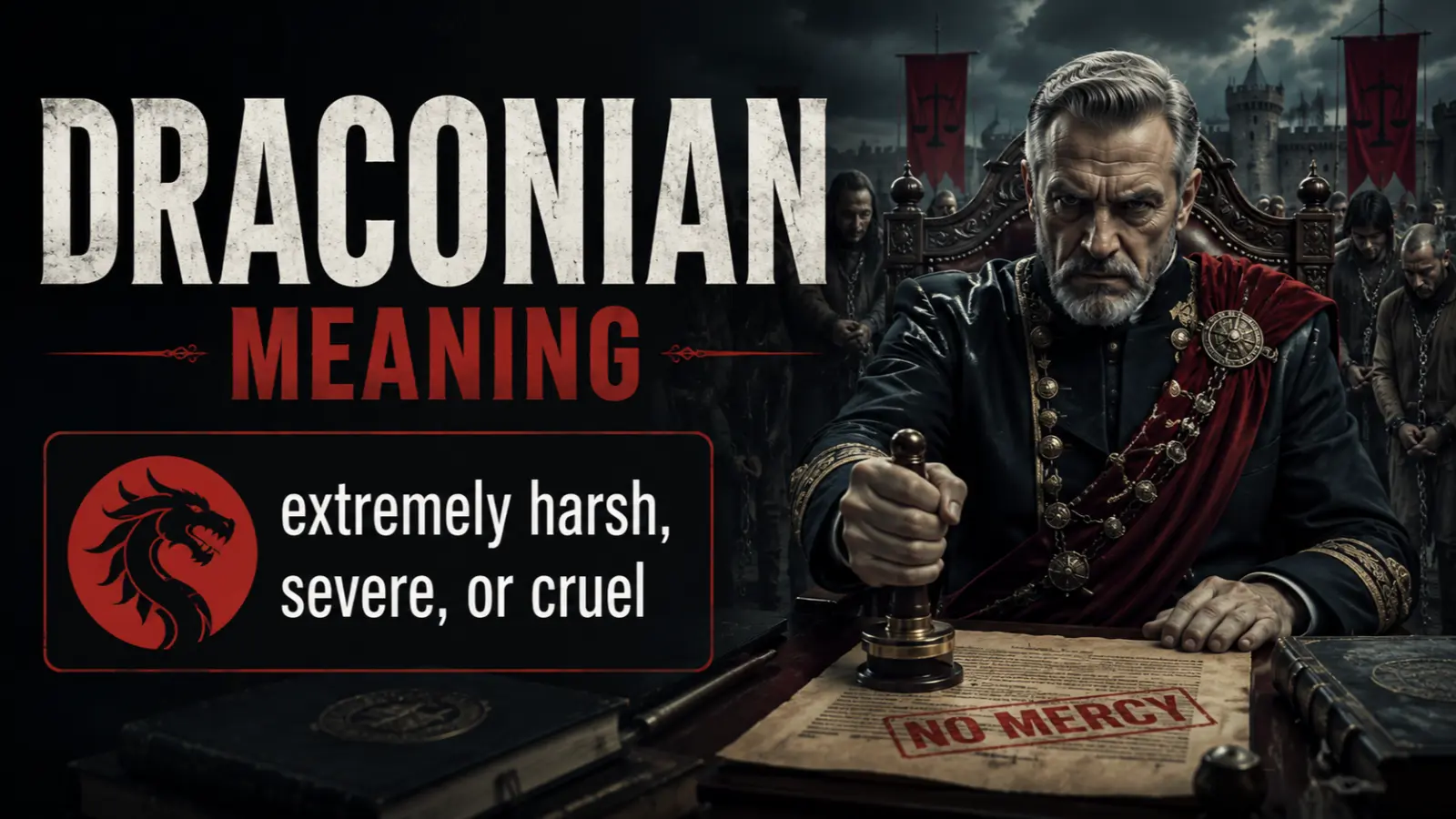
Draconian means extremely harsh, severe, or cruel, especially when describing a law, rule, punishment, restriction, or official action.

It usually suggests that something is much stricter or more severe than seems reasonable or necessary.

In simple English, draconian means extremely harsh or severe.

For example, if a school suspends a student for an entire year because they were one minute late, someone might call that a draconian punishment.

Quick Meaning of Draconian

Draconian means extremely severe, harsh, or excessive, especially when referring to laws, rules, punishments, restrictions, or official measures.

In simple terms:

Draconian = extremely harsh or severe.

For example:

“The company introduced draconian penalties for minor mistakes.”

This means the penalties are unusually severe and may be considered excessive.

The word is stronger than strict. A strict rule may be reasonable, while a draconian rule often suggests that the severity has gone too far.

What Does Draconian Mean in English?

In English, draconian is an adjective used for something that is extremely strict, severe, or harsh.

It is especially common when talking about:

  • Laws
  • Rules
  • Punishments
  • Restrictions
  • Regulations
  • Government policies
  • Official measures
  • Penalties

For example:

“The government introduced draconian measures to control the situation.”

This suggests that the measures are exceptionally strict and possibly excessive.

The word usually has a negative or critical tone. If someone describes a policy as draconian, they normally believe it places unusually heavy restrictions or imposes an unnecessarily severe response.

Draconian Meaning in Simple English

Think of a situation where a small mistake receives a huge punishment.

Imagine a school rule that says a student who arrives two minutes late will be suspended for an entire month. That could reasonably be described as a draconian rule.

Why? The rule is not simply strict. Its punishment is far more severe than the mistake seems to justify.

A simple way to remember the word is:

Draconian = extremely strict, harsh, and possibly excessive.

This idea of excessive severity is what makes draconian different from ordinary words such as strict or firm.

Draconian Law Meaning

The draconian law meaning is a law that is considered extremely harsh, severe, or excessive, especially because of its restrictions or punishments.

For example:

“Critics described the new law as draconian.”

This means the critics believe the law goes too far.

A law does not have to be literally cruel to be called draconian. The word can simply express the opinion that its penalties, restrictions, or requirements are far too severe.

For example, a law that gives an extremely heavy punishment for a minor offense might be criticized as a draconian law.

The expression is common in news reporting, political discussions, legal commentary, and public debates.

Examples of Draconian

Here are some natural examples of how draconian is used:

“The company introduced draconian penalties for minor mistakes.”

The penalties are considered extremely harsh.

“Critics called the new law draconian.”

The critics believe the law is excessively severe.

“The airline’s baggage rules seemed draconian to many passengers.”

The rules were unusually strict or difficult.

“The judge was criticized for imposing a draconian punishment.”

The punishment was considered far too severe.

“The school adopted draconian measures to stop cheating.”

The measures were extremely strict.

What Is a Good Example of Draconian?

A good example of something draconian is a rule that imposes an extremely severe punishment for a very small mistake.

For instance, imagine a workplace that automatically fires an employee for arriving two minutes late once. Someone might describe that policy as draconian because the consequence seems excessive compared with the offense.

This example shows why the word often carries the idea of unreasonable or excessive severity, not just strictness.

Draconian in a Sentence

The most common structure is:

draconian + noun

Common combinations include:

  • draconian laws
  • draconian rules
  • draconian punishment
  • draconian restrictions
  • draconian measures
  • draconian policies
  • draconian penalties
  • draconian regulations

For example:

“The government imposed draconian restrictions on travel.”

You can also use the word after a linking verb:

“The new policy is draconian.”

Or:

“Critics described the policy as draconian.”

In both cases, the speaker is saying that the policy is extremely harsh.

Draconian vs. Strict

Strict and draconian are related, but they are not exact synonyms.

Strict means that rules are firmly enforced and allow little freedom. Draconian suggests a much more extreme level of severity and often implies that the response is excessive.

WordMeaningExample
StrictFirm and closely controlled“The teacher has strict classroom rules.”
SevereVery serious or harsh“The punishment was severe.”
DraconianExtremely harsh or excessive“The law imposed draconian penalties.”

A strict rule is not automatically draconian.

For example, a company may have a strict rule against sharing confidential information. If the rule is reasonable and necessary, calling it draconian would not make sense.

If the company fires someone for accidentally making a tiny, harmless mistake, however, the punishment might be described as draconian.

Draconian vs. Harsh

Harsh means unpleasantly severe, cruel, or difficult to tolerate.

Draconian is more specific and is particularly useful for laws, rules, punishments, restrictions, policies, and official actions.

Compare these examples:

“The coach gave him a harsh punishment.”

This simply means the punishment was severe.

“The coach introduced draconian punishments for minor mistakes.”

This suggests the punishments are unusually extreme and possibly unreasonable.

So, harsh is broader, while draconian often emphasizes extreme severity in rules or official measures.

Draconian vs. Severe

The words draconian and severe can overlap, but they are not interchangeable in every situation.

Severe can describe many things, including:

  • Severe weather
  • Severe pain
  • Severe damage
  • Severe injuries
  • Severe criticism
  • Severe punishment

Draconian is usually connected to rules, laws, punishments, restrictions, policies, or official measures.

For example:

“The region experienced severe flooding.”

You would not normally replace severe with draconian here.

But:

“The government introduced severe restrictions.”

could become:

“The government introduced draconian restrictions.”

The second sentence adds the idea that the restrictions are extremely harsh and potentially excessive.

Draconian Synonyms

If you are looking for a draconian synonym, several words may work depending on the context.

Common alternatives include:

  • Harsh
  • Severe
  • Strict
  • Cruel
  • Excessive
  • Punitive
  • Uncompromising
  • Overly restrictive

However, these words are not always identical.

Strict can describe a reasonable rule that is firmly enforced. Cruel focuses more on suffering or lack of compassion. Excessive emphasizes that something goes beyond what is reasonable.

A useful way to remember the difference is:

Draconian combines extreme severity with the suggestion that the severity may be excessive.

Antonyms of Draconian

There is no single perfect opposite in every situation, but these words can work depending on the context:

  • Lenient
  • Mild
  • Flexible
  • Merciful
  • Reasonable
  • Moderate
  • Forgiving

For example:

“The old policy was draconian, but the new policy is much more lenient.”

Here, lenient means the new rules are less strict and allow more freedom.

Draconian Origin

The draconian origin can be traced to Draco, an ancient Athenian lawgiver whose name became associated with a famously severe code of laws.

Draco’s laws were introduced in Athens in the 7th century B.C. Later tradition emphasized their harsh punishments, helping make his name a symbol of extreme legal severity.

This association eventually gave English the adjective draconian, meaning exceptionally harsh or severe.

Where Did Draconian Come From?

If you ask where draconian came from, the short answer is that it comes from the name Draco.

His name became associated with severe laws and punishments, and over time draconian developed into a general English word for something extremely harsh, especially a law, rule, or official measure.

The word has been used in English for centuries and remains common in formal writing, news reports, political discussions, and everyday criticism.

Does Draconian Mean Dragon?

Not exactly.

The similarity between draconian and dragon has a real historical connection. The name Draco is related to the ancient Greek word drakōn, which was associated with a dragon or serpent.

However, draconian does not mean “dragon” in modern English.

Today, the word means:

Extremely harsh, severe, or excessive.

So:

Draconian ≠ dragon

The two words are historically connected, but their modern meanings are different.

What Does It Mean When Someone Says Draco?

The meaning of Draco depends on the context.

Historically, Draco refers to the ancient Athenian lawgiver whose name gave us draconian. In modern contexts, Draco can also be a personal name, fictional character name, or other proper noun.

When discussing the origin of draconian, however, Draco specifically refers to the ancient Athenian lawgiver.

Draconian Meaning in Fantasy

The draconian meaning in fantasy usually depends on the context.

In most fantasy writing, draconian keeps its standard English meaning: extremely harsh or severe.

For example:

“The kingdom lived under draconian laws imposed by the emperor.”

Here, draconian describes the laws as extremely harsh.

Fantasy writers may also use the word around dragon-related themes because of its historical connection to drakōn. Still, the normal dictionary meaning remains severe or harsh, not simply “dragon.”

So, if you see draconian in a fantasy story, check the surrounding sentence before assuming it refers to a dragon.

Draconian Meaning in Farsi

The meaning of draconian in Farsi depends slightly on the context.

Possible translations include:

بسیار سخت‌گیرانه، شدید، یا ظالمانه

When describing a law, rule, punishment, or government measure, the word generally refers to something extremely harsh or severe.

For example, a draconian law could be understood as a law with unusually strict restrictions or severe punishments.

The exact Farsi translation may change depending on whether the original sentence focuses on strictness, severity, cruelty, or excessive punishment.

Is Draconian Formal or Informal?

Draconian is mainly a formal English word, although it can also appear in everyday conversation.

You are most likely to see it in:

  • News articles
  • Legal writing
  • Political discussions
  • Academic writing
  • Professional commentary
  • Opinion pieces

It can also sound natural in casual conversation:

“That’s a pretty draconian rule.”

However, people often use simpler words such as strict, harsh, or severe in everyday speech.

The word is not slang. It is a standard English adjective with a strong critical meaning.

Pronunciation of Draconian

In American English, draconian is approximately pronounced:

drə-KOH-nee-un

The main stress is on the middle syllable:

dra-CO-ni-an

Pronunciation may vary slightly between speakers, but the stressed middle sound is the key part to remember.

Does Draconian Mean Cruel?

Draconian can suggest cruelty, but its main meaning is extreme severity.

For example:

“The government introduced draconian restrictions.”

This mainly means the restrictions are extremely harsh.

But:

“The prison imposed draconian punishments.”

Here, the word can suggest both extreme severity and cruel treatment.

So, draconian does not always mean deliberately cruel. Its central idea is that something is unusually severe, often to an excessive degree.

Common Mistakes With Draconian

One common mistake is using draconian as if it simply means strict.

For example:

“My teacher is draconian because she expects us to finish our homework on time.”

This is not necessarily a good use. Expecting students to complete homework on time may simply be a strict but reasonable rule.

A stronger example would be:

“The school introduced a draconian punishment for students who submitted homework one minute late.”

Here, the punishment is clearly much more severe than the mistake.

Another mistake is using draconian for anything difficult or unpleasant.

You would not normally say:

“We had a draconian thunderstorm.”

Instead, say:

“We had a severe thunderstorm.”

Use draconian mainly for extremely harsh laws, rules, punishments, restrictions, policies, or official measures.

Frequently Asked Questions About Draconian

What is the simple meaning of draconian?

Draconian means extremely severe, harsh, or excessive, especially when describing laws, rules, punishments, restrictions, or official actions.

Is draconian a negative word?

Usually, yes. It normally expresses criticism because it suggests that something is excessively harsh or severe.

What is a good example of draconian?

A rule that gives an extremely severe punishment for a minor mistake is a good example. For instance, suspending a student for a year because they were late once could be considered draconian.

What is a synonym for draconian?

Common synonyms include harsh, severe, strict, cruel, excessive, punitive, and uncompromising. The best alternative depends on the context.

Is draconian the same as strict?

No. Strict means firmly controlled or enforced, while draconian suggests an extreme level of harshness that may go beyond what is reasonable.

What does draconian law mean?

A draconian law is a law considered extremely harsh or severe, especially because its restrictions or punishments are excessive.

Where did draconian come from?

The word comes from Draco, an ancient Athenian lawgiver whose laws became associated with unusually severe punishments.

What does it mean when someone says Draco?

Draco can refer to the ancient Athenian lawgiver associated with the origin of draconian. Depending on the context, it can also be a person’s name or a fictional character.

Why is draconian connected to dragons?

The name Draco is historically related to the ancient Greek word drakōn, which was associated with a dragon or serpent. However, modern draconian means extremely harsh, not “dragon.”

What is draconian in fantasy?

In fantasy, draconian usually means extremely harsh or severe. Its surrounding context may involve dragons because of the word’s historical connection to drakōn, but the standard meaning remains “very harsh.”

Is draconian formal English?

Yes. Draconian is mainly a formal English adjective, although it can also be used in everyday conversation when criticizing an unusually harsh rule or policy.

Conclusion

Draconian means extremely harsh, severe, or excessive, especially when describing a law, rule, punishment, or restriction.

It is stronger than strict because it often suggests that something has gone too far.

The word comes from Draco, an ancient Athenian lawgiver, and its history also explains its connection to the word dragon.

Just remember: draconian means extremely harsh not “dragon.”

Leave a Reply

Your email address will not be published. Required fields are marked *