Home / Word Meanings / Fiancé Meaning: Definition, Fiancé vs Fiancée, Examples, Pronunciation & Usage

Fiancé Meaning: Definition, Fiancé vs Fiancée, Examples, Pronunciation & Usage

fiance meaning

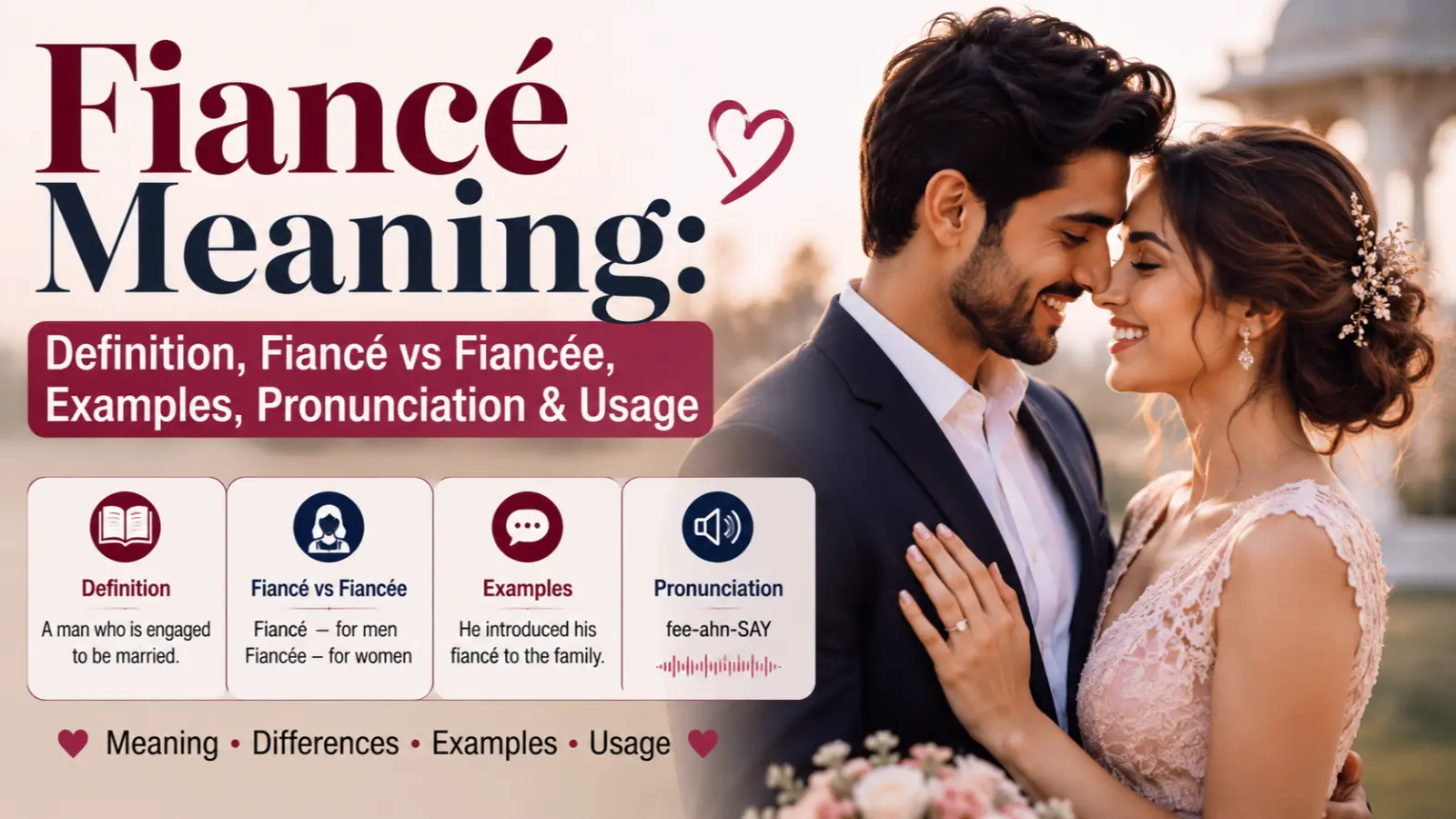
The fiancé meaning is simple: a fiancé is someone who is engaged to be married.

In traditional English usage, fiancé refers to a man who is engaged, while fiancée refers to a woman who is engaged.

However, modern American English also uses fiancé as a gender-neutral term in some contexts.

If you are wondering, “Do I call my girlfriend fiancé or fiancée?”, the traditional answer is fiancée. A woman who is engaged to be married is traditionally called a fiancée, while an engaged man is called a fiancé.

Both words describe the stage between dating and marriage.

Quick Meaning

Fiancé meaning: a person who is engaged to be married.

Traditionally:

  • Fiancé = an engaged man
  • Fiancée = an engaged woman

For example:

“My fiancé and I are getting married next June.”

This traditionally means that the speaker is engaged to a man.

In simple terms, the relationship usually progresses like this:

Dating → Engaged → Married

Before the engagement, you may call your partner your boyfriend or girlfriend. After becoming engaged, the traditional terms are fiancé or fiancée. After marriage, the terms usually become husband, wife, or spouse.

What Does Fiancé Mean in a Relationship?

In a relationship, a fiancé is the person you are formally engaged to marry. The word indicates more than simply being in a serious romantic relationship because an engagement has taken place.

For example:

“She introduced me to her fiancé.”

This means she introduced someone she is engaged to marry.

Another example is:

“My fiancé and I are choosing our wedding venue.”

The sentence tells us that the couple has already made a formal commitment to marry.

So, the fiancé meaning in relationship is essentially an engaged romantic partner who is expected to become your husband or wife.

A boyfriend or girlfriend may be in a serious relationship without being engaged. A fiancé or fiancée, however, has traditionally agreed or promised to marry their partner.

Fiancé vs Fiancée

The difference between fiancé and fiancée comes from French and has traditionally been maintained in English.

WordTraditional meaningExample
FiancéA man engaged to be married“Her fiancé is a teacher.”
FiancéeA woman engaged to be married“His fiancée is a lawyer.”

The easiest way to remember the traditional spelling is that fiancée has an extra “e”.

Fiancé → traditionally male

Fiancée → traditionally female

Modern American English can be broader, though. Some American dictionary definitions recognize fiancé as a gender-neutral word for a person who has formally promised to marry another person. If you want to make the traditional gender distinction clear, fiancé for a man and fiancée for a woman remains the safest choice.

Do I Call My Girlfriend Fiancé or Fiancée?

If your girlfriend is now formally engaged to you, the traditional term is fiancée.

For example:

“My girlfriend is now my fiancée.”

Before the engagement, she is your girlfriend. After the engagement, she can traditionally be called your fiancée. After you get married, she becomes your wife.

The traditional progression is:

Girlfriend → Fiancée → Wife

For a male partner:

Boyfriend → Fiancé → Husband

That said, modern American English sometimes uses fiancé as a gender-neutral term. Still, fiancée remains a standard and widely recognized spelling for an engaged woman.

Is Fiancé a Female Term?

Traditionally, fiancé is not the female form.

The traditional distinction is:

  • Fiancé = engaged man
  • Fiancée = engaged woman

Therefore, if someone searches for “fiancé female,” the traditional answer is fiancée.

For example:

“Her fiancé proposed last year.”

Here, fiancé refers to a man.

“His fiancée is planning the wedding.”

Here, fiancée refers to a woman.

In modern American English, however, some dictionaries also recognize fiancé as gender-neutral. This means you may encounter the word used for an engaged person regardless of gender.

Can Fiancée Be Used for a Man?

Traditionally, fiancée is not used for a man.

If a man is engaged to be married, the traditional spelling is fiancé.

For example:

“Her fiancé works in New York.”

If a woman is engaged to be married:

“His fiancée works in New York.”

So, if you are searching for “fiancée for man,” the traditional answer is fiancé.

The distinction comes from the French forms that English borrowed. The extra e in fiancée traditionally marks the feminine form.

Is a Fiancé Still a Boyfriend or Girlfriend?

A fiancé or fiancée can still be your romantic partner, but the word gives more specific information about the relationship.

Compare these examples:

“He is my boyfriend.”

This tells us that the speaker is romantically involved with him.

“He is my fiancé.”

This tells us that the speaker is romantically involved with him and they are engaged to be married.

So, a fiancé can still be thought of as a romantic partner, but fiancé describes a different relationship stage.

The same applies to a woman:

“She is my girlfriend.”

means they are dating.

“She is my fiancée.”

means they are engaged.

Therefore, if someone asks “Is a fiancé still a girlfriend?”, the answer depends on the traditional gender terms, but the key difference is that an engagement has been added to the relationship.

Fiancé vs Boyfriend or Girlfriend

The main difference between these terms is the level of commitment they describe.

TermMeaning
BoyfriendA male romantic partner
GirlfriendA female romantic partner
FiancéTraditionally, a man engaged to marry
FiancéeTraditionally, a woman engaged to marry
HusbandA married male spouse
WifeA married female spouse
SpouseA married partner

For example:

“Sam is my boyfriend.”

Sam is the speaker’s romantic partner.

“He is my fiancé.”

Sam is traditionally the speaker’s male partner who is engaged to marry them.

“After the wedding, Sam will be my spouse.”

He is already married to the speaker.

These terms should not normally be treated as interchangeable because they describe different relationship situations.

Fiancé vs Husband

A fiancé is someone you are engaged to marry, while a husband is someone you are already married to.

For example:

“My fiancé and I are getting married next month.”

The marriage has not happened yet.

After the wedding, the relationship can be described as:

“My husband and I have been married for a year.”

The same distinction applies to fiancée and wife.

Fiancée → before marriage

Wife → after marriage

This is why calling someone your fiancé usually tells people that the wedding has not happened yet.

Fiancé in a Sentence

Fiancé is a noun. It can be used with possessive words such as my, your, his, her, our, and their.

Here are some natural examples:

“Have you met my fiancé?”

“My fiancé and I are planning our wedding.”

“Her fiancé surprised her with flowers.”

“I am meeting my fiancé after work.”

“When did you meet your fiancé?”

“My fiancé helped me choose the wedding invitations.”

You can also use the word after a person’s name:

“Daniel, her fiancé, helped organize the wedding.”

These examples show that fiancé normally refers to an existing engagement rather than simply a serious dating relationship.

Fiancé Meaning in American English

Fiancé is common in American English and can be used in both everyday conversation and formal writing.

For example:

“I’m going to dinner with my fiancé tonight.”

This sounds completely natural in casual conversation.

The word can also appear in wedding announcements:

“Emily and her fiancé, Daniel, are planning a summer wedding.”

One important point is that modern American English does not always strictly follow the traditional masculine and feminine distinction. Some American dictionaries recognize fiancé as a gender-neutral term, while fiancée remains a familiar traditional form for an engaged woman.

Therefore, both traditional and modern usage can be encountered.

How Do You Pronounce Fiancé?

In American English, fiancé is pronounced approximately:

fee-ahn-SAY

The final syllable sounds similar to “say.”

The pronunciation of fiancée is essentially the same:

fee-ahn-SAY

The difference between the two words is mainly in their traditional spelling and usage, not pronunciation.

The accent mark in fiancé and fiancée comes from their French origin.

Where Does the Word Fiancé Come From?

Fiancé is a French loanword that entered English from French.

It is related to the French verb fiancer, associated with becoming engaged or promising to marry. English adopted both fiancé and fiancée, which explains why the words retain their French-style spelling.

The traditional masculine and feminine distinction also comes from French.

Although the words have a French origin, fiancé and fiancée are now well established in everyday English.

Is Fiancé Formal or Informal?

Fiancé is a standard English word rather than slang. It can be used in casual, professional, and formal situations.

You can use it in:

  • Everyday conversations
  • Text messages
  • Emails
  • Social media posts
  • Wedding announcements
  • Articles
  • Formal writing

For example:

“I’m having dinner with my fiancé tonight.”

works in casual conversation.

A sentence such as:

“The bride and her fiancé announced their wedding date.”

also works in a more formal context.

Is Fiancé Slang?

No, fiancé is not slang.

It is a standard English noun that means someone who is engaged to be married. It is commonly used in normal conversations as well as formal writing.

You may sometimes see fiance written without the accent mark online. This is often because English keyboards make accented characters less convenient to type.

The standard spelling is fiancé, while the traditional feminine form is fiancée.

Fiancé Meaning and Wife

A fiancé is not yet a husband or wife.

If a man is engaged to be married, he can traditionally be called a fiancé. Once the marriage takes place, he becomes a husband.

Similarly:

Fiancée → Wife

For example:

“My fiancé and I are getting married in December.”

After the wedding:

“My husband and I moved into our new home.”

So, when people search for “fiancé meaning wife,” the important distinction is that a fiancé is a future husband, not a wife or husband yet.

Is Fiancé the Same as Betrothed?

Fiancé and betrothed have closely related meanings, but their style is different.

A fiancé is the person someone is engaged to marry.

Betrothed can also describe someone who is engaged to be married, but it sounds more formal, literary, or old-fashioned.

For example:

“She introduced me to her fiancé.”

sounds natural in modern conversation.

“She introduced me to her betrothed.”

is grammatically correct but sounds much more formal.

For everyday American English, fiancé or fiancée is usually the more natural choice.

Fiancé Synonyms and Related Words

There is no perfect synonym that works in every situation, but several related expressions can communicate a similar idea.

Engaged partner is a clear gender-neutral phrase.

Betrothed has a similar meaning but sounds more formal or old-fashioned.

Future husband can refer to a male fiancé when focusing on the expected marriage.

Future wife can refer to a female fiancée.

Spouse-to-be is another understandable expression, although it is less common than fiancé or fiancée.

The best choice depends on the context and the style of the sentence.

Does Fiancé Have an Opposite?

There is no exact one-word antonym for fiancé.

If you are talking about relationship status, words such as single or unattached may sometimes express an opposite situation, but they are not direct antonyms.

If an engagement ends, natural English usually says:

“They called off the engagement.”

or:

“They are no longer engaged.”

These phrases are more precise than trying to use a single opposite word.

What Does Fiancé Mean Without the Accent?

You may see fiance written without the accent mark, especially in text messages, social media posts, or online searches.

The intended word is usually fiancé.

Similarly, fiancee is commonly used online for fiancée.

For careful or standard writing, however, the accented forms are preferred:

fiancé

fiancée

The absence of an accent usually does not change the intended meaning in casual digital communication.

Does Fiancé Mean Money?

No. Fiancé has nothing to do with money.

If you see searches such as “fiancé meaning money,” they may be caused by confusion between fiancé and words such as finance or financial.

Compare:

  • Fiancé = a person engaged to be married
  • Finance = money management or financial matters
  • Financial = related to money or finances

For example:

“My fiancé manages the company’s finances.”

Here, fiancé refers to the person’s engaged partner, while finances refers to money.

These words sound somewhat similar but have completely different meanings.

Common Mistakes With Fiancé

One common mistake is using fiancé for someone who is simply a boyfriend or girlfriend.

If two people are dating but have not become engaged, calling one person a fiancé can give the wrong impression.

Another mistake is confusing fiancé and fiancée when following traditional English usage.

Remember:

Fiancé → traditionally an engaged man

Fiancée → traditionally an engaged woman

A third common issue is leaving out the accent marks. While fiance and fiancee are frequently seen online, fiancé and fiancée are the standard spellings.

Finally, don’t confuse fiancé with finance. They have different meanings, spellings, and origins.

FAQs About Fiancé Meaning

What does fiancé mean in simple English?

A fiancé is someone who is engaged to be married. Traditionally, the word refers to an engaged man.

Do I call my girlfriend fiancé or fiancée?

Traditionally, an engaged girlfriend is your fiancée. The spelling fiancé is traditionally used for an engaged man.

Is it fiancé or fiancée?

Both are correct words. Traditionally, fiancé refers to a man and fiancée refers to a woman.

Is a fiancé still a girlfriend or boyfriend?

A fiancé or fiancée is still a romantic partner, but the term specifically indicates that the couple is engaged to be married.

Is fiancé a female term?

Traditionally, no. Fiancé is the masculine form, while fiancée is the feminine form. Some modern American English dictionaries also recognize fiancé as gender-neutral.

Can fiancée be used for a man?

Traditionally, no. An engaged man is called a fiancé, while an engaged woman is called a fiancée.

What is fiancé meaning in a relationship?

In a relationship, a fiancé is the person you are formally engaged to marry. The word describes a relationship that has moved beyond ordinary dating toward marriage.

Is fiancé slang?

No. Fiancé is a standard English word, not slang. It is used in casual conversations, texts, social media, and formal writing.

Does fiancé mean money?

No. Fiancé means an engaged partner. It is unrelated to finance, which refers to money and financial matters.

How do you pronounce fiancé?

In American English, fiancé is pronounced approximately fee-ahn-SAY. The feminine form fiancée has essentially the same pronunciation.

Conclusion

The fiancé meaning is a person who is engaged to be married. In traditional English usage, fiancé refers to an engaged man, while fiancée refers to an engaged woman.

The words describe the relationship stage between dating and marriage.

If you are asking whether your girlfriend should be called your fiancé or fiancée, the traditional spelling is fiancée. Likewise, a man who is engaged to be married is traditionally called a fiancé.

However, modern American English sometimes uses fiancé as a gender-neutral term, so both forms can appear in contemporary writing.

The most important point is that a fiancé is not simply a boyfriend or girlfriend. The word indicates a formal engagement to marry.

“Once the couple marries, they can be described as spouses or married partners.”

Leave a Reply

Your email address will not be published. Required fields are marked *