Home / Word Meanings / Oy Vey Meaning: Definition, Origin, Examples, and How to Use It

Oy Vey Meaning: Definition, Origin, Examples, and How to Use It

oy vey meaning

Have you ever heard someone say “oy vey!” when something goes wrong? Maybe they forgot an appointment, received bad news, or realized they have too much work to do.

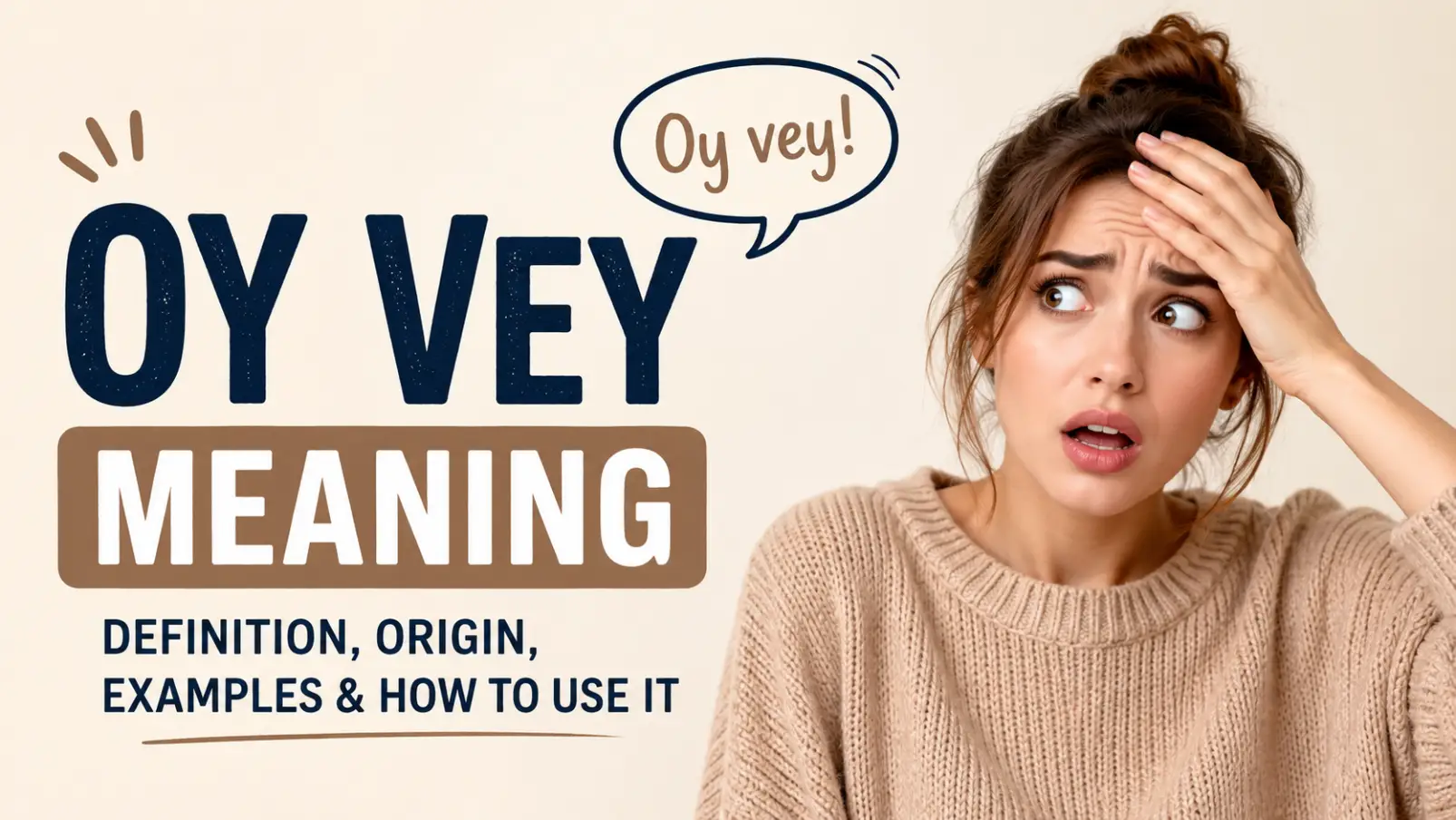
The oy vey meaning is an expression of dismay, frustration, worry, sadness, or distress. In simple English, it can be similar to “Oh no!” “Oh dear!” “Ugh!” or “Good grief!” depending on the situation.

Oy vey comes from Yiddish and has a strong connection with Jewish language and culture. Today, the expression is also familiar to many English speakers, especially in American English. The tone can be serious, tired, surprised, or playful.

People also search for oy vey meaning in English, oy vey meaning in Yiddish, oy vey meaning Jewish, and oy vey meaning slang because the phrase can be heard in many different contexts.

Quick Meaning

Oy vey is a Yiddish interjection used to express dismay, frustration, distress, grief, worry, or exasperation. The exact feeling depends on the situation and the speaker’s tone. Merriam-Webster defines it as an expression of dismay, frustration, or grief.

Example:

“Oy vey, I forgot my wallet.”

Here, oy vey shows frustration or regret.

What Does Oy Vey Mean?

The oy vey meaning is best understood as an emotional reaction to something unpleasant, difficult, surprising, or upsetting.

For example:

“Oy vey, I forgot my appointment!”

The speaker is upset with themselves for making a mistake.

Another example is:

“Oy vey, this traffic is terrible.”

Here, the phrase expresses frustration.

The expression does not always mean that something serious has happened. Someone might also use it for a small everyday problem:

“Oy vey, I have three loads of laundry to fold.”

The laundry is not a disaster. The speaker is simply feeling tired or overwhelmed.

That is why oy vey does not have one perfect English translation. Its meaning changes slightly with the situation.

Oy Vey Meaning in English

In English, oy vey can often be understood as:

  • “Oh no!”
  • “Oh dear!”
  • “Ugh!”
  • “Good grief!”
  • “What a problem!”
  • “This is frustrating.”
  • “I can’t believe this.”
  • “What a mess!”

For example:

“Oy vey, I missed the bus.”

A natural English version could be:

“Oh no, I missed the bus.”

The two expressions communicate a similar reaction, but oy vey has a distinct Yiddish background.

So, when someone searches for oy vey meaning in English, the simplest answer is: it is an emotional expression used when something is frustrating, worrying, disappointing, or troublesome.

Oy Vey Meaning in Yiddish

Oy vey is a Yiddish expression written in Yiddish as אױ װײ. The Jewish English Lexicon gives its etymology as “oh woe” and describes it as an exclamation of dismay, exasperation, or surprise.

The literal sense is useful for understanding its history, but people do not normally translate it word for word when using it in conversation.

For example:

“Oy vey, that’s a lot of work.”

The speaker is not literally saying “oh woe.” They are reacting to the situation and showing that it feels difficult or frustrating.

Is Oy Vey Jewish or Yiddish?

Oy vey is Yiddish, and it has a strong connection with Jewish language and culture.

The Jewish English Lexicon lists Yiddish as its language of origin and notes that the expression is used by both Jewish and non-Jewish speakers.

This is an important distinction. Yiddish and Hebrew are different languages, even though Yiddish includes vocabulary from Hebrew and Aramaic along with other linguistic influences.

So if someone asks, “Is oy vey Jewish?”, the answer is that it is a Yiddish expression strongly associated with Jewish speech and culture.

Is Oy Vey Hebrew?

No. Oy vey is a Yiddish expression, not a standard modern Hebrew phrase.

People sometimes assume it is Hebrew because Yiddish has a long connection with Jewish language and culture. However, the Jewish English Lexicon specifically identifies oy vey as Yiddish.

There are related expressions in Hebrew, but they should not automatically be treated as the same phrase.

The easiest way to remember it is:

Oy vey = Yiddish

Hebrew = a separate language

Where Does Oy Vey Come From?

The phrase comes from Yiddish. Oxford gives its literal meaning as “oh woe” and dates the expression to the late 19th century.

Merriam-Webster gives more detail about its word history. It explains that the expression was borrowed from Yiddish and combines oy, an interjection expressing surprise or dismay, with vey, an interjection expressing distress or grief. Merriam-Webster lists 1914 as the first known use of oy vey in English.

This does not mean the phrase itself was invented in 1914. It means that 1914 is the date Merriam-Webster records for its first known English use.

The expression later became familiar beyond Yiddish-speaking communities and is now recognized by many English speakers.

How Do You Pronounce Oy Vey?

Oy vey is pronounced:

OY VAY

The pronunciation is approximately:

/ˌɔɪ ˈveɪ/

Oxford gives this pronunciation, while Merriam-Webster gives ˈȯi-ˈvā.

The first word, oy, sounds like the “oy” sound in boy.

The second word, vey, sounds approximately like “vay” and rhymes with day.

So you can say:

“OY vay!”

The Jewish English Lexicon also gives the pronunciation as oy-VAY.

When to Use Oy Vey

You can use oy vey when reacting to something frustrating, disappointing, stressful, worrying, or troublesome.

Common situations include:

  • You made a mistake.
  • You received disappointing news.
  • You have too much work.
  • Something went wrong unexpectedly.
  • You are worried about a problem.
  • You are having a difficult day.
  • A small problem is becoming annoying.

For example:

“Oy vey, I forgot to charge my phone.”

Or:

“Oy vey, we’re going to be late.”

It can also be used humorously:

“Oy vey, I ate the whole pizza.”

The problem does not have to be serious. Sometimes the expression simply makes a reaction sound more dramatic or playful.

Examples of Oy Vey

Here are some simple examples to show how the expression works.

Example 1: Forgetting something

“Oy vey, I left my keys at home.”

The speaker is frustrated because they made a mistake.

Example 2: Bad traffic

“Oy vey, we’ve been stuck in traffic for an hour.”

Here, the phrase shows frustration and impatience.

Example 3: Too much work

“Oy vey, I have so much work to finish tonight.”

The speaker feels overwhelmed.

Example 4: Disappointing news

“Oy vey, that’s really disappointing.”

Here, the expression shows sadness or dismay.

Example 5: A small problem

“Oy vey, the printer is out of ink again.”

The problem is annoying rather than serious.

Example 6: Humorous use

“Oy vey, I ate way too much at dinner.”

The phrase adds a playful or dramatic reaction.

Oy Vey in a Sentence

Because oy vey is an interjection, it often appears at the beginning of a sentence.

Examples:

“Oy vey, what a day!”

“Oy vey, I can’t believe I did that.”

“Oy vey, we’re going to be late.”

“Oy vey, this project is taking forever.”

It can also appear at the end:

“We missed the last train, oy vey.”

And sometimes it stands alone:

“Oy vey!”

When the situation is already clear, those two words can communicate the entire reaction.

Is Oy Vey Slang?

Oy vey is better described as a Yiddish expression or interjection than ordinary English slang.

It sounds casual and is commonly used in informal speech, humor, texting, social media, and popular culture. However, its history is different from modern English slang.

People may search for oy vey meaning slang because they hear the phrase in casual conversations or memes. In practice, it usually expresses frustration, worry, disappointment, surprise, or dismay.

So, oy vey is informal, but calling it simply “slang” misses its Yiddish origin.

What Does Vey Mean in Slang?

Vey does not have a separate modern English slang meaning in oy vey.

It is part of the Yiddish expression oy vey, whose literal sense is connected with woe, distress, or grief. Merriam-Webster explains that vey is an interjection expressing distress or grief.

So it is better to understand the complete expression rather than treat vey as an English slang word.

For example:

“Oy vey, I have so much work to do.”

The word vey is not being used as a separate slang term. The entire expression communicates the speaker’s reaction.

Oy Vey vs. Oh No

“Oh no” and “oy vey” can have similar meanings, but they are not exactly the same.

Oh no is a standard English expression. It can show surprise, concern, disappointment, or alarm.

Oy vey comes from Yiddish and has a distinct cultural and linguistic history.

Compare:

“Oh no, I missed my flight.”

“Oy vey, I missed my flight.”

Both sentences show frustration. The second has a Yiddish flavor that the first does not.

Oy Vey vs. Oy

Oy can also be used by itself.

The Jewish English Lexicon describes oy as a Yiddish interjection expressing dismay, exasperation, or surprise.

For example:

“Oy, how am I going to finish all this work?”

The longer form is:

“Oy vey, how am I going to finish all this work?”

Both can express a similar emotional reaction.

Oy Vey vs. Oy Gevalt

Oy vey and oy gevalt are related Yiddish expressions, but they are not identical.

Its commonly expresses dismay, frustration, worry, or distress.

It can be used as an exclamation of alarm or strong distress.

The exact strength depends on the speaker and situation, so it is better not to treat these expressions as having a strict one-to-one intensity scale.

For everyday English learners, a useful shortcut is:

Oy vey = “Oh no!” / “Oh dear!”

Oy gevalt = an alarmed or distressed reaction

Oy Vey Meaning in Spanish

There is no single Spanish translation that works in every situation.

Depending on the context, oy vey may be similar to:

  • ¡Ay, no! — Oh no!
  • ¡Dios mío! — My God!
  • ¡Qué problema! — What a problem!
  • ¡Ay, Dios! — Oh God!

For example:

“Oy vey, I forgot my passport.”

A natural Spanish reaction might be:

“¡Ay, no! Olvidé mi pasaporte.”

The exact translation depends on the emotion. A mild problem may call for ¡Ay, no!, while a stronger reaction may use a different expression.

Oy Vey Meaning in French

In French, possible equivalents include:

  • Oh non ! — Oh no!
  • Oh là là ! — Oh dear! / Wow!
  • Quel problème ! — What a problem!

For example:

“Oy vey, we’re late again.”

could be expressed naturally as:

“Oh non, nous sommes encore en retard !”

There is no perfect French replacement because oy vey carries its own Yiddish cultural background.

Oy Vey Meaning in Italian

In Italian, a similar reaction might be:

  • Oh no! — Oh no!
  • Oddio! — Oh my God!
  • Che problema! — What a problem!

For example:

“Oy vey, I broke my phone.”

could be expressed as:

“Oh no, ho rotto il telefono.”

Again, these are approximate translations rather than exact equivalents.

Oy Vey Meaning in Hebrew

Although oy vey is Yiddish, people sometimes search for its Hebrew meaning because of its connection with Jewish language and culture.

A related Hebrew expression is oy va’avoy (אוי ואבוי), which can express distress or dismay and may be understood as something like “oh no” or “woe.”

However, it is important not to say that oy vey is Hebrew. The expression oy vey itself is identified as Yiddish.

Oy Vey Meaning in Jewish Culture

Oy vey has a long connection with Jewish and Yiddish speech.

The Jewish English Lexicon lists the expression as Yiddish and notes that it is used by both Jewish and non-Jewish speakers today.

Its use can depend on family, community, age, region, and personal speaking style. Some people may use it naturally in everyday conversation, while others may mainly recognize it from books, television, comedy, or popular culture.

Because the expression has a cultural background, it is best used naturally rather than as a caricature.

Is Oy Vey Offensive?

Oy vey is not inherently a swear word or offensive expression.

However, it is connected to Yiddish and Jewish culture, so context matters. Using the phrase naturally to express frustration is different from using it to mock Jewish people or imitate stereotypes.

For example:

“Oy vey, I forgot my keys.”

This is simply an informal emotional reaction.

The safest approach is to understand the phrase’s cultural background and use it naturally. Avoid exaggerated accents or a mocking tone.

Is Oy Vey Formal or Informal?

Oy vey is informal.

It works well in:

  • Casual conversation
  • Text messages
  • Social media
  • Personal writing
  • Humor
  • Informal storytelling

It is usually not suitable for a formal report or academic paper.

For example, this would sound too casual in a business report:

“Oy vey, the project is behind schedule.”

A professional version would be:

“The project is currently behind schedule.”

Is Oy Vey in the Bible?

No, “oy vey” is not a phrase from the Bible.

It is a Yiddish expression that developed in Jewish European communities. The expression itself should not be described as a biblical phrase.

However, the word “woe” does appear in many English Bible translations. Since oy vey has the literal sense “oh woe,” people may sometimes connect the expression with biblical language.

The important distinction is:

The idea of “woe” appears in the Bible, but “oy vey” itself is Yiddish, not a biblical expression.

Oy Vey Meaning in Memes

On social media, oy vey can appear in memes and humorous posts about frustrating, awkward, embarrassing, or stressful situations.

For example, imagine a meme showing someone with a huge list of tasks and the caption:

“Oy vey!”

In this setting, the phrase may be playful rather than a sign of serious distress.

Meme usage often makes the expression more dramatic for comic effect. A person might use it after spilling coffee, missing a bus, losing their phone, or dealing with a long Monday.

Common Spellings of Oy Vey

The most common spelling is:

oy vey

You may also see:

  • oy vay
  • oy veh
  • oi vey
  • oi vay

Merriam-Webster lists oy vay and oy veh as less common variants.

The Jewish English Lexicon also lists alternative spellings such as oi vey, oi vei, and oi vay.

For standard English writing, oy vey is the safest and most familiar spelling.

Common Mistakes With Oy Vey

One common mistake is assuming that oy vey always means “I am very sad.” It can express sadness, but it can also show frustration, worry, dismay, surprise, or exasperation.

Another mistake is treating vey as an English slang word. In oy vey, the words work together as one expression.

It is also incorrect to call oy vey a Hebrew phrase simply because it is associated with Jewish culture. Its language of origin is Yiddish.

Finally, do not assume that everyone who uses oy vey is Jewish. The expression has spread beyond Jewish communities and is now familiar to many non-Jewish English speakers as well.

Is Oy Vey Used in American English?

Yes. Oy vey is familiar in American English, especially in informal speech and writing.

Its history in American English is tied to the spread of Yiddish expressions in the United States. Merriam-Webster records the first known English use of oy vey in 1914.

Today, you may encounter the expression in:

  • Everyday conversation
  • Books
  • Television
  • Comedy
  • Social media
  • Memes
  • Informal messages

Its meaning remains easy to understand: the speaker is reacting to something troublesome, frustrating, disappointing, worrying, or upsetting.

Oy Vey Synonyms and Similar Expressions

There is no perfect synonym for oy vey, but several English expressions can communicate a similar feeling.

The best choice depends on the situation.

For example, “Oh no!” is a very natural replacement when something suddenly goes wrong, while “Ugh!” works better for annoyance.

FAQs

What does oy vey mean in simple English?

Oy vey means something like “Oh no,” “Oh dear,” “Ugh,” or “Good grief.” It expresses emotions such as frustration, worry, dismay, sadness, or distress.

What does oy vey mean in English?

In English, oy vey is an informal expression used to react to something unpleasant, frustrating, disappointing, or stressful.

Is oy vey a Yiddish phrase?

Yes. Oy vey comes from Yiddish. Its literal sense is commonly given as “oh woe.”

Is oy vey Hebrew or Yiddish?

Oy vey is Yiddish, not standard modern Hebrew. It has a strong connection with Jewish language and culture.

What does vey mean in slang?

In oy vey, vey is not a separate English slang word. It is part of the Yiddish expression and is associated with distress, grief, or woe.

When should you use oy vey?

Use oy vey in informal situations when reacting to frustration, worry, disappointment, stress, or a troublesome situation.

Is oy vey the same as oh no?

They can have similar meanings, but “oh no” is English, while “oy vey” is a Yiddish expression.

What does oy vey mean in Spanish?

Depending on the context, oy vey can be similar to Spanish expressions such as “¡Ay, no!” or “¡Dios mío!” There is no single exact translation for every situation.

What does oy vey mean in French?

Possible French equivalents include “Oh non !” and “Oh là là !”, depending on the situation and emotion.

What does oy vey mean in Italian?

Possible Italian equivalents include “Oh no!” and “Oddio!”, depending on the context.

Is oy vey in the Bible?

No. Oy vey is Yiddish, not a biblical phrase. It has the literal sense “oh woe,” which may explain why people sometimes connect it with biblical language.

How do you say “Oh my God” in Yiddish?

There is no single exact Yiddish translation that should always be used for “Oh my God.” Oy vey can express distress or surprise, but it does not literally mean “Oh my God.”

Is oy vey offensive?

Oy vey is not inherently offensive. However, because it has a Yiddish and Jewish cultural background, it should not be used to mock Jewish people or imitate stereotypes.

Conclusion

The oy vey meaning is an emotional reaction that can express dismay, frustration, worry, sadness, distress, or exasperation. In simple English, it may be similar to “Oh no,” “Oh dear,” “Ugh,” or “Good grief,” depending on the situation.

Oy vey comes from Yiddish and has a strong connection with Jewish language and culture. The expression is now also familiar to many English speakers, especially in American English.

It is informal and works best in everyday conversation, texts, social media, humor, and casual writing.

The key is to look at the context and tone. Someone saying “oy vey” after hearing bad news may be genuinely upset, while someone saying it about a pile of laundry may simply be joking or feeling overwhelmed.

Once you understand that difference, oy vey is a simple and expressive phrase to recognize in English.

Leave a Reply

Your email address will not be published. Required fields are marked *