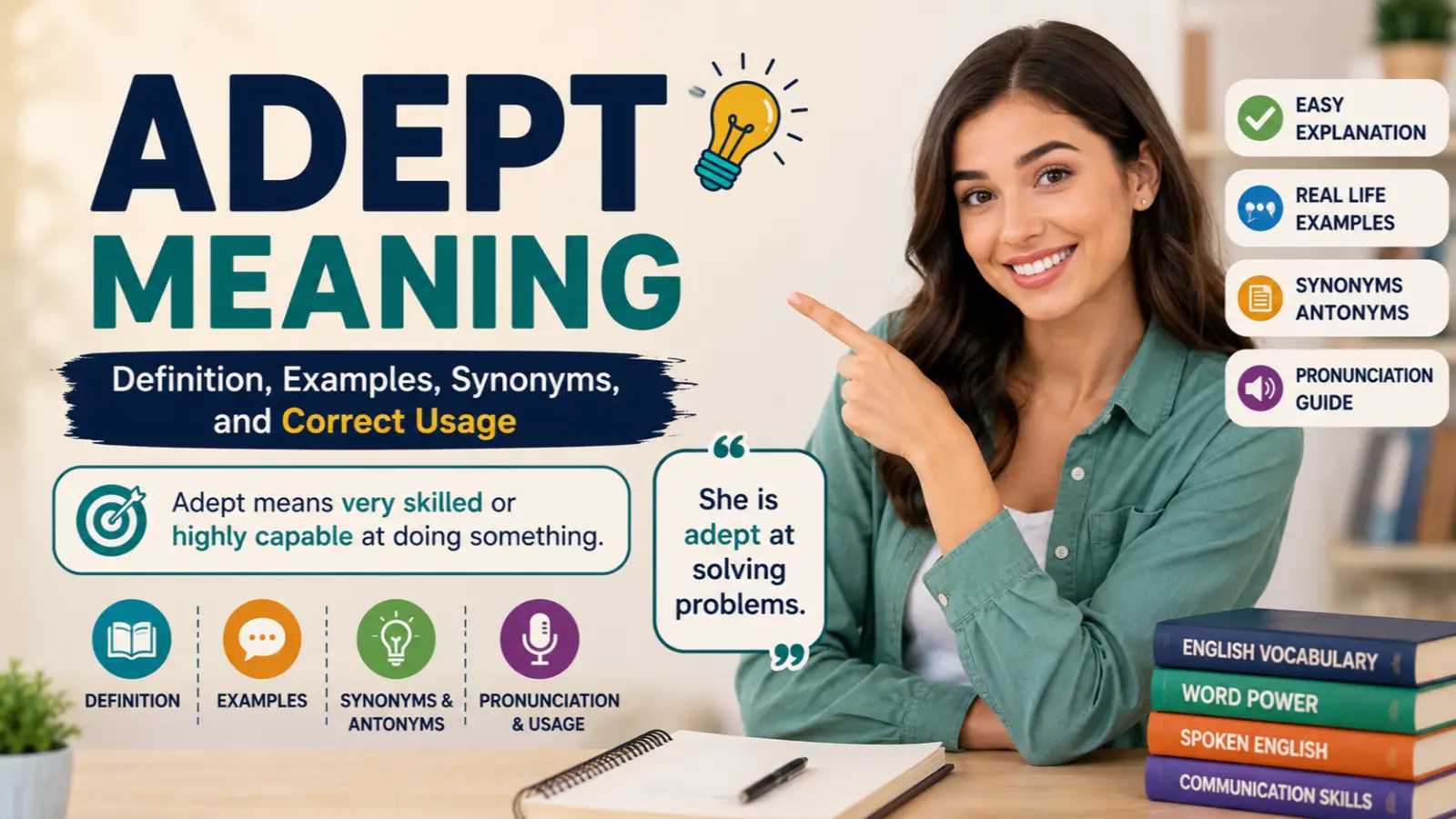
The adept meaning is very skilled or highly capable at doing something. If someone is adept at a task, they can usually do it well because of ability, practice, training, or experience.
For example:
“She is adept at solving difficult problems.”
This means she is very skilled at solving difficult problems.
Adept is most commonly used as an adjective, especially in the pattern “adept at + noun” or “adept at + -ing verb.” You can use it to describe skills in communication, technology, business, sports, writing, art, problem-solving, and many other areas.
Cambridge defines adept as having a natural ability to do something that requires skill, while Merriam-Webster defines it as thoroughly proficient or expert.
Quick Meaning of Adept
Adept means very skilled, capable, or proficient at something.
In simple English:
Adept = very good at doing something that requires skill.
For example:
“He is adept at using computers.”
This simply means:
“He is very good at using computers.”
The word usually gives a positive impression. Calling someone adept suggests that they can handle a particular task with a high level of ability.
Adept in Simple English
| Word | Simple meaning | Example |
|---|---|---|
| Adept | Very skilled | “She is adept at writing.” |
| Skilled | Good at a particular skill | “He is a skilled mechanic.” |
| Proficient | Competent and well-trained | “She is proficient in Spanish.” |
| Expert | Highly knowledgeable or skilled | “He is an expert in biology.” |
The easiest way to remember it is:
Adept = highly skilled at something.
What Does Adept Mean?
The main adept meaning is highly skilled or very capable at doing something.
For example:
“Maria is adept at managing large teams.”
This tells us that Maria is not simply able to manage a team. She has a strong ability to do it effectively.
You can use adept for many types of skills, including:
- Writing
- Speaking
- Teaching
- Cooking
- Programming
- Negotiating
- Playing music
- Solving problems
- Managing people
- Using technology
- Playing sports
The skill can be practical, creative, academic, professional, or social.
For example:
“He is adept at explaining complicated ideas.”
“She is adept at negotiating with clients.”
“The player is adept at reading the game.”
In each example, adept highlights a strong ability.
How to Use Adept in a Sentence
The most common structure is:
be adept at + noun
Example:
“She is adept at communication.”
You can also use:
be adept at + verb-ing
Examples:
“She is adept at communicating with customers.”
“He is adept at solving technical problems.”
“They are adept at finding practical solutions.”
“The student is adept at learning new languages.”
“Our manager is adept at handling difficult situations.”
Oxford also lists adept at/in something and adept at/in doing something as established constructions.
Adept Before a Noun
You can also use adept directly before a noun:
“He is an adept negotiator.”
Here, adept describes the negotiator and means highly skilled.
Compare these two sentences:
“He is an adept negotiator.”
“He is adept at negotiating.”
Both are correct. The first describes him as a skilled negotiator, while the second focuses on his ability to negotiate.
Examples of Adept in Everyday English
The word adept can describe many different abilities.
At Work
“Jordan is adept at working with difficult clients.”
This means Jordan is highly skilled at dealing with challenging clients.
At School
“Maya is adept at explaining complicated ideas.”
She has a strong ability to make difficult ideas easier to understand.
With Technology
“My brother is adept at fixing computer problems.”
He is very skilled at solving computer-related issues.
In Sports
“The player is adept at reading the game.”
The player is highly capable of understanding what is happening and responding effectively.
In Communication
“She is adept at making people feel comfortable.”
This means she is particularly skilled at helping others feel relaxed.
These examples show that adept is not limited to one profession or type of skill.
Adept as an Adjective
In modern English, adept is most commonly used as an adjective.
An adjective describes a person or thing.
For example:
“He is an adept writer.”
Here, adept describes the writer.
You can also use it after a linking verb:
“He is adept at writing.”
Both structures are correct.
Merriam-Webster lists the adjective meaning as “thoroughly proficient” and gives examples such as an adept negotiator and adept at fixing computers.
Adept as a Noun
Adept can also be a noun, although this use is less common in everyday conversation.
As a noun, an adept means a person who is highly skilled or well-trained in something. Merriam-Webster and Oxford both recognize this noun use.
For example:
“She is an adept at chess.”
This means she is highly skilled at chess.
The noun form can sound more formal or literary.
In ordinary conversation, you are more likely to hear:
“She is adept at chess.”
than:
“She is an adept at chess.”
Adept vs Skilled
Adept and skilled are very close in meaning.
Skilled is more common and straightforward:
“He is a skilled carpenter.”
Adept can sound slightly more polished and often emphasizes strong ability in a particular activity:
“He is adept at solving complex design problems.”
Both words describe someone who can do something well.
Merriam-Webster explains that adept can suggest special aptitude as well as proficiency, while skilled focuses more directly on ability developed through knowledge or experience.
Adept vs Proficient
Proficient means having a good or higher-than-average level of ability.
For example:
“She is proficient in Excel.”
“He is proficient in Spanish.”
Adept also describes strong ability, but it can emphasize special aptitude or an ability to handle something skillfully.
“She is adept at finding creative solutions.”
Merriam-Webster notes that proficient often suggests competence developed through training and practice, while adept can suggest special aptitude along with proficiency.
In simple terms:
- Adept = highly capable or skillful
- Proficient = well-trained and competent
- Skilled = good at a particular skill
- Expert = extremely knowledgeable or highly skilled
Adept vs Expert
Expert usually suggests a very high level of knowledge or skill.
For example:
“Dr. Lee is an expert in chemistry.”
Adept can describe strong ability without claiming that someone is an authority or expert in the entire field.
“Dr. Lee is adept at explaining complex chemistry concepts.”
Someone can therefore be adept at a specific task without being an expert in the entire subject.
What Is Another Word for Adept?
If you are looking for another word for adept, several synonyms may work depending on the sentence.
Common synonyms include:
- Skilled
- Skillful
- Proficient
- Expert
- Capable
- Accomplished
- Talented
- Experienced
- Competent
- Adroit
Merriam-Webster lists skilled, skillful, proficient, experienced, and expert among common synonyms.
However, these words are not perfect replacements in every sentence.
For example:
“She is adept at solving problems.”
can become:
“She is skilled at solving problems.”
But:
“She is an expert in medicine.”
does not always mean exactly the same thing as:
“She is adept at medicine.”
The best synonym depends on the context and the level of ability you want to express.
What Is the Antonym of Adept?
Common adept antonyms include:
- Inept
- Unskilled
- Incompetent
- Inexperienced
- Clumsy
These are not exact opposites in every situation.
Inept means lacking the ability or skill needed to do something well.
“He was inept at handling the situation.”
Unskilled means lacking a particular skill.
“The worker was unskilled in using the equipment.”
Inexperienced means lacking experience, but an inexperienced person may still have natural ability. Therefore, it is not always a direct opposite of adept.
Is Adept a Positive Word?
Yes. Adept is normally a positive word.
It is generally used to praise someone’s ability.
For example:
“She is adept at managing people.”
This suggests that she is good at managing people.
Similarly:
“He is adept at solving technical problems.”
This is a compliment about his technical ability.
If someone describes you as adept, they are usually saying that you are capable, skilled, or particularly good at something.
Is Adept Slang?
No. Adept is not normally slang.
It is a standard English vocabulary word used in everyday, professional, academic, and written English.
You may see it in:
- Text messages
- Social media
- School assignments
- Business writing
- Job descriptions
- News articles
- Professional profiles
- Academic writing
For example:
“She is adept at editing videos.”
That sentence can appear in a casual conversation or a professional profile.
Although adept may sound more formal than good at or skilled, it is not an internet abbreviation or slang term.
Adept Meaning in Texting
When someone uses adept in a text message, the meaning normally stays the same: very skilled or capable at something.
For example:
“You’re really adept at fixing computers.”
This means:
“You’re really good at fixing computers.”
It is not like abbreviations such as LOL or BRB. Adept is a normal English word, not an acronym.
Because the word sounds somewhat polished, a person may choose it instead of simpler phrases such as good at, skilled, or talented.
Emotionally Adept Meaning
The phrase emotionally adept describes someone who is skilled at understanding, managing, or responding to emotions.
For example:
“She is emotionally adept and knows how to handle difficult conversations.”
This suggests that she understands emotional situations well and responds thoughtfully.
Someone who is emotionally adept may be good at:
- Understanding other people’s feelings
- Communicating during difficult situations
- Managing emotional reactions
- Showing empathy
- Handling sensitive conversations
It is similar in idea to being emotionally intelligent, although the two expressions are not identical.
What Is a Spiritual Adept?
A spiritual adept is a person who is considered highly skilled, knowledgeable, or experienced in spiritual practices or traditions.
The exact meaning depends on the religious, philosophical, or spiritual tradition being discussed.
For example:
“The teacher was regarded as a spiritual adept.”
Here, adept means someone with advanced knowledge or ability in spiritual practice.
The phrase can appear in discussions of meditation, mysticism, religious traditions, philosophy, or personal spiritual development. It is not a separate dictionary meaning of adept; rather, it applies the general idea of being highly skilled to a spiritual context.
Adept Meaning in Medical Contexts
If you search for “adept meaning medical,” there is an important distinction to understand.
The lowercase word adept still means skilled or highly capable in medical writing.
For example:
“The surgeon was adept at performing complex procedures.”
Here, adept has its ordinary English meaning.
However, ADEPT in all capital letters can also be used as an acronym in specific medical or research contexts. For example, ADEPT has been used for Antibody-Directed Enzyme Prodrug Therapy, a type of cancer-treatment approach. Other medical organizations and programs also use ADEPT as an acronym for different terms.
So context matters:
- adept = skilled or highly capable
- ADEPT = may be a medical acronym, depending on the context
Do not assume that every appearance of ADEPT in a medical document refers to the ordinary English word.
Adept Meaning in Chinese
If you are looking for the adept meaning in Chinese, the word can be translated with terms such as 擅长的, 熟练的, or 内行的, depending on the sentence and context. Cambridge provides these kinds of translations for adept.
For example, the sentence:
“She is adept at painting.”
would be translated according to the idea of being skilled or proficient at painting.
Because translations depend on context, there is not always one perfect Chinese word for every use of adept.
Is Adept Formal or Informal?
Adept is neutral to somewhat formal in tone.
It is completely correct in everyday English, but phrases such as good at and skilled at are often more natural in very casual conversation.
Compare:
“She’s really good at computers.”
and:
“She’s adept at using advanced software.”
Both are correct. The second sounds more polished and professional.
You may see adept in:
- Business writing
- Professional profiles
- Job descriptions
- Academic writing
- News articles
- Formal presentations
- Everyday English
It is not a slang word.
Pronunciation of Adept
In American English, adept is commonly pronounced:
uh-DEPT
The stress falls on the second syllable.
The pronunciation is:
/əˈdept/
Cambridge gives the U.S. pronunciation as /əˈdept/.
For example:
“She is adept at writing.”
The word should sound like uh-DEPT, not with the main stress on the first syllable.
Adept Pronunciation as a Noun
There is also a pronunciation difference worth knowing.
As an adjective, adept is commonly pronounced:
uh-DEPT
As a noun, dictionaries also record pronunciations with stronger stress on the first syllable, such as AD-ept. Merriam-Webster and Collins both distinguish the adjective and noun pronunciations.
Origin and History of Adept
The word adept has a long history.
Merriam-Webster traces the noun to New Latin adeptus, meaning someone who had attained a high degree of proficiency. The word ultimately comes from Latin and is related to the idea of attaining or achieving something.
The noun entered English in the 17th century, and the adjective developed soon afterward.
Historically, the noun was associated with people believed to have attained special knowledge, including knowledge connected with alchemy and related traditions. Over time, the word developed into the broader modern sense of someone who is highly skilled or proficient.
Today, adept has a much wider meaning and can describe skill in almost any area.
Common Mistakes with Adept
1. Confusing Adept With Adapt
This is one of the most common mistakes.
Adept = skilled
Adapt = adjust or change
Correct:
“She is adept at public speaking.”
Correct:
“She quickly adapted to her new job.”
Incorrect:
“She is adapt at public speaking.”
2. Forgetting “At”
The most common structure is:
adept at + noun or -ing verb
Correct:
“He is adept at solving problems.”
Correct:
“She is adept at communication.”
3. Using Adept as a Verb
Adept is not normally used as a verb.
Incorrect:
“She adepts at writing.”
Correct:
“She is adept at writing.”
4. Assuming Adept Always Means Expert
Adept and expert are related, but they are not always interchangeable.
Someone can be adept at a specific task without being an expert in an entire field.
FAQs About Adept Meaning
What does adept mean in simple English?
Adept means very skilled or very good at doing something. It usually describes someone who can perform a task well because of ability, training, practice, or experience.
What is an example of adept?
“Sarah is adept at solving difficult problems.”
This means Sarah is very good at solving difficult problems.
Is adept a positive word?
Yes. Adept is normally a positive word because it praises someone’s skill or ability.
What is another word for adept?
Common synonyms include skilled, skillful, proficient, expert, capable, accomplished, and talented. The best synonym depends on the context.
What is the difference between adept and proficient?
Both describe strong ability. Proficient often emphasizes competence developed through training and practice, while adept can suggest special aptitude as well as proficiency.
What is the difference between adept and adapt?
Adept means skilled or highly capable. Adapt means to change or adjust to a new situation.
What preposition is used with adept?
The most common preposition is at:
“She is adept at communicating with customers.”
Adept in is also possible in some contexts, particularly before a field or area of activity, but adept at is the most useful pattern to remember. Oxford lists both at and in constructions.
Is adept slang?
No. Adept is a standard English word, not slang.
What does emotionally adept mean?
Emotionally adept describes someone who is skilled at understanding, managing, or responding to emotions and emotional situations.
What does spiritual adept mean?
A spiritual adept is someone regarded as highly skilled or knowledgeable in spiritual practices or traditions.
Does ADEPT have a medical meaning?
Yes, ADEPT can be used as a medical or research acronym for different terms depending on the organization or field. One documented medical use is Antibody-Directed Enzyme Prodrug Therapy. The ordinary word adept, however, simply means skilled.
Conclusion
The adept meaning is simple: very skilled, capable, or proficient at doing something.
It is most commonly used as an adjective, especially in the pattern “adept at + noun or -ing verb.” For example, “He is adept at solving problems” means that he is highly skilled at solving problems.
Adept is similar to words such as skilled, proficient, capable, and expert, but each has a slightly different tone. It is also important to remember the difference between adept and adapt: adept means skilled, while adapt means to adjust or change.

Hi, I’m Mia Walker, a Content Research Writer at Hublioo.com with 3+ years of experience in creating educational language content.
I enjoy breaking down complex words, internet slang, abbreviations, and everyday expressions into clear, practical explanations that anyone can understand.
My focus is on delivering original, easy-to-read, and well-organized content that helps readers expand their vocabulary and use English with greater confidence.