
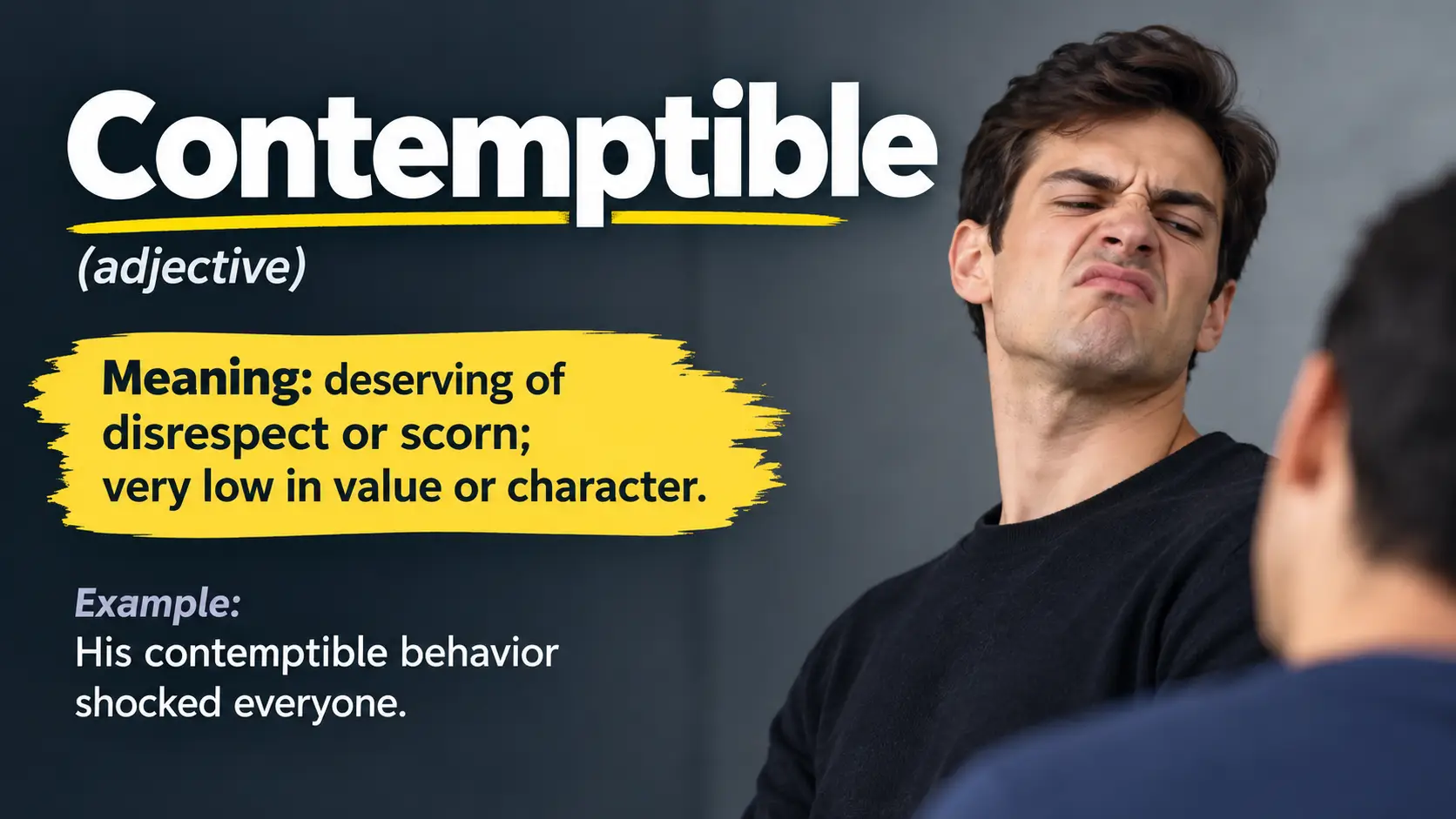
Have you ever heard someone describe a person, action, or behavior as contemptible and wondered what it really means? The word sounds strong, and it usually carries a very negative judgment.
Contemptible meaning is “deserving contempt, scorn, or strong disrespect.” In simple words, something contemptible is so bad, dishonest, cruel, or shameful that people feel it does not deserve respect. Cambridge defines the word as “deserving contempt,” while Oxford describes it as something “not deserving any respect at all.”
This article explains the meaning of contemptible in simple English. You will learn how to pronounce it, how to use it in a sentence, what words are similar, how it differs from contemptuous, and when it is appropriate to use this strong adjective.
Quick Answer: What Does Contemptible Mean?
Contemptible means deserving strong dislike, disrespect, or scorn because of something very bad, dishonest, cruel, or shameful.
For example:
“Taking advantage of older people is contemptible.”
This means the behavior is considered deeply wrong and deserves strong criticism and condemnation.
Contemptible is an adjective. It can describe a person, action, behavior, decision, idea, or situation.
A few simple examples are:
“His contemptible behavior shocked everyone.”
“She made a contemptible decision.”
“The criminals carried out a contemptible act.”
“The lie was contemptible.”
The word is stronger than simply saying something is bad or mean. It shows that the speaker has a very low opinion of the thing being described.
Contemptible Meaning and Definition
The basic contemptible meaning is something that deserves contempt or scorn.
Merriam-Webster defines contemptible as “worthy of contempt.” It also lists related ideas such as mean, disgusting, hateful, nasty, despicable, vile, and disgraceful.
The word is often used when someone believes that a person has behaved in a morally wrong or deeply unpleasant way.
For example:
“Lying to protect a friend is one thing, but lying to hurt an innocent person is contemptible.”
Here, contemptible shows more than simple disagreement. The speaker believes the action is seriously wrong and deserves strong disapproval.
The word can describe both people and things:
“a contemptible person”
“a contemptible act”
“contemptible behavior”
“a contemptible lie”
“a contemptible decision”
It is also possible to use the word for something that is not morally evil but is considered extremely poor or unworthy. Merriam-Webster notes that the word can suggest a low standing or quality that provokes scorn.
How to Pronounce Contemptible
Contemptible is pronounced approximately:
kuhn-TEMP-tuh-buhl
The stress is on the second syllable: TEMP.
Cambridge gives the U.S. pronunciation as /kənˈtemptəbəl/.
The word begins with the same sound as contempt, which can make it easier to remember.
Try saying it slowly:
“con-TEMP-ti-ble”
Then say it naturally:
“contemptible”
Grammar and Correct Usage
Contemptible is an adjective. That means it is used to describe a noun.
For example:
“His behavior was contemptible.”
In this sentence, behavior is the noun, and contemptible describes it.
You can place the adjective before a noun:
“She committed a contemptible act.”
Or after a linking verb:
“The act was contemptible.”
You can also use stronger forms such as very contemptible or utterly contemptible when the context calls for extra emphasis.
For example:
“His treatment of the workers was utterly contemptible.”
Because contemptible is a strong word, it should not be used for every small mistake. Forgetting to return a pencil might be annoying, but calling it “contemptible” would usually sound exaggerated.
The word works best when the behavior or action is seriously wrong, cruel, dishonest, shameful, or deeply disrespectful.
Contemptible vs. Contemptuous
One of the most common points of confusion is the difference between contemptible and contemptuous.
They look and sound similar, but they usually describe different things.
Contemptible means deserving contempt.
Contemptuous means showing contempt or treating someone with strong disrespect.
Consider these examples:
“His actions were contemptible.”
This means his actions deserved strong disrespect.
“He gave me a contemptuous look.”
This means his look showed that he felt superior or disrespectful toward me.
A simple way to remember the difference is:
Contemptible = deserves contempt.
Contemptuous = shows contempt.
Merriam-Webster explains that the two words were once used more interchangeably, but modern usage generally keeps this distinction.
Synonyms for Contemptible
There are many words that can be used instead of contemptible, but they do not all have exactly the same feeling.
Common synonyms include:
Despicable, extremely bad and deserving strong dislike or moral condemnation.
Vile extremely unpleasant, evil, or morally bad.
Disgraceful, shameful and deserving criticism.
Shameful causing embarrassment or loss of respect.
Meaning unkind or selfish.
Wretched, very bad, miserable, or low in quality.
Detestable strongly disliked or hated.
Abominable, extremely bad or unpleasant.
Pitiable deserving pity, and sometimes also contempt.
For example, “despicable” is often very close to “contemptible,” especially when talking about serious moral wrongdoing. Merriam-Webster notes that despicable can suggest utter worthlessness and moral indignation, while contemptible has a broader sense of provoking scorn.
Contemptible vs. Similar Words
It helps to compare contemptible with everyday words that are easier to understand.
Calling someone bad is a general negative judgment.
The word mean usually describes a person who is unkind or hurtful.
Someone described as disrespectful has shown a lack of respect toward others.
Using despicable makes a much stronger moral judgment about a person or action.
By contrast, contemptible means that the person or behavior deserves contempt or scorn.
For example:
“He was mean to his brother.”
This sounds like ordinary unkind behavior.
“He was contemptible for deliberately hurting innocent people.”
This sounds much more serious and morally condemning.
Choosing the right word depends on how strong you want your statement to be.
Real-Life Examples of Contemptible
Here are some simple examples showing how contemptible can appear in everyday writing and speech.
“Taking advantage of someone who trusts you is contemptible.”
This means exploiting someone’s trust is deeply wrong and deserves strong disapproval.
“The company was criticized for its contemptible treatment of its workers.”
Here, the word describes behavior that is considered seriously unfair or shameful.
“Everyone agreed that cheating vulnerable customers was contemptible.”
The word emphasizes the moral seriousness of cheating.
“He made a contemptible remark about his coworker.”
This means the remark was considered especially offensive or disrespectful.
“Destroying someone’s reputation with a lie is a contemptible thing to do.”
Here, contemptible describes an action rather than a person.
“She refused to defend his contemptible behavior.”
This means she would not support behavior that she considered deeply wrong.
These examples show why the word is often connected with actions involving dishonesty, cruelty, unfairness, selfishness, or serious disrespect.
Is Contemptible a Strong Word?
Yes. Contemptible is a strong and usually formal word.
Calling something contemptible is much stronger than calling it unpleasant or annoying. It tells the reader that you believe the person or action is beneath respect.
For that reason, the word is common in serious writing, criticism, journalism, books, speeches, and formal discussions. Oxford labels it as formal and gives “not deserving any respect at all” as its main definition.
In casual conversation, people may choose simpler words such as:
“awful”
“terrible”
“disgusting”
“shameful”
“despicable”
Still, contemptible is useful when you want to make a strong judgment without using profanity or very informal language.
Origin and History of Contemptible
The word has a long history in English.
Merriam-Webster records its first known use in the 14th century. The word came into English through Middle French and Latin. Its Latin root is connected to contemnere, meaning “to look down on,” “to despise,” or “to show no respect.”
Oxford also traces the word to Latin contemnere, with related forms passing through Old French and later English.
This history helps explain the modern meaning. Something contemptible is something people look down on because they believe it is unworthy of respect.
The related noun contempt refers to the feeling of strong disrespect or scorn itself.
Common Mistakes With Contemptible
One common mistake is confusing contemptible with contemptuous.
Remember:
“His behavior was contemptible.”
His behavior deserved contempt.
“He was contemptuous of his classmates.”
He showed disrespect toward his classmates.
Another mistake is using contemptible for something that is merely inconvenient.
For example, “The bus was five minutes late, which was contemptible” sounds overly dramatic in most situations.
A better choice would be:
“The bus was five minutes late, which was annoying.”
Use contemptible when the situation truly involves behavior or qualities that deserve strong criticism or scorn.
A third mistake is assuming that contemptible always means “evil.” The word can describe anything considered deeply unworthy, shameful, or deserving of scorn, although serious moral wrongdoing is a common context.
FAQs About Contemptible Meaning
What is the simple meaning of contemptible?
Contemptible means deserving strong disrespect, scorn, or condemnation. It often describes behavior that is dishonest, cruel, shameful, or deeply wrong.
Is contemptible a bad word?
It is a negative and strong word, but it is not a swear word. It is a formal adjective used to strongly criticize a person, action, behavior, or idea.
What is a synonym for contemptible?
Common synonyms include despicable, vile, disgraceful, shameful, detestable, and mean. The best synonym depends on the exact situation.
What is the difference between contemptible and contemptuous?
Contemptible means something deserves contempt. Contemptuous means someone shows contempt. For example, a cruel action can be contemptible, while a disrespectful facial expression can be contemptuous.
Can contemptible describe a person?
Yes. You can call someone a “contemptible person” when you believe that person’s behavior or character is deeply shameful or unworthy of respect.
Is contemptible a formal word?
Yes. Dictionaries commonly label contemptible as formal. It is especially useful in serious writing, criticism, and situations where you want to express strong disapproval in a precise way.
Conclusion
The easiest way to remember contemptible meaning is this: something contemptible deserves contempt, scorn, or strong disrespect.
It is a powerful adjective used for people, actions, behavior, decisions, or ideas that are viewed as deeply wrong, shameful, cruel, dishonest, or unworthy of respect.
The word is stronger than simple terms such as “bad” or “mean,” so it is best used when the situation truly calls for strong criticism.
It is also helpful to remember the difference between contemptible and contemptuous: something contemptible deserves contempt, while something contemptuous shows contempt.
Once you understand that difference, the word becomes much easier to use. When you need a formal, precise way to describe behavior that deserves serious disapproval, contemptible can be the right word.

Hi, I’m Mia Walker, a Content Research Writer at Hublioo.com with 3+ years of experience in creating educational language content.
I enjoy breaking down complex words, internet slang, abbreviations, and everyday expressions into clear, practical explanations that anyone can understand.
My focus is on delivering original, easy-to-read, and well-organized content that helps readers expand their vocabulary and use English with greater confidence.