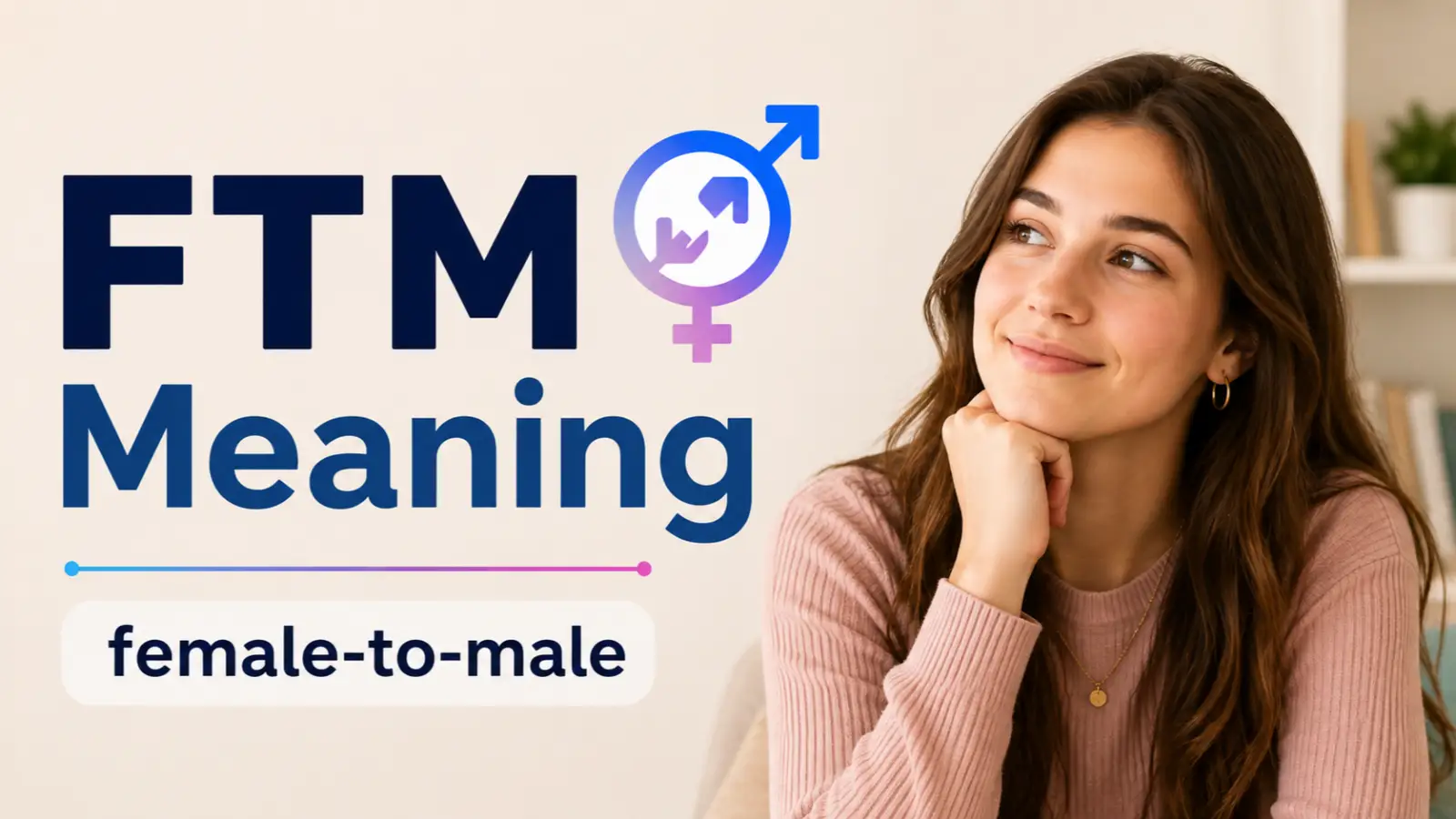
Short answer: FTM stands for female-to-male and refers to a transgender man — someone who was assigned female at birth but identifies and lives as a man. Many people prefer the term “trans man,” so always follow the individual’s own language.
Here is FTM at a glance:
| Detail | Info |
|---|---|
| Term | FTM |
| Part of speech | Noun / adjective (abbreviation) |
| Core meaning | Female-to-male: a transgender man (assigned female at birth, identifies as male) |
| Tone | Neutral (identity term — use respectfully) |
| You’ll see it in | LGBTQ+ spaces, social media, medical & community contexts |
What Does FTM Mean? The Full Definition
FTM is an abbreviation for female-to-male. It describes a transgender man: a person who was assigned female at birth and whose gender identity is male. The term appears in medical literature, LGBTQ+ community spaces, and personal identity descriptions — “He identifies as FTM.”
Language here is personal and evolving. Many trans men prefer simply “trans man” or just “man,” finding FTM overly clinical or focused on transition rather than identity. The respectful rule is simple: use the term the person themselves uses, and never apply FTM to someone who hasn’t used it for themselves. For another identity-adjacent abbreviation, see our MB meaning guide (a very different kind of abbreviation!).
For the full dictionary entry, see Merriam-Webster’s definition of FTM.
Is FTM Rude? Tone & Register Check
Is FTM rude? No — FTM is a neutral, factual identity term, not a slur. But context and consent matter: using it for someone who hasn’t claimed it, using it to out someone, or using it mockingly is disrespectful. Register check: neutral identity term. Many prefer “trans man” in everyday speech; FTM is most at home in medical, community, and informational contexts.
FAQs About FTM
What does FTM stand for?
FTM stands for female-to-male. It refers to a transgender man — someone assigned female at birth who identifies and lives as a man.
What is the difference between FTM and MTF?
FTM (female-to-male) describes a transgender man; MTF (male-to-female) describes a transgender woman. The abbreviation names the direction from birth assignment to gender identity.
Is FTM offensive?
No — it’s a neutral term. But many trans men prefer “trans man,” and you should always use whatever term the individual prefers. Using it to out or mock someone is offensive.
Should I say FTM or trans man?
“Trans man” is the safest default in everyday conversation. FTM is fine when the person uses it themselves or in medical/community contexts.
How should I respond if someone tells me they are FTM?
Thank them, affirm them, and use their correct name and pronouns. Keep it simple and kind: “Thanks for trusting me with that.” Related reading: MB meaning.
What Are the Synonyms and Antonyms of FTM?
- Related terms: trans man, transgender man, transmasculine (broader umbrella)
- Antonyms / counterparts: MTF (male-to-female, a transgender woman), cisgender man (not transgender)
These aren’t true synonyms — identity terms don’t swap like adjectives — but they are the related vocabulary. “Trans man” is the most widely preferred everyday term. For respectful language guidance on other topics, see oy vey meaning.
How Do You Use FTM in a Sentence?
Respectful usage examples:
- “He came out as FTM during his second year of college.”
- “The clinic offers healthcare tailored to FTM patients.”
- “Many FTM individuals prefer the term ‘trans man.’”
- “The support group welcomes FTM, MTF, and nonbinary members.”
- “She asked what FTM means so she could better support her brother.”
- “FTM is an adjective or noun describing a transgender man’s experience.”
Common Mistakes People Make With FTM
- Applying FTM to someone who hasn’t used it. Never label someone’s identity for them — follow their lead.
- Using FTM as an insult or joke. It’s a neutral identity term; mocking it is harassment, not humor.
- Asking intrusive medical questions. Someone’s transition details are private. Don’t ask unless they volunteer.
- Confusing FTM with MTF. FTM = trans man; MTF = trans woman. Mixing them up misgenders people.
How Can You Use FTM in Everyday Conversation?
FTM comes up in conversations about identity, allyship, and healthcare. If someone uses FTM for themselves, mirror their language. If you are unsure what term someone prefers, ask privately and kindly — “What language do you prefer I use?” — rather than guessing.
How to reply if someone tells you they are FTM: thank them for trusting you, use their name and pronouns correctly, and treat it as normal — because it is. “Thanks for telling me. I’ve got you.” Avoid intrusive questions about bodies or medical history; those are never owed to anyone.
FTM vs. MTF: What’s the Difference?
FTM vs. MTF: the two abbreviations are mirror images. FTM = female-to-male = a transgender man (assigned female at birth). MTF = male-to-female = a transgender woman (assigned male at birth). The letter order describes the direction of transition: starting point first, identity second. Both are clinical-origin terms; both are increasingly supplemented by “trans man” and “trans woman” in everyday language. Never use either term to speculate about someone’s identity — they describe how people describe themselves.
Key Takeaways
- 🌟 FTM = female-to-male; a transgender man.
- Neutral identity term — never a slur, never a joke.
- Many prefer “trans man” in everyday speech; follow the individual’s lead.
- FTM (trans man) vs. MTF (trans woman) — don’t mix them up.
- Respectful reply: thank them, use correct name/pronouns, skip intrusive questions.
Where Did the Word FTM Come From?
FTM emerged in transgender community and medical literature in the late 20th century as shorthand for “female-to-male,” alongside its counterpart MTF (male-to-female). Both terms date in print to around the early 1990s. They were originally clinical descriptors used by doctors and researchers, then adopted by community members as identity labels. In recent years, person-first language like “trans man” has become more common in everyday use, while FTM remains frequent in medical, legal, and online community contexts.
Read More Articles
🔮Weary Meaning: Definition, Examples, Pronunciation & Usage
🔮Malice Meaning: Definition, Malice vs Spite & Legal Examples
🔮Dapper Meaning: Definition, Examples, Synonyms & Style Guide

Hi, I’m Claire Morgan, a Senior Language Content Specialist at Hublioo.com. I have 5+ years of experience creating clear and easy-to-understand content about word meanings, slang, acronyms, phrases, and modern English usage. My goal is to simplify complex language and help readers understand words with confidence through accurate, well-researched, and reader-friendly explanations.