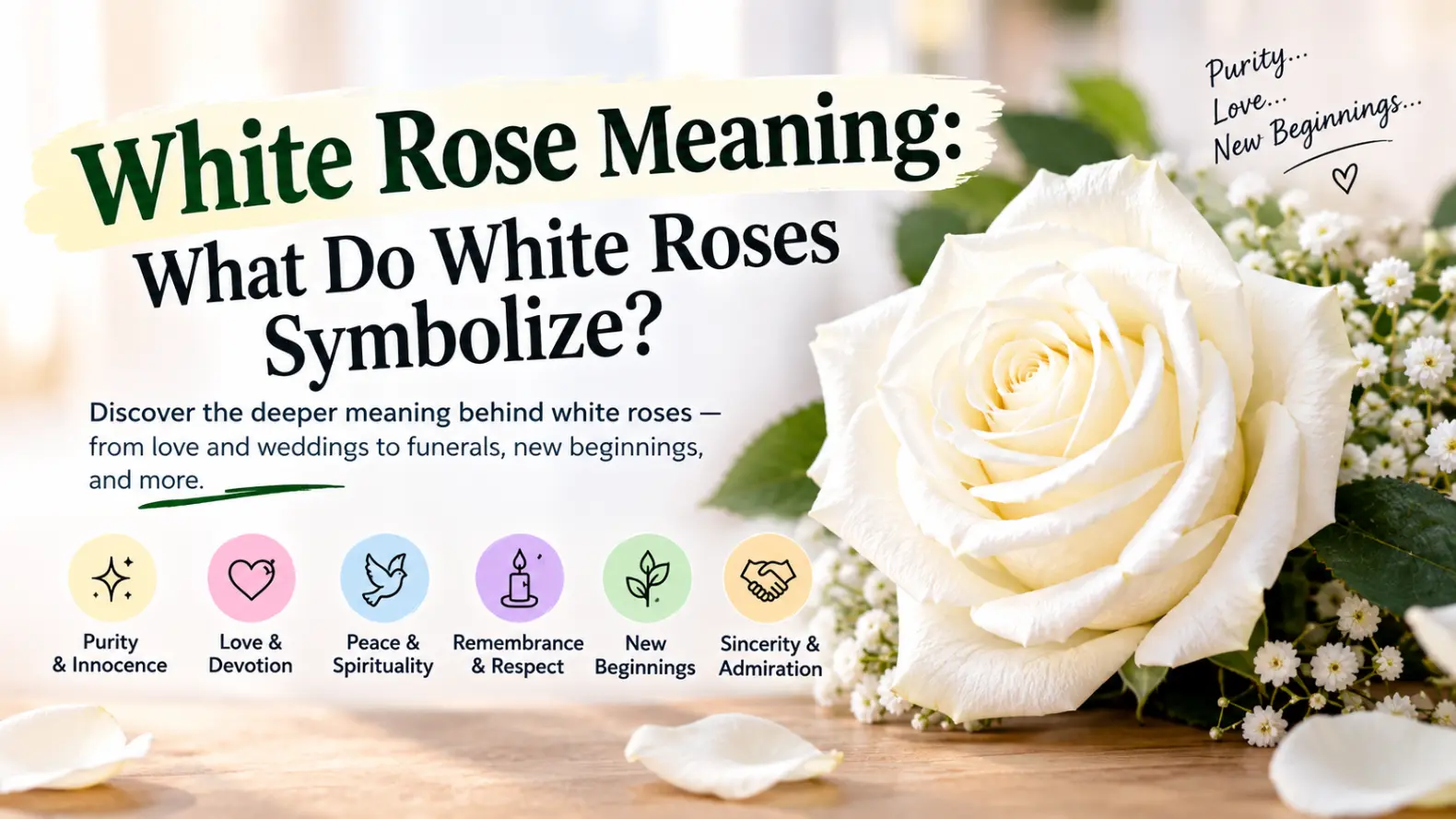
Quick Answer: White roses symbolize purity, innocence, remembrance, and new beginnings. They’re the flower of weddings (sincerity, unity), funerals (reverence, farewell), and sincere sympathy — a quieter, more spiritual kind of love than the passion of red roses — devotion over desire.
| Quick Fact | Detail |
|---|---|
| Term | White rose |
| Core symbolism | Purity, innocence, remembrance, new beginnings |
| Tone | Sincere, reverent, peaceful |
| Key occasions | Weddings, funerals, sympathy, anniversaries |
White roses symbolize purity, innocence, remembrance, and new beginnings. They are common at weddings and memorials alike.
– Part of speech: Symbol
– Meaning: Purity, remembrance, new beginnings
– Origin: Victorian flower language
– Usage: Weddings, funerals, sympathy
– Example: “She carried white roses down the aisle.”
What Do White Roses Symbolize?
The white rose speaks in a softer register than its red sibling. Where red roses declare passion, white roses communicate something purer and more layered:
- Purity and innocence — the oldest and most universal meaning. White has signified moral cleanliness across cultures for millennia, and the rose carries it naturally.
- Remembrance and reverence — honoring someone who has passed, or a memory held sacred.
- New beginnings — fresh starts, clean slates, hopeful futures.
- Sincerity and devotion — love without agenda; loyalty without drama.
- Peace and spirituality — calm, grace, and the sacred.
- Respect and admiration — honoring someone’s character rather than desiring them.
Together, these form a coherent personality: the white rose is the flower of love at its most sincere — whether that’s marital devotion, grief, friendship, or faith. It never shouts; it testifies.
Where Did White Rose Symbolism Come From?
The symbolism is ancient and layered:
- Greek and Roman myth: white roses were linked to Aphrodite/Venus and to innocence — legend held that roses were white until stained red by the goddess’s blood, giving the white rose a “before passion” purity.
- The House of York (1400s): the white rose was the emblem of the House of York in England’s Wars of the Roses — a political symbol of loyalty and lineage that embedded the flower in English identity.
- Christian tradition: the white rose became associated with the Virgin Mary (the “Mystical Rose”), representing purity and heavenly grace.
- Victorian floriography (1800s): the “language of flowers” assigned the white rose meanings of innocence, secrecy (“sub rosa” — under the rose), and worthiness. Victorians literally conversed in bouquets. (The Old Farmer’s Almanac keeps a handy guide to this flower language.)
Each era added a layer without erasing the last — which is why the white rose feels so richly meaningful today. Few symbols carry 2,000 years of consistent association.
What Do White Roses Mean at Weddings?
Unity, sincerity, and new beginnings — the white rose is arguably the wedding flower. Bridal bouquets, ceremony arches, and table centerpieces lean white because the symbolism aligns perfectly with marriage: two people beginning something pure together.
Specifically at weddings, white roses signal:
- Purity of intention — love offered sincerely.
- Unity — two lives joined into one clean start.
- Loyalty — devotion meant to last.
- Hope — optimism about the shared future.
They also photograph beautifully and complement any palette, which doesn’t hurt. But couples choose them primarily for meaning: a white rose bouquet says “my love is sincere” more eloquently than any vow. For more on what makes love’s expressions meaningful, see the meaning of “precious” — the word so many vows reach for.
What Do White Roses Mean at Funerals?
Reverence, remembrance, and peaceful farewell. White roses are among the most common funeral flowers because they say what grief often can’t: this person was cherished, and we honor them.
At memorials, they carry specific weight:
- Remembrance — keeping the person’s memory pure and alive.
- Reverence — deep respect for a life lived.
- Peace — wishing the departed rest, and the living comfort.
- Sympathy — quiet solidarity with the grieving, without presumption.
A single white rose laid on a casket is one of humanity’s most eloquent gestures — no words needed. Unlike red roses (which can feel romantic at a funeral), white roses are universally appropriate for expressing sympathy to anyone: family, friends, colleagues.
White Rose vs. Red Rose: What’s the Difference?
| Aspect | White Rose | Red Rose |
|---|---|---|
| Core meaning | Purity, remembrance, new beginnings | Romantic passion, desire |
| Love type | Sincere, spiritual, devoted | Romantic, intense, physical |
| Best occasions | Weddings, funerals, sympathy, christenings | Valentine’s Day, anniversaries, proposals |
| Emotional register | Quiet, reverent | Bold, declarative |
The short version: red says “I desire you”; white says “I honor you.” Both are love — but different loves. A red rose proposes; a white rose promises. Interestingly, red and white roses together traditionally symbolize unity and togetherness — the blending of passion and purity — which is why the combination appears at weddings and in unity ceremonies.
Neither is “better” — they’re different instruments. Choosing between them is really asking: what kind of love am I expressing? For admiration of someone’s character — a mentor, a virtuous friend — white is the natural choice.
How Do You Use White Roses?
Practical guidance for giving them well:
- Sympathy: a simple bouquet or single stem is always appropriate. No card essay needed — “with sympathy” suffices.
- Weddings: bridal bouquets, boutonnieres, and ceremony décor. Mix with greenery or blush tones for warmth.
- New beginnings: housewarmings, graduations, new babies — anywhere “fresh start” fits.
- Apologies: white roses can signal sincere regret — purity of intention after a mistake.
- Number symbolism: a single white rose = remembrance or focused devotion; a dozen = classic sincere love; white rose wreaths = memorial tribute.
One cultural note: in some East Asian traditions, white is the color of mourning rather than weddings — so for multicultural events, a quick check with the family avoids unintended signals. Symbolism is powerful precisely because it’s shared; make sure you’re sharing the same dictionary.
Frequently Asked Questions
What does a single white rose mean?
Focused, sincere devotion — or remembrance. A single white rose is a minimalist statement: one pure sentiment, whether that’s sympathy, sincere love, or honoring someone’s memory.
Are white roses only for funerals?
Not at all — they’re equally the flower of weddings, new beginnings, and sincere love. The funeral association is strong but it’s only one chapter of a much larger symbolic story.
What do white roses mean in a relationship?
Sincere, committed, respectful love — devotion without games. Giving white roses early in dating suggests serious intentions; in long relationships, they reaffirm loyalty and deep respect.
Do white roses mean sympathy?
Yes — they’re one of the most traditional sympathy flowers, expressing reverence, remembrance, and peaceful farewell. They’re appropriate for grieving families, friends, and colleagues alike.
What’s the spiritual meaning of white roses?
Purity, grace, and divine love — in Christian tradition they’re linked to the Virgin Mary, and more broadly they symbolize spiritual clarity and peace across many faiths.
Key Takeaways
- White roses symbolize purity, innocence, remembrance, and new beginnings.
- At weddings they mean unity and sincere love; at funerals, reverence and farewell.
- Their symbolism spans Greek myth, the House of York, Christian tradition, and Victorian floriography.
- White = “I honor you”; red = “I desire you.” Together, they mean unity.
- Always appropriate for sympathy; check cultural context for weddings in some East Asian traditions.
Read More Articles
🔮Brick and Mortar Meaning: Definition, Examples & Business Guide
🔮Intricate Meaning: Definition, Intricate vs Complex & Beautiful Examples

Hi, I’m Claire Morgan, a Senior Language Content Specialist at Hublioo.com. I have 5+ years of experience creating clear and easy-to-understand content about word meanings, slang, acronyms, phrases, and modern English usage. My goal is to simplify complex language and help readers understand words with confidence through accurate, well-researched, and reader-friendly explanations.