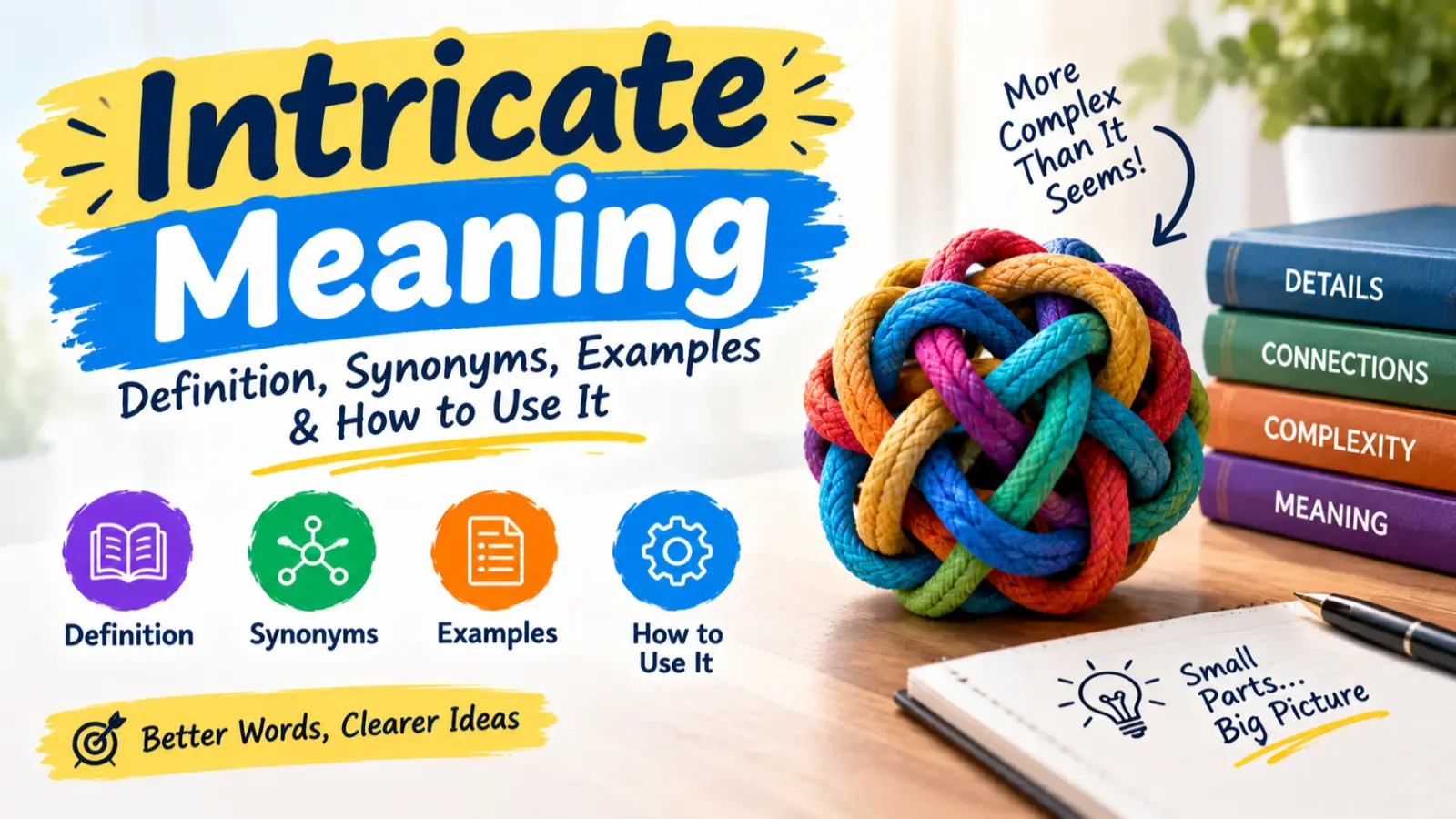
Short answer: Intricate means having many small, interwoven parts that are hard to follow separately — like intricate lace, an intricate plot, or intricate machinery. It suggests detailed craftsmanship rather than just confusion. The quintessential intricate design? A hand-knotted Persian rug.
Here is Intricate at a glance:
| Detail | Info |
|---|---|
| Term | Intricate |
| Part of speech | Adjective |
| Core meaning | Having many complexly interwoven parts; detailed and hard to follow |
| Tone | Neutral / admiring |
| You’ll see it in | Art, design, reviews, science, everyday descriptions |
Intricate vs. Complex: What’s the Difference?
Intricate vs. complex vs. complicated: the classic trio. Complex means made up of many parts — a neutral fact (“a complex recipe”). Complicated means hard to understand or deal with — often a complaint (“complicated legal procedures”). Intricate means the parts are so finely interlaced they are hard to follow separately — and it usually admires the craftsmanship (“an intricate web of deceit”). A thing can be all three at once, but choose intricate when you want to honor the detail, complicated when you want to flag the difficulty.
How Do You Use Intricate in a Sentence?
Six examples:
- “The box was carved with intricate floral patterns.”
- “The novel’s intricate plot kept me guessing.”
- “Watchmakers assemble intricate gears smaller than rice grains.”
- “The spider wove an intricate web between the branches.”
- “Their intricate dance routine took months to perfect.”
- “The treaty negotiations were intricate and delicate.”
Key Takeaways
- 🌟 Intricate = many finely interwoven parts, hard to trace separately.
- Usually admiring — it praises detail and craftsmanship.
- From Latin intricare, “to entangle” — what’s intricate must be unraveled.
- Complex = many parts; complicated = hard to grasp; intricate = finely interlaced.
- Perfect compliment for art, design, and craftsmanship.
- Adverb form: intricately (“an intricately carved door”).
FAQs About Intricate
What does intricate mean in simple terms?
Having many small, interconnected parts that are finely woven together — like lace, a detailed carving, or a twisty plot. It suggests impressive detail.
What is the difference between intricate and complex?
Complex = made of many parts (neutral). Intricate = parts so finely interlaced they’re hard to follow separately (often admiring). All intricate things are complex, but not vice versa.
Is intricate a positive word?
Usually, yes. It praises craftsmanship and detail. It can be neutral when describing puzzles or problems.
What is an example of something intricate?
Lace, watch gears, spider webs, henna designs, cathedral carvings, and twisty mystery plots are classic examples.
What is the opposite of intricate?
Simple, plain, or straightforward. “A simple design” is the opposite of “an intricate design.” Related: ethereal meaning.
What does “intricate detail” mean?
Very fine, elaborate small-scale detail — the kind you notice on close inspection. “The watch face has intricate detailing” praises the craftsmanship visible under a magnifying glass.
What Does Intricate Mean? The Full Definition
Intricate is an adjective meaning having many complexly interrelated parts — so finely woven or detailed that the parts are hard to trace individually. “Intricate lacework,” “an intricate web of lies,” “intricate machinery.” It can also mean difficult to resolve or analyze, as in “an intricate legal puzzle.”
Unlike “complicated” (which often complains), intricate usually admires: it praises the skill in the weaving. An intricate design is a marvel; a complicated tax form is a headache. For another richly textured word, see our ethereal meaning guide.
Nature is the master of the intricate: snowflakes, leaf veins, nautilus shells, and neural networks all display intricacy no engineer could improve on. That is why the word feels at home in both science writing and art criticism — it honors complexity wherever it appears, whether grown, built, or imagined.
For the full dictionary entry, see Merriam-Webster’s definition of intricate.
What Are the Synonyms and Antonyms of Intricate?
- Synonyms: complex, complicated, elaborate, detailed, involved, knotty
- Antonyms: simple, plain, straightforward, uncomplicated, basic
Nuance: complex = made of many parts (neutral); complicated = hard to understand (often negative); intricate = finely interwoven (often admiring). Elaborate stresses ornate detail. For more precise vocabulary, explore onomatopoeia meaning.
Is Intricate Rude? Tone & Register Check
Is intricate rude? No — it is neutral to admiring. Calling a design intricate is praise; calling a problem intricate is respectful acknowledgment of its difficulty. It never insults. Register check: neutral, slightly elevated. Works in casual chat, reviews, and formal writing alike.
Where Did the Word Intricate Come From?
Intricate comes from the Latin intricatus, past participle of intricare — “to entangle, perplex” — from in- (“in”) + tricae (“trifles, entanglements, perplexities”). It entered English in the 1400s. The image is literally of threads tangled together: what is intricate must be unraveled, while what is merely complicated must be sorted out. Its cousins intrigue and extricate share the same tangled root.
How Can You Use Intricate in Everyday Conversation?
“Intricate” is a wonderful everyday compliment for anything detailed: tattoos, recipes, embroidery, architecture, storylines. “That’s so intricate!” tells a maker you noticed their effort.
It also works for abstract complexity — “an intricate plan,” “intricate politics” — where it sounds thoughtful rather than whiny. Because it admires rather than complains, it keeps conversations positive even when describing difficult things.
Common Mistakes People Make With Intricate
- Using intricate as pure criticism. It usually admires — for complaints about difficulty, “complicated” fits better.
- Spelling it “intricit” or “intrikate.” It’s i-n-t-r-i-c-a-t-e.
- Calling simple things intricate. The word promises many interwoven parts — don’t spend it on the plain.
Read More Articles
🔮Brick and Mortar Meaning: Definition, Examples & Business Guide
🔮Benevolent Meaning: Definition, Examples, Synonyms & Usage
🔮Condescending Meaning: Definition, Examples & Signs to Spot

Hi, I’m Mia Walker, a Content Research Writer at Hublioo.com with 3+ years of experience in creating educational language content.
I enjoy breaking down complex words, internet slang, abbreviations, and everyday expressions into clear, practical explanations that anyone can understand.
My focus is on delivering original, easy-to-read, and well-organized content that helps readers expand their vocabulary and use English with greater confidence.