
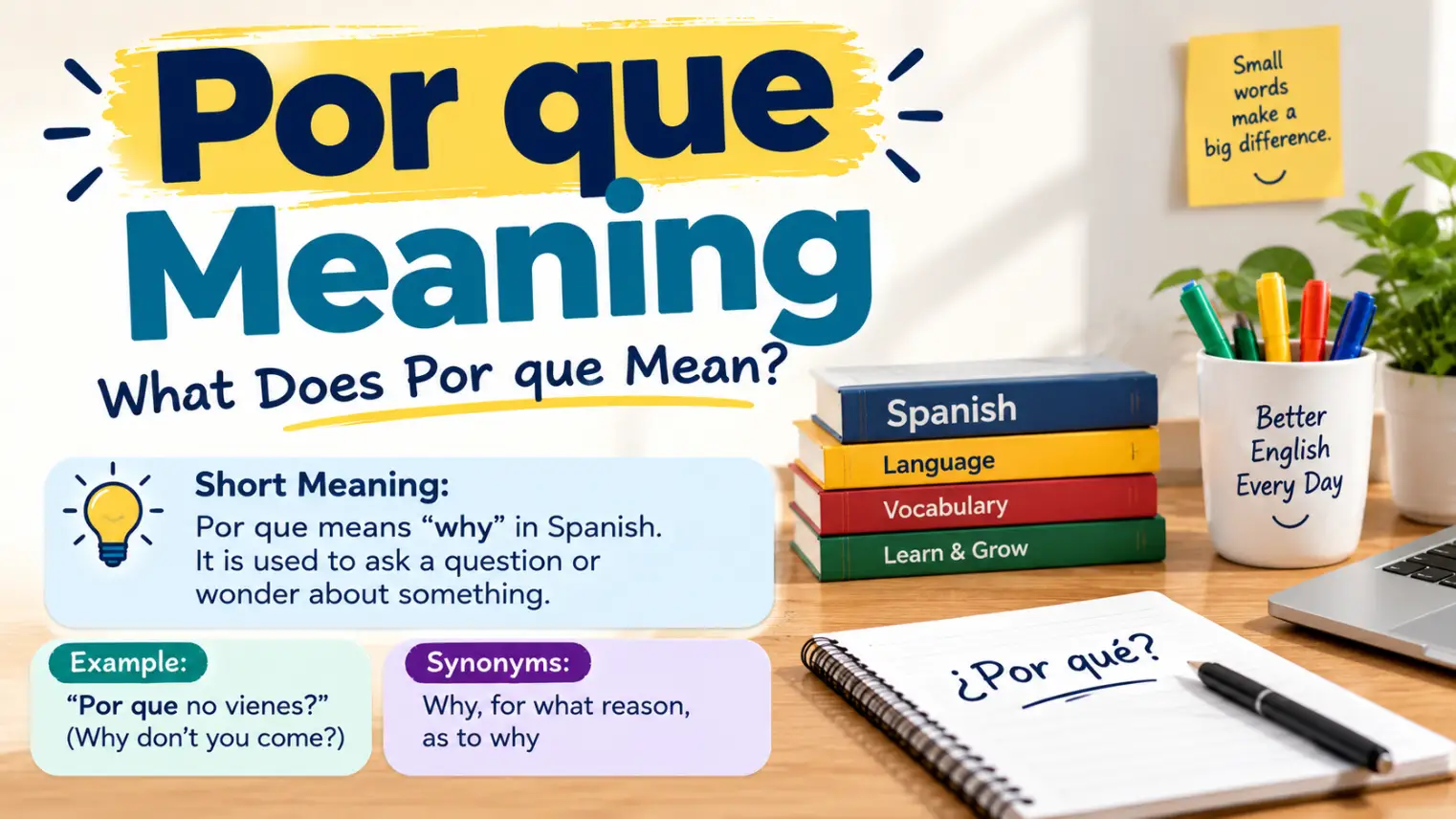
If you are learning Spanish, you may wonder what “por que” means and why it looks so similar to “por qué,” “porque,” and “porqué.”
Although these four forms look almost identical, they have different grammatical functions and meanings.
Por que is written as two separate words without an accent.
Depending on the sentence, it can form expressions that may be translated as “for which,” “because of which,” “for whom,” or can appear in constructions such as “for everyone to…” However, it is less common in everyday Spanish than por qué and porque.
In this guide, you will learn the exact meaning of por que, when it is used, how it differs from the other three forms, and how to recognize each one in real Spanish sentences.
Quick Answer: What Does Por Que Mean?
Por que is a Spanish two-word construction made up of por and que. It does not have one single English translation because its meaning depends on how it functions in the sentence.
Depending on the context, por que can express ideas such as:
- for which
- because of which
- for whom
- for that
- for someone or something to…
For example:
Luchamos por que todos tengan las mismas oportunidades.
This means:
“We fight for everyone to have the same opportunities.”
It is important to remember that por que is not normally the Spanish word for “why.” When asking “why,” Spanish normally uses por qué with an accent.
Por Que Meaning and Basic Definition
To understand por que, it helps to look at its two parts.
Por can have several meanings in Spanish, including “for,” “by,” “through,” and “because of,” depending on the context.
Que can mean “that,” “which,” or “who,” depending on its grammatical role.
When por and que appear together as two separate words, they can form a grammatical construction rather than a single word with one fixed translation.
For example:
Luchamos por que todos participen.
A natural English translation is:
“We fight for everyone to participate.”
The important point is that you should not automatically translate por que as “why.” Its meaning must be understood from the complete sentence.
Por Que vs. Por Qué, Porque, and Porqué
Spanish has four commonly confused forms:
- por que — two words, no accent
- por qué — two words, with an accent
- porque — one word, no accent
- porqué — one word, with an accent
Their functions are different.
| Spanish Form | Main Meaning | Example |
|---|---|---|
| por que | grammatical combination of por + que | Luchamos por que todos participen. |
| por qué | why / for what reason | ¿Por qué estás aquí? |
| porque | because | Estoy aquí porque trabajo. |
| porqué | the reason / the cause | No entiendo el porqué. |
A simple way to remember them is:
Por qué = why
Porque = because
Porqué = the reason
Por que = por + que in specific grammatical constructions
When Is “Por Que” Used in Spanish?
Por que is used when por and que have separate grammatical roles in a sentence.
One common pattern appears after a verb or expression that uses the preposition por, followed by que introducing another clause.
For example:
Luchamos por que todos tengan una oportunidad.
This means:
“We fight for everyone to have an opportunity.”
Here, por belongs to the expression luchar por, while que introduces the following clause.
Another example is:
Trabajamos por que el proyecto tenga éxito.
This can be translated as:
“We work for the project to succeed.”
The exact English translation may change depending on the context, so it is better to understand por que as a grammatical combination rather than memorize one fixed translation.
Por Que in Relative Clauses
Another important point is that por can appear before a relative pronoun.
For example:
La razón por la que vine es importante.
This means:
“The reason why I came is important.”
You may sometimes encounter older, formal, or less common constructions involving por que, but modern Spanish frequently uses forms such as:
- por la que
- por el que
- por las que
- por los que
These forms make the relationship between the noun and the relative clause clearer.
For Spanish learners, por la que and similar forms are generally more useful to recognize in everyday reading and writing.
Por Que vs. Por Qué: What Is the Difference?
The biggest difference is the accent mark and grammatical function.
Por qué = “why”
It is normally used in questions when asking for a reason.
¿Por qué estudias español?
“Why do you study Spanish?”
It can also appear in an indirect question:
No sé por qué estudias español.
“I don’t know why you study Spanish.”
Por que = two-word grammatical construction
Por que does not normally mean “why” in a direct question.
For example:
Luchamos por que todos tengan los mismos derechos.
This means:
“We fight for everyone to have the same rights.”
So, if you are asking “why?”, remember to use the accented form:
¿Por qué…?
Porque vs. Porqué
Another common source of confusion is porque and porqué.
Porque = “because”
Porque is written as one word and is normally used to give a reason or explanation.
Estoy cansado porque trabajé todo el día.
“I am tired because I worked all day.”
It answers or explains a question such as ¿Por qué…?
Porqué = “the reason” or “the cause”
Porqué is written as one word with an accent and functions as a noun.
It is commonly used with an article or another determiner.
No entiendo el porqué de su decisión.
“I don’t understand the reason for their decision.”
Because porqué is a noun, you may see forms such as:
- el porqué
- un porqué
- los porqués
Why Does the Accent Mark Matter?
Spanish accent marks can distinguish words that otherwise look very similar.
Compare:
¿Por qué estás aquí?
“Why are you here?”
Estoy aquí porque trabajo.
“I am here because I work.”
No entiendo el porqué.
“I don’t understand the reason.”
These three sentences use different forms because they perform different grammatical jobs.
The fourth form, por que, is used in specific constructions:
Trabajamos por que todos participen.
Learning the four forms together is one of the easiest ways to avoid confusing them.
Real-Life Examples of Por Que
Here are several examples showing how por que can appear in Spanish.
Luchamos por que todos tengan los mismos derechos.
“We fight for everyone to have the same rights.”
Trabajamos por que el proyecto tenga éxito.
“We work for the project to succeed.”
La situación por que pasó fue difícil.
This type of construction may be encountered in formal or older Spanish, although modern Spanish often uses a clearer relative structure such as “la situación por la que pasó.”
The key lesson is that por que should be understood from its grammatical context rather than translated word-for-word every time.
Common Mistakes With Por Que
One of the most common mistakes is using por que when you actually mean por qué.
Incorrect for a direct “why” question:
¿Por que estás aquí?
Correct:
¿Por qué estás aquí?
The accent on qué is important.
Another common mistake is using porque when asking a direct question.
Instead of:
¿Porque estás aquí?
Use:
¿Por qué estás aquí?
And when answering:
Estoy aquí porque necesito ayuda.
There is also a difference between porqué and porque.
Porque means “because.”
Porqué means “the reason” or “the cause.”
For example:
No entiendo el porqué de su decisión.
This means:
“I don’t understand the reason for their decision.”
A Simple Way to Remember the Four Forms
You can remember the four forms by thinking about the job each one does.
1. Por qué → asking why
¿Por qué llegaste tarde?
“Why did you arrive late?”
2. Porque → giving a reason
Porque perdí el autobús.
“Because I missed the bus.”
3. Porqué → naming the reason
No entiendo el porqué.
“I don’t understand the reason.”
4. Por que → separate grammatical elements
Luchamos por que todos participen.
“We fight for everyone to participate.”
This four-part rule makes the difference much easier to remember.
Is “Por Que” Common in Modern Spanish?
Por que is a correct construction in certain grammatical contexts, but it is generally less common for beginners than por qué and porque.
If you are learning conversational Spanish, you will encounter por qué frequently when someone asks a question and porque when someone gives an explanation.
You may encounter por que more often when reading formal Spanish or studying specific grammatical constructions.
When expressing “the reason why”, modern Spanish commonly uses structures such as:
- la razón por la que
- la razón por la cual
- el motivo por el que
- la causa por la que
These structures are especially useful for learners because they are clear and common.
Por Que Meaning in Simple Terms
If you only need the basic idea, remember this:
Por que is two separate words without an accent and is used in specific grammatical constructions. It does not normally mean “why” by itself.
For “why,” use:
por qué
For “because,” use:
porque
For “the reason” or “the cause,” use:
porqué
Once you understand these four forms, Spanish questions and explanations become much easier to read and write.
FAQs:
What does “por que” mean in English?
Por que does not have one fixed English translation. Depending on the sentence, it can express ideas such as “for which,” “because of which,” or “for someone or something to.”
Does “por que” mean “why” in Spanish?
Usually, no. Por qué with an accent is the normal form used to ask “why?” in Spanish.
What is the difference between “por que” and “por qué”?
Por que is two words without an accent and appears in specific grammatical constructions. Por qué is two words with an accent and normally means “why” in questions and indirect questions.
What does “porque” mean?
Porque is one word and normally means “because.” It is used to provide a reason or explanation.
What does “porqué” mean?
Porqué is a noun meaning “the reason” or “the cause.” It is often used with an article, such as el porqué.
Is “por que” common in everyday Spanish?
It is less common for beginners than por qué and porque. You may encounter it in specific grammatical constructions, formal writing, and some relative structures.
Which form should a Spanish beginner learn first?
Start with por qué for “why” and porque for “because.” Then learn porqué and por que as you become more familiar with Spanish grammar.
Conclusion
Understanding por que meaning becomes much easier when you compare it with por qué, porque, and porqué.
Although the four forms look almost identical, each one has a different grammatical function.
Remember the simple rule: por qué means “why,” porque means “because,” and porqué means “the reason” or “the cause.” Por que is written as two separate words without an accent and appears in specific grammatical constructions where por and que have separate roles.
If you are learning Spanish, do not worry about memorizing every possible use immediately.
Start by recognizing the four forms in real sentences and paying attention to the space and accent mark. With practice, the difference between por que, por qué, porque, and porqué will become much easier to understand.

Hi, I’m Mia Walker, a Content Research Writer at Hublioo.com with 3+ years of experience in creating educational language content.
I enjoy breaking down complex words, internet slang, abbreviations, and everyday expressions into clear, practical explanations that anyone can understand.
My focus is on delivering original, easy-to-read, and well-organized content that helps readers expand their vocabulary and use English with greater confidence.