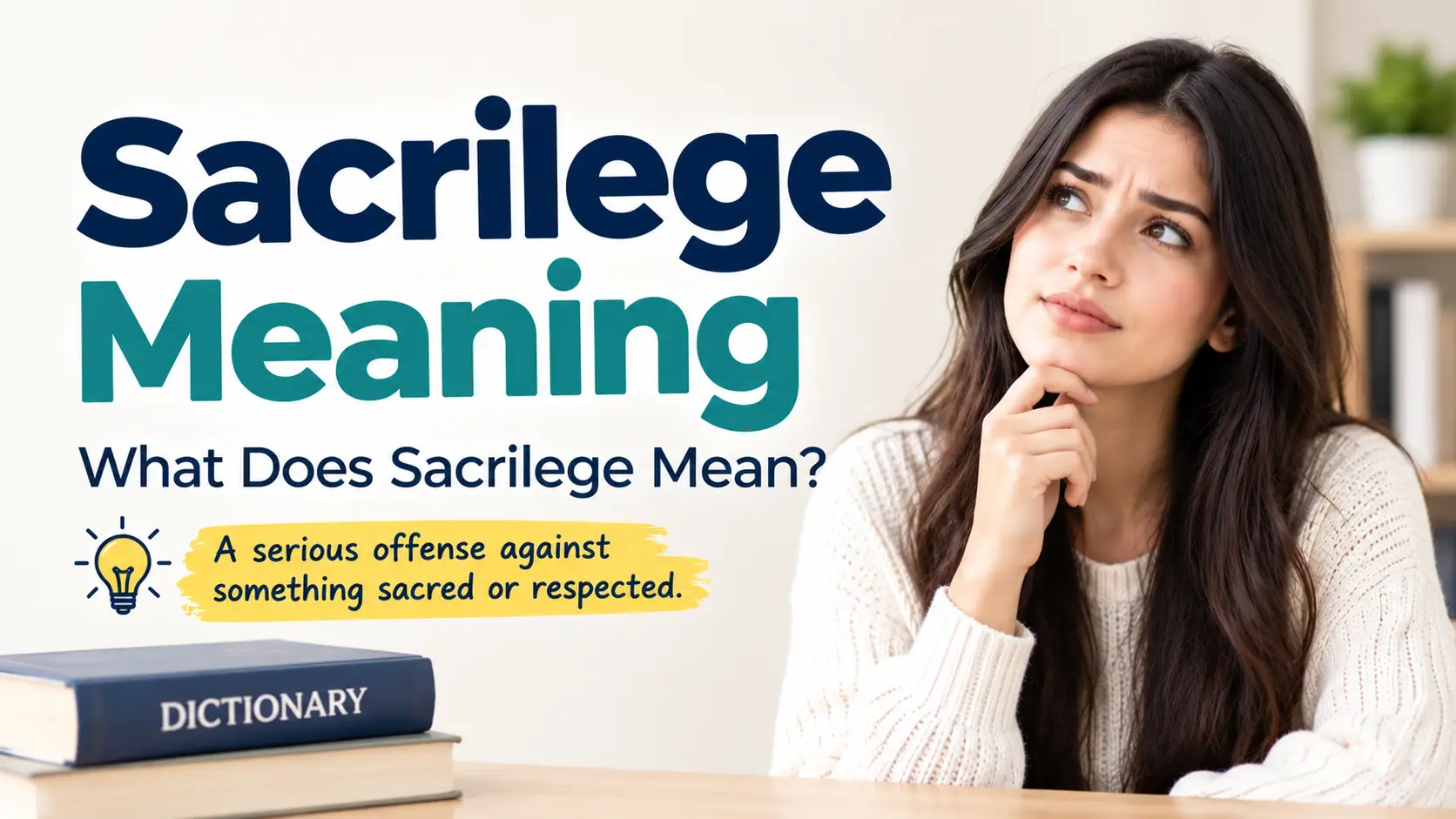
The sacrilege meaning is treating something sacred, holy, or deeply respected with serious disrespect.
It can refer to a religious object, place, ceremony, symbol, or practice.
In everyday English, sacrilege can also be used figuratively for something that violates a tradition or belief people strongly value.
For example, damaging a sacred religious object could be described as sacrilege. In a more casual context, someone might jokingly say, “Changing that traditional recipe is sacrilege.”
The word is a noun and is strongly associated with religion, although its figurative use is common in modern English.
This guide explains what sacrilege means, how to use it, its pronunciation and origin, and how it differs from related words such as blasphemy, profanity, desecration, and sacrilegious.
Quick Answer: Sacrilege Meaning
Sacrilege means showing serious disrespect toward something considered sacred, holy, or deeply respected.
It can involve damaging, stealing, misusing, violating, or otherwise treating a sacred thing in an inappropriate way.
For example:
“Damaging the sacred object was considered sacrilege.”
The word can also be used figuratively for something people strongly value:
“Changing the original recipe would be sacrilege.”
In the second example, the word is usually humorous or exaggerated rather than religious.
What Does Sacrilege Mean?
Sacrilege refers to an action that seriously disrespects or violates something considered sacred.
In a religious context, the sacred thing could be a place of worship, religious object, ceremony, symbol, or practice. The exact actions considered sacrilegious can differ between religions and traditions because beliefs about what is sacred are not the same everywhere.
The word can also have a broader, nonreligious meaning. People sometimes use sacrilege to describe an action that goes against something they consider extremely important or worthy of respect.
For example:
“Fans considered changing the classic ending an act of sacrilege.”
The ending is not literally sacred. Instead, the speaker is using the word to emphasize how strongly fans value the original.
Sacrilege in Simple Terms
In simple English, sacrilege means treating something sacred or deeply respected as though it does not deserve respect.
You can think of it this way:
Something is sacred → it deserves special respect → someone seriously violates or disrespects it → the action may be called sacrilege.
A religious example could involve damaging a sacred object or misusing a place of worship.
A cultural example could involve destroying a historic site that a community considers deeply important.
A humorous example could involve changing a beloved traditional recipe.
The seriousness of sacrilege depends on the context. In religious writing, it can describe a deeply offensive act. In casual conversation, it may simply be dramatic or playful language.
How to Use Sacrilege in a Sentence
Sacrilege is a noun. It commonly appears with phrases such as “an act of sacrilege,” “considered sacrilege,” and “would be sacrilege.”
Examples:
- “Stealing items from the sacred building was considered sacrilege.”
- “They believed damaging the religious statue would be sacrilege.”
- “She called the destruction of the monument an act of sacrilege.”
- “It would be sacrilege to destroy such an important historical site.”
- “Some fans consider changing the original song sacrilege.”
- “The misuse of the sacred object was considered sacrilege.”
One useful sentence pattern is:
It would be sacrilege to + verb
For example:
“It would be sacrilege to throw away that family recipe.”
This structure can be completely serious or used humorously, depending on what is being discussed.
Sacrilege as a Religious Term
In religious contexts, sacrilege generally refers to violating, misusing, damaging, or showing serious disrespect toward something regarded as sacred.
This could include a:
- Sacred object
- Place of worship
- Religious symbol
- Ceremony
- Ritual
- Religious practice
- Sacred site
However, what qualifies as sacrilege depends on the particular religious or cultural tradition. An object or practice may be considered sacred by one community but not by another.
For this reason, the word should be understood within its religious context rather than treated as having exactly the same meaning across every belief system.
Sacrilege vs. Blasphemy
Sacrilege and blasphemy are closely related, but they are not identical.
| Word | Basic Meaning | Common Focus |
|---|---|---|
| Sacrilege | Serious disrespect or violation of something sacred | Sacred objects, places, practices, or ceremonies |
| Blasphemy | Disrespectful or offensive expression concerning God, a deity, or religion | Speech, writing, or expressions |
| Desecration | Treating something sacred in a way that violates its sacred character | Sacred places or objects |
| Profanity | Irreverence toward something sacred or offensive language | Language and behavior |
For example:
“Damaging a sacred religious object was considered sacrilege.”
By contrast:
“The offensive statement about the deity was described as blasphemy.”
The two concepts can overlap, but sacrilege usually focuses on the treatment or violation of something sacred, while blasphemy more often focuses on words or expressions considered offensive toward religion or a deity.
Sacrilege vs. Desecration and Profanity
Desecration is another word closely connected with sacrilege. It refers to treating something sacred in a way that violates or removes its sacred character.
For example:
“The desecration of the temple shocked the community.”
Profanity can also involve disrespect toward something sacred, but the word has a broader everyday meaning. It is commonly associated with offensive or vulgar language.
Although these words overlap, they emphasize different ideas:
- Sacrilege focuses on a serious violation or disrespectful act involving something sacred.
- Desecration emphasizes treating something sacred as unholy or violating its sacred character.
- Profanity can refer to irreverence toward sacred things or, more commonly, offensive language.
Understanding these differences helps you choose the word that best fits the situation.
Sacrilege Synonyms and Related Words
There is no single perfect synonym for sacrilege, but several words have related meanings.
Desecration
The act of treating something sacred in a way that violates its sacred character.
Profanation
The act of treating something sacred or holy without proper respect.
Irreverence
A lack of respect for something considered worthy of honor.
Blasphemy
Speech or expression showing serious disrespect toward God, a deity, or religious beliefs.
Violation
A broader word meaning an act that breaks a rule, principle, or boundary.
The best word depends on the context. Sacrilege is especially useful when the focus is on serious disrespect toward something sacred.
Is Sacrilege Always Religious?
No. Sacrilege is strongly connected with religion, but it can also be used figuratively in nonreligious situations.
This figurative use suggests that something is so important or highly valued that changing, damaging, or disrespecting it feels almost like violating something sacred.
For example:
“Putting ketchup on that traditional dish is sacrilege.”
The speaker is not making a religious statement. They are exaggerating to show how strongly they dislike the idea.
Other examples include:
“Changing the classic movie ending would be sacrilege to longtime fans.”
“Replacing the historic building with a modern structure felt like sacrilege.”
“Changing that family recipe is culinary sacrilege.”
This figurative use is common when people talk about food, music, movies, books, sports, fashion, traditions, and history.
Sacrilege as a Figurative Expression
The figurative use of sacrilege allows speakers to express strong disapproval in a dramatic or humorous way.
For example:
“You put ketchup on a steak? Sacrilege!”
The speaker does not literally mean that the action is a religious offense. Instead, the word creates a strong emotional effect.
You may hear similar expressions such as:
- “Changing the original recipe is sacrilege.”
- “Skipping the final book in the series is sacrilege.”
- “Replacing the classic logo would be sacrilege.”
- “Calling that famous movie boring is sacrilege to its fans.”
- “Changing the traditional design would be cultural sacrilege.”
In these examples, sacrilege means something closer to “a serious violation of what we value” rather than an actual religious offense.
Origin and History of Sacrilege
The word sacrilege has a long history and ultimately comes from Latin.
It entered English through Old French and can be traced to the Latin word sacrilegium, which was associated with the stealing or violation of sacred things. It was related to sacrilegus, referring to someone who stole sacred objects.
The meaning gradually broadened. Instead of referring only to the taking of sacred things, sacrilege came to describe improper or irreverent treatment of things considered sacred.
Over time, English speakers also began using the word figuratively. This explains why modern speakers can describe a change to a beloved tradition, work of art, recipe, or cultural object as “sacrilege,” even though it is not literally religious.
The word therefore has both a religious sense and a broader figurative sense in modern English.
How to Pronounce Sacrilege
In American English, sacrilege is commonly pronounced:
SAK-ruh-lij
The Cambridge pronunciation is:
/ˈsæk.rə.lɪdʒ/
The final part sounds similar to “lidge.”
The related adjective sacrilegious is pronounced approximately:
sak-ruh-LEE-jus
Example:
“The artwork was considered sacrilegious.”
Sacrilege and Sacrilegious: What Is the Difference?
The main difference is grammatical.
Sacrilege is a noun. It names the act or idea of disrespecting something sacred.
“The act was considered sacrilege.”
Sacrilegious is an adjective. It describes something that shows, involves, or is related to sacrilege.
“The act was considered sacrilegious.”
A simple way to remember the difference is:
Sacrilege = the act or idea
Sacrilegious = describes the act, behavior, words, or thing
For example:
“They considered the behavior sacrilege.”
“They considered the behavior sacrilegious.”
Both sentences communicate a similar idea, but they use different grammatical forms.
Common Mistakes With Sacrilege
One common mistake is thinking that sacrilege simply means something bad or wrong. The word is more specific. It involves disrespect, violation, or inappropriate treatment of something considered sacred or deeply respected.
Another mistake is assuming that sacrilege and blasphemy are exact synonyms. They can overlap, but sacrilege generally focuses on the violation or disrespect of something sacred, while blasphemy more commonly concerns offensive expressions about God, a deity, or religious beliefs.
It is also important to pay attention to tone.
In a religious context, sacrilege can be a very serious word. In casual conversations about food, music, movies, or traditions, it can simply be humorous exaggeration.
For example:
“Adding sugar to that family recipe is sacrilege!”
Here, the speaker most likely means that they strongly dislike the change.
Examples of Sacrilege
Here are examples showing both serious and figurative uses:
Religious Examples
“Damaging the sacred statue was considered sacrilege.”
“The community regarded the misuse of the religious object as an act of sacrilege.”
“Entering the sacred area without permission was viewed as sacrilege.”
Historical and Cultural Examples
“Destroying the historic monument was described as sacrilege.”
“The community saw the removal of the ancient site as cultural sacrilege.”
Figurative Examples
“Changing the original family recipe would be sacrilege.”
“To longtime fans, replacing the classic logo was sacrilege.”
“Calling that legendary movie overrated is sacrilege to some fans.”
These examples show why context matters. The same word can describe a serious religious violation or a playful way of expressing strong disapproval.
FAQs:
What is the simple meaning of sacrilege?
Sacrilege means treating something sacred, holy, or deeply respected with serious disrespect. It is most commonly associated with religious objects, places, practices, or ceremonies.
Is sacrilege a bad word?
No, sacrilege is not a swear word. It is a serious vocabulary term used to describe disrespect toward something considered sacred. In casual conversation, it can also be used humorously or as an exaggeration.
What is an example of sacrilege?
Damaging or seriously misusing an object that a religious community considers sacred could be described as sacrilege. The exact acts considered sacrilegious depend on the beliefs and traditions involved.
What is the difference between sacrilege and blasphemy?
Sacrilege usually refers to violating or showing serious disrespect toward something sacred. Blasphemy more often refers to offensive or disrespectful speech, writing, or expressions about God, a deity, or religious beliefs.
Can sacrilege be used for nonreligious things?
Yes. Sacrilege can be used figuratively for something people value deeply. For example, a fan might jokingly call changing a classic movie or traditional recipe “sacrilege.”
What is a synonym for sacrilege?
Related words include desecration, profanation, irreverence, and violation. However, these words are not always exact synonyms and may emphasize different aspects of disrespect.
What is the adjective form of sacrilege?
The adjective form is sacrilegious. It describes something that involves, shows, or is considered sacrilege.
For example:
“They considered the act sacrilegious.”
Conclusion
The sacrilege meaning is the serious or disrespectful treatment of something considered sacred, holy, or deeply respected.
The word is most closely associated with religion and can describe the misuse, violation, damage, or disrespect of sacred objects, places, practices, or ceremonies.
In modern English, sacrilege can also be used figuratively.
People may use it to describe changes to traditions, food, music, movies, art, or other things they value strongly. In these situations, the word is often humorous or exaggerated rather than religious.
Sacrilege is also different from related terms such as blasphemy, profanity, and desecration, even though their meanings can overlap.
Understanding the context and grammatical form will help you use sacrilege and sacrilegious correctly and naturally.

Hi, I’m Mia Walker, a Content Research Writer at Hublioo.com with 3+ years of experience in creating educational language content.
I enjoy breaking down complex words, internet slang, abbreviations, and everyday expressions into clear, practical explanations that anyone can understand.
My focus is on delivering original, easy-to-read, and well-organized content that helps readers expand their vocabulary and use English with greater confidence.