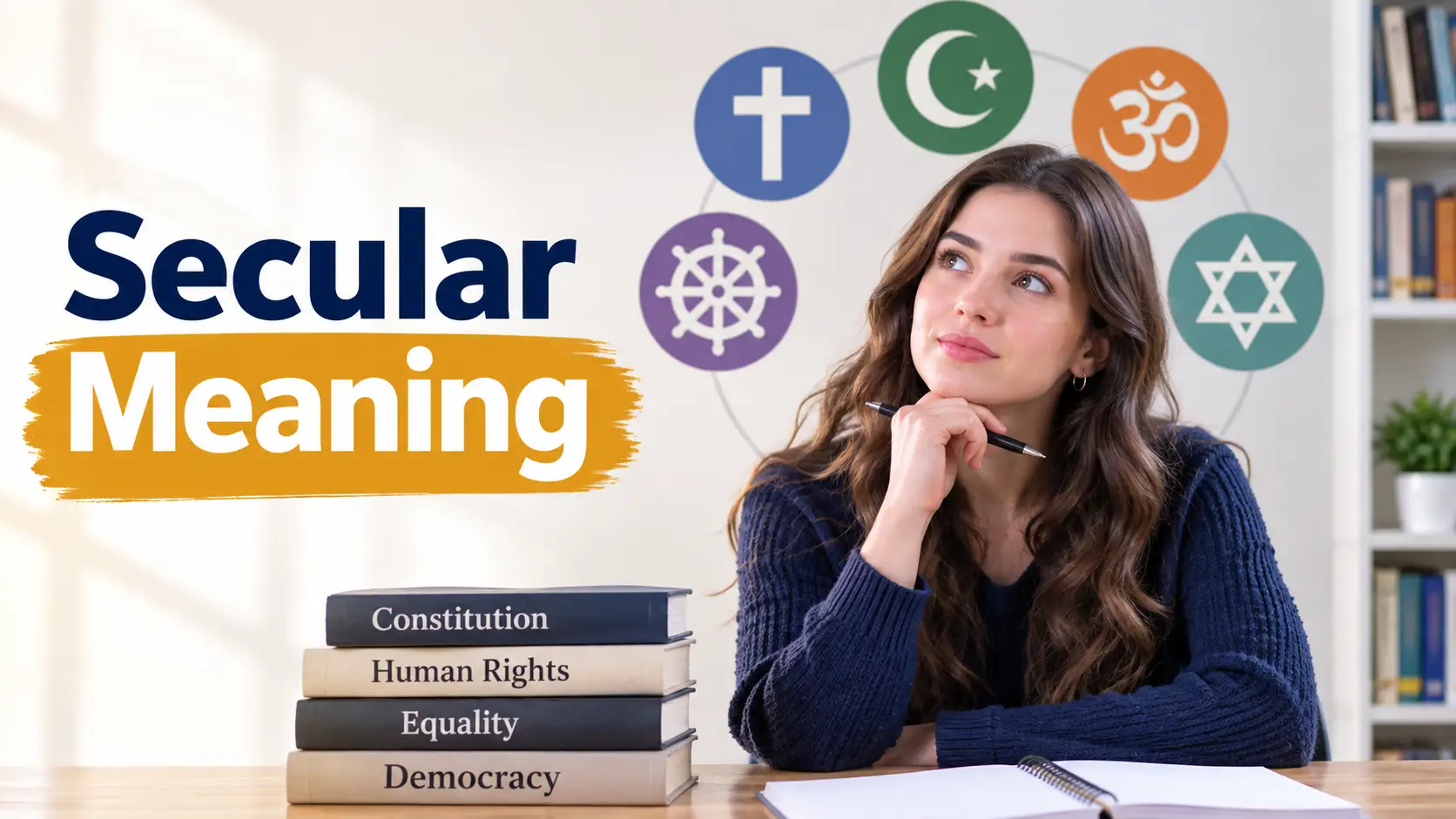
The word secular usually means something that is separate from religion or religious control.
For example, a secular school teaches general subjects without being based on the beliefs of a particular religion. The word can describe government, education, culture, music, people, or ideas.
But secular does not always mean “anti-religious.” That is a common misunderstanding. In many contexts, it simply means that religion is not the main basis for something. The exact meaning depends on how the word is used.
In this guide, you will learn the secular meaning, where the word comes from, how to use it in a sentence, how it differs from related words such as religious and nonreligious, and what it means in government and everyday life.
Quick Answer: What Does Secular Mean?
Secular means not connected with religion or religious authority, especially when describing government, education, laws, or public life.
For example:
“Many public schools provide secular education.”
Here, secular education means education that is not based on the teachings of a particular religion.
The word can also describe a person, belief, activity, or organization that is not religious. However, context matters. A secular person may simply keep religion separate from a particular part of life rather than reject religion completely.
Secular Meaning in Simple Words
In simple English, secular means separate from religion.
Think of it this way: if something is religious, religion plays an important role in it. If something is secular, religion is not the main basis for it.
For example, a religious ceremony may include prayers or other religious practices. A secular ceremony may focus on the event itself without religious elements.
The word is especially common when people talk about government, laws, schools, society, and public institutions.
A secular government does not base its official rules on the religious beliefs of one particular faith. This does not necessarily mean that religion is forbidden. In many uses, it means that the government and religious institutions have separate roles.
What Does Secular Mean in Government?
In government and politics, secular generally refers to a system in which the government is separate from religious authority.
A secular government does not officially make one religion the basis of all government decisions. Instead, public laws and policies are generally handled through civil or political institutions.
For example:
“A secular government serves citizens with different religious beliefs.”
The exact meaning of secularism differs from country to country. Some secular systems place strong limits on government involvement in religion, while others allow religion to have a public role while keeping government authority separate from religious institutions.
So, it is important not to assume that every secular country follows exactly the same model.
What Does Secular Mean in Education?
Secular education is education that is not based on the teachings of a particular religion.
For example, a secular school may teach subjects such as mathematics, science, history, English, and geography without requiring students to follow a specific religious belief.
This does not mean that students cannot study religion. A school can teach about religions from a historical, cultural, or academic point of view while still providing secular education.
For example:
“The class studied the history of religion from a secular perspective.”
Here, the word means the class approached the subject as an academic topic rather than as religious instruction.
Secular vs. Religious
The simplest contrast is secular vs. religious.
Something religious is connected with faith, worship, religious teachings, or a religious institution. Something secular is not primarily based on religion.
Consider these examples:
“A religious ceremony included prayers.”
“A secular ceremony included speeches and music but no religious service.”
Both events can be meaningful. The main difference is if religion is part of the ceremony.
The contrast can also apply to organizations, education, laws, and public institutions.
Is Secular the Same as Nonreligious?
The words secular and nonreligious can overlap, but they are not always identical.
Nonreligious usually means that something or someone is not religious.
Secularism often emphasizes separation from religion, especially in public or institutional settings.
For example, a person may be religious but support a secular government. In that case, the person’s personal beliefs are religious, while their view of government is secular.
This is why the word should always be understood from its context.
Is Secular the Same as Atheist?
No. Secular does not automatically mean atheist.
An atheist generally does not believe in the existence of gods. Secular, on the other hand, usually describes a separation from religion or religious authority.
A person can believe in God and still support secular government. Likewise, an atheist can support secular institutions.
These terms describe different ideas, so they should not be treated as synonyms.
Grammar and Correct Usage of Secular
Secular is most often used as an adjective.
Common phrases include:
“secular government”
“secular education”
“secular society”
“secular law”
“secular organization”
“secular music”
“secular ceremony”
“secular values”
For example:
“The university offers both religious studies and secular courses.”
“The group held a secular wedding ceremony.”
“The country has a secular legal system.”
The related noun secularism refers to the idea or system of keeping religion separate from certain areas of public life.
Another related word is secularist, which can describe a person who supports secularism.
Origin and History of the Word Secular
The word secular comes from the Latin word saeculum, which referred to an age, generation, or period of time.
Through its history, the word developed a connection with the ordinary world and life outside religious institutions. In older religious contexts, secular could be used to distinguish ordinary or worldly matters from religious or monastic life.
Over time, the word gained broader meanings. Today, it is commonly used when discussing religion’s relationship with government, education, culture, law, and public life.
Because the meaning has changed over time, older uses of secular may not match exactly how people use the word today.
Common Examples of Secular
Here are some everyday examples that make the meaning easier to understand.
A secular school provides education without making a particular religion the basis of instruction.
A secular government keeps government authority separate from religious authority.
A secular ceremony does not require religious prayers or rituals.
A secular song is not written as religious worship or religious teaching.
A secular organization does not exist mainly to promote a religion.
A secular activity is an ordinary activity that does not have a religious purpose.
The word does not automatically tell you if something is good or bad. It mainly describes its relationship to religion.
Common Mistakes About the Word Secular
One common mistake is thinking that secular means anti-religious. That is too broad. Secularism usually means separate from religion or not based on religious authority.
Another mistake is treating secular and atheist as the same thing. They are different. One describes a relationship to religion or religious authority, while the other describes a position about belief in gods.
It is also a mistake to assume that secular means that religion must disappear from society. In many discussions, secularism is about how public institutions and religious beliefs relate to each other.
Finally, remember that the meaning can change with context. “Secular music” and “secular government” use the word in related but slightly different ways.
Real-Life Sentences Using Secular
Here are some simple examples:
“The organization is secular and welcomes people from many religious backgrounds.”
“The ceremony was secular, so it did not include religious prayers.”
“She supports secular education in public schools.”
“The museum presented the topic from a secular, historical perspective.”
“The debate focused on if the government should remain secular.”
“Secular music can explore love, nature, friendship, and many other subjects.”
These examples show how flexible the word can be.
Secular Meaning in Everyday Conversation
In everyday conversation, people may use secular when discussing religion and public life, but the word can also appear in academic, legal, historical, and cultural writing.
For example, a person might say:
“I prefer a secular wedding.”
This usually means the person wants a wedding without religious elements.
A writer might say:
“The novel reflects the growth of secular culture.”
In that sentence, secular refers to culture that is less centered on religious beliefs or institutions.
Because the word can carry different meanings in different settings, looking at the words around it is helpful.
FAQs:
What is the simple meaning of secular?
Secular means separate from religion or not based on religious beliefs or authority. It is often used for government, education, laws, culture, and public institutions.
Does secular mean anti-religious?
No. Secularism usually means separate from religion. A secular system does not necessarily oppose religion or religious belief.
What is an example of something secular?
A public event without religious rituals can be described as secular. Secular schools, government systems, ceremonies, and organizations are other examples.
What is the opposite of secular?
The closest opposite depends on the context, but religion is often the clearest opposite. In some contexts, sacred may also be used as a contrast.
Is a secular person an atheist?
Not necessarily. A secular person may believe in a religion but prefer to keep religious beliefs separate from certain areas of public life.
What is secularism?
Secularism is a broad idea about keeping religion separate from government or other areas of public life. Its meaning and practice can differ between countries and political systems.
Conclusion:
The secular meaning is easiest to understand as “separate from religion” or “not based on religious authority.”
The word can describe government, schools, ceremonies, organizations, culture, music, and other parts of life.
However, secular does not automatically mean anti-religious, atheist, or opposed to faith.
A person can be religious while supporting secular government or secular public institutions.
The key is to look at the context. If someone talks about a secular school, they usually mean a school that is not based on a particular religion.
If they discuss secular government, they usually mean government that operates separately from religious authority.
When you see secular in a sentence, think first about separation from religion, then use the surrounding words to understand the exact meaning.

Hi, I’m Mia Walker, a Content Research Writer at Hublioo.com with 3+ years of experience in creating educational language content.
I enjoy breaking down complex words, internet slang, abbreviations, and everyday expressions into clear, practical explanations that anyone can understand.
My focus is on delivering original, easy-to-read, and well-organized content that helps readers expand their vocabulary and use English with greater confidence.