Quick answer: “Ring Around the Rosie” is a traditional children’s singing game – kids hold hands, circle around singing, and fall down at the end. The famous theory that it is secretly about the bubonic plague is almost certainly a myth: there is no solid historical evidence linking the rhyme to the plague, and the story only appeared centuries after the rhyme itself.
| Fact | Detail |
|---|---|
| What it is | Children’s nursery rhyme and circle game |
| US name | “Ring Around the Rosie” |
| UK name | “Ring a Ring o’ Roses” |
| First printed | 1881 (though likely older, passed down orally) |
| About the plague? | No solid evidence – the theory emerged much later |
| How it is played | Hold hands, circle while singing, fall down at the end |
What Is Ring Around the Rosie?
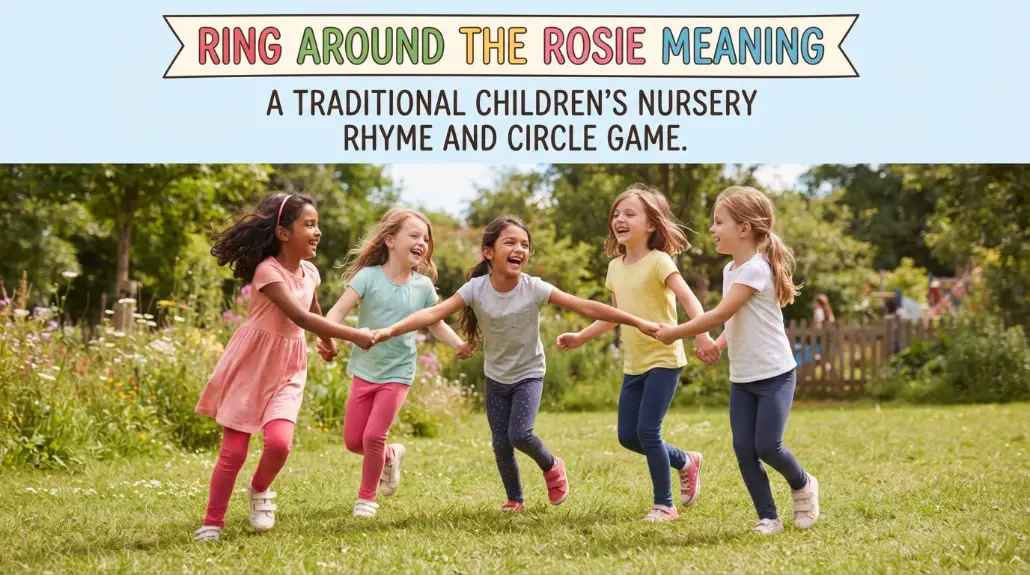
At its simplest, Ring Around the Rosie is a children’s game. A group of kids joins hands in a circle, walks or skips around while singing the rhyme, and performs an action at the end – in the familiar American version, everyone falls down laughing.
The classic US lyrics go:
Ring around the rosie,
A pocket full of posies,
Ashes, ashes,
We all fall down!
That is the whole thing. No hidden verses, no secret code – just a short, bouncy rhyme built for movement, rhythm, and the comedy of collapsing in a heap. Like many playground traditions, its power is physical and social, not literary.
Is Ring Around the Rosie Really About the Plague?
Probably not – and historians are fairly confident about this. The plague theory claims each line secretly describes the Black Death: the “rosie” is a plague rash, “posies” are the flowers people carried against the smell, “ashes” are cremation ashes, and “we all fall down” is death.
It is a gripping story. It is also, by the evidence, wrong – or at least unproven to the point that scholars treat it as folklore about folklore. The key problems:
- Timing: The plague theory only started circulating in the mid-20th century – centuries after both the plague and the rhyme’s first printing.
- No contemporary link: Nobody in the 1300s-1800s wrote down that the rhyme was about the plague. For a song supposedly encoding a pandemic, that silence is deafening.
- The lyrics do not fit neatly: Early printed versions have different words (“Hush! Hush! Hush! Hush!”), and the plague reading only works if you cherry-pick one version.
- Folklorists push back: Researchers of nursery rhymes have repeatedly called the plague origin “implausible” given the evidence.
Why Do People Think It’s About the Plague?
Because it is a great story – and great stories outrun boring facts. The theory seems to have taken off after World War II, possibly popularized by retellings that loved the irony of children cheerfully singing about death. Once it entered trivia books and early internet forwards, it became “common knowledge” through sheer repetition.
There is also a psychological pull: the rhyme sounds slightly dark (“ashes,” “we all fall down”), and humans love hidden meanings. A secret plague code feels more exciting than “kids liked spinning in circles.” But exciting is not the same as true – the same way the APT song title attracted wilder theories than the simple truth.
What Do the Lyrics Actually Mean?
Taken at face value – which is how folklorists think we should take them – the lines are ordinary:
- “Ring around the rosie” – the ring (circle) the children form; “rosie” is likely just a pretty rhyming word, possibly referring to roses.
- “A pocket full of posies” – a posy is a small bunch of flowers. Kids carrying flowers, or pretending to, fits a garden game.
- “Ashes, ashes” – in early versions this line was “Hush! Hush!” or “A-tishoo, a-tishoo” (a sneeze). “Ashes” may be a mishearing that stuck.
- “We all fall down” – the game’s finale: everyone theatrically collapses. The oldest fun in the world.
None of this requires a plague. It requires children, a circle, and an excuse to fall over.
Where Did the Rhyme Come From?
Honestly? We do not know for certain. The rhyme was first printed in 1881, but it was clearly circulating orally before that – folk rhymes are often far older than their first printing. (Merriam-Webster’s folklore entry covers the term, and specialist overviews collect the main origin theories alongside the evidence against the plague story.)
What we can say: circle singing games exist in cultures worldwide and are usually very old in form.
Why Are There So Many Versions?
Oral tradition is a game of telephone played across generations. Compare:
- American: “Ring around the rosie / A pocket full of posies / Ashes, ashes / We all fall down!”
- British: “Ring-a-ring o’ roses / A pocket full of posies / A-tishoo! A-tishoo! / We all fall down!”
- Other variants: Some end with jumping up, sneezing, or curtsying instead of falling.
Each community kept the skeleton (circle + rhyme + finale) and improvised the flesh. This variation undermines the plague theory: a coded plague memorial would need stable wording to preserve its “code,” but the words kept changing.
Why Does the Song Sound Creepy?
Three reasons it gives adults the shivers:
- The plague story primes you to hear darkness – remove the story and it is just a bouncy tune.
- Minor-key playground singing – children singing slightly off-key in unison has an innately eerie quality (horror movies exploit this).
- “We all fall down” – out of context, collapsing reads as ominous; in context, it is slapstick.
It is the same mechanism that makes any innocent thing creepy once someone tells you a dark backstory.
How Do You Play the Ring Around the Rosie Game?
For anyone who somehow missed childhood:
- Everyone holds hands in a circle.
- Walk or skip around while singing the rhyme together.
- On “we all fall down,” everyone drops to the ground (theatrically is best).
- Get up, giggling, and go again.
Variants add sneezes, jumps, or spins. The game needs no equipment, no winners, and no skill – which is exactly why it has lasted so long.
Like the right hand itching superstition, which has its own centuries-old mythology.
FAQ About Ring Around the Rosie
What is the real story behind Ring Around the Rosie?
It is a traditional children’s circle game of uncertain origin, first printed in 1881. The plague backstory is a modern myth.
Is Ring Around the Rosie about the plague?
Almost certainly not. The plague interpretation appeared centuries after the rhyme, with no contemporary evidence to support it.
What does “a pocket full of posies” mean?
A posy is a small bunch of flowers. The line most likely describes children carrying (or pretending to carry) flowers.
What does “ashes, ashes, we all fall down” mean?
Early versions used “Hush! Hush!” or sneezing sounds (“a-tishoo”), suggesting “ashes” is a later mishearing.
Why do children fall down in the game?
Because it is funny. Theatrical collapsing is the punchline of the game – pure physical comedy.
What is the British version called?
“Ring a Ring o’ Roses” – same game, slightly different lyrics, with sneezing instead of “ashes.”
Key Takeaways
- Ring Around the Rosie is a children’s circle game, not a coded historical document.
- The plague theory is almost certainly a myth – it appeared centuries late with no supporting evidence.
- The lyrics describe ordinary playground imagery: circles, flowers, and theatrically falling down.
- Many lyric versions exist because oral tradition reshapes rhymes over generations.
- It sounds creepy mainly because the plague story primes you to hear it that way – plus horror movies love children’s rhymes.
Read More Articles
🔮Kink Definition and Examples: What It Really Means
🔮Mucho Gusto Meaning: What It Means & How to Use It in Spanish
🔮Right Hand Itching Meaning: Money, Luck & What Science Says

Hi, I’m Mia Walker, a Content Research Writer at Hublioo.com with 3+ years of experience in creating educational language content.
I enjoy breaking down complex words, internet slang, abbreviations, and everyday expressions into clear, practical explanations that anyone can understand.
My focus is on delivering original, easy-to-read, and well-organized content that helps readers expand their vocabulary and use English with greater confidence.