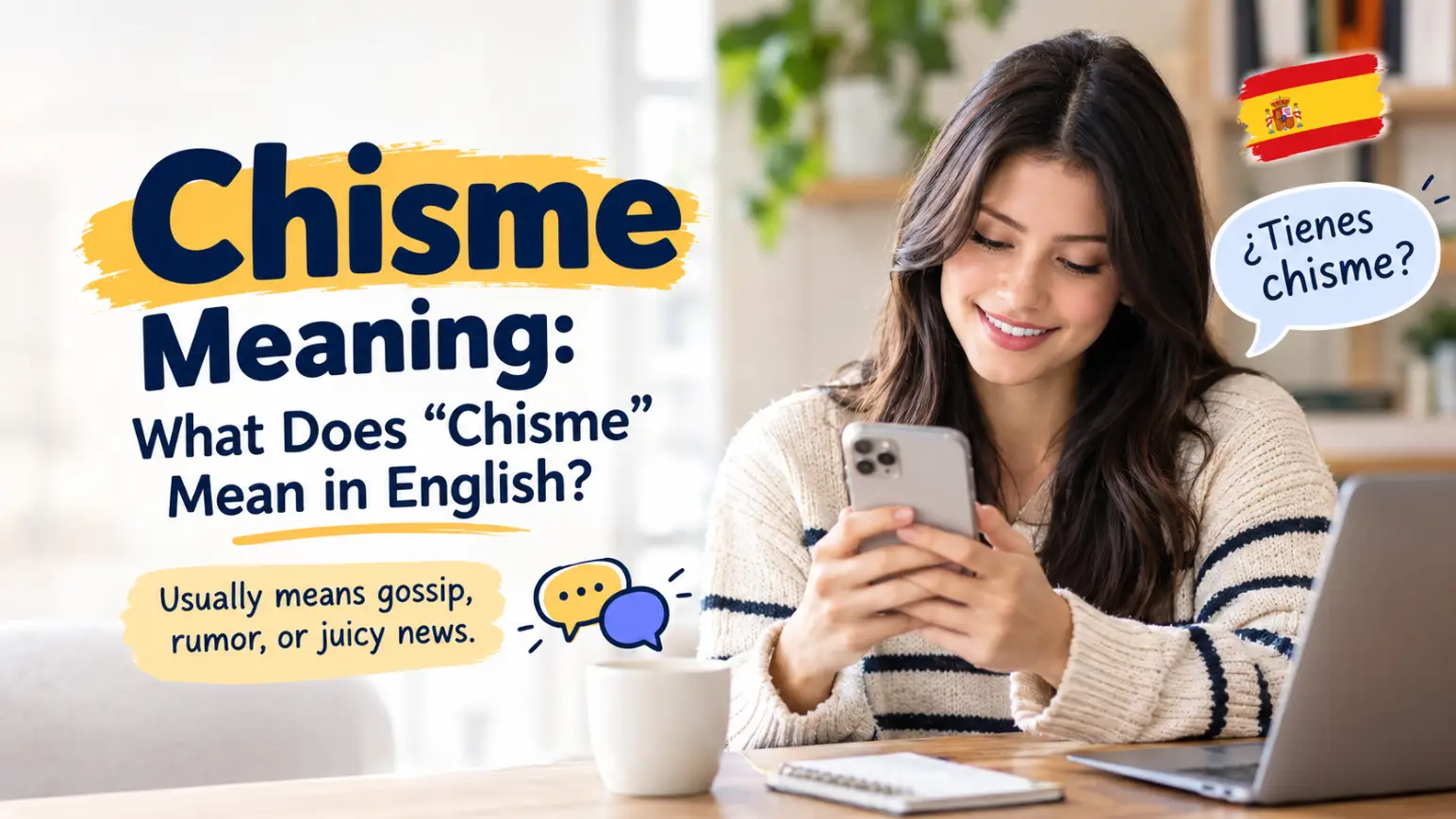
“Chisme” is a Spanish word that usually means gossip or rumor in English.
It can describe information people share about someone else, especially when the information is personal, interesting, or not confirmed.
Depending on the situation, “chisme” can sound playful, harmless, or negative. You may hear it in Spanish conversations, social media posts, TV shows, and everyday slang.
Understanding the chisme meaning also requires knowing how Spanish speakers use the word in real life. Sometimes a person says “chisme” simply to mean juicy news or an interesting story. Other times, it refers to spreading information that should probably stay private.
This guide explains the meaning, pronunciation, common expressions, examples, and cultural use of “chisme” in simple English.
Quick Answer: What Does Chisme Mean?
The chisme meaning in English is usually “gossip,” “rumor,” or “juicy news.”
For example:
“¿Tienes chisme?” means “Do you have any gossip?” or “What’s the latest gossip?”
“Cuéntame el chisme” means “Tell me the gossip” or “Tell me what happened.”
The exact English translation depends on the context. “Gossip” is the closest common translation, but “chisme” can sometimes have a lighter, more playful meaning.
Chisme Meaning and Definition
In Spanish, chisme is a noun. It generally refers to information or talk about other people, especially private, surprising, or interesting information.
The word can describe both the information itself and the act of talking about it.
For example, if two friends discuss a celebrity’s relationship, one person might call the story “chisme.” If coworkers talk about someone’s personal life, that conversation could also be called “chisme.”
In English, “gossip” is usually the best match. However, the emotional tone can change.
Sometimes “chisme” suggests something negative, such as spreading rumors. In casual conversations, it can also be used in a fun way, similar to saying, “Tell me all the tea!”
That is why translating “chisme” word for word does not always capture its full meaning.
How Do You Pronounce Chisme?
“Chisme” is commonly pronounced roughly like CHEEZ-meh.
The first sound, “ch,” is similar to the sound in the English word “cheese.” The final “e” has a sound closer to the “e” in “met” than the silent “e” often found in English words.
The Spanish pronunciation may vary slightly by region and accent, but “CHEEZ-meh” is a useful pronunciation guide for English speakers.
You may also hear the plural form chismes, which means “gossip” or “pieces of gossip.”
How Is Chisme Used in Spanish?
Chisme is very common in informal speech. Friends may use it when talking about news, relationships, celebrities, family matters, workplace stories, or anything else that feels interesting.
For example, someone might ask:
“¿Qué pasó? Cuéntame el chisme.”
This means:
“What happened? Tell me the gossip.”
A person might also say:
“Traigo un chisme.”
This can mean:
“I have some gossip.”
The phrase does not always mean that the speaker is spreading harmful information. Among friends, it can simply introduce an interesting story.
Tone and context matter a lot.
Common Expressions With Chisme
Several informal Spanish expressions use the word “chisme.”
“Cuéntame el chisme” means “Tell me the gossip.” It is a casual way to ask someone to share an interesting story.
“¿Cuál es el chisme?” means “What’s the gossip?” or “What’s the latest?”
“Hay mucho chisme” means “There’s a lot of gossip.”
“Puro chisme” can mean “Nothing but gossip” or “It’s all gossip.”
“No seas chismoso” means “Don’t be a gossip” or “Don’t be nosy.”
“No sea chismosa” is the feminine form and carries the same general idea.
“Me encanta el chisme” literally means “I love gossip.” In casual use, it can be playful and does not always mean the person enjoys spreading harmful rumors.
Chisme vs. Chismoso and Chismosa
These words are related, but they do not mean exactly the same thing.
Chisme is the gossip or the piece of information.
Chismoso describes a male person who is nosy or likes gossip.
Chismosa describes a female person who is nosy or likes gossip.
For example:
“Ella es muy chismosa.”
This means:
“She is very gossipy” or “She loves gossip.”
“Él es chismoso.”
This means:
“He is a gossip” or “He is nosy.”
The ending changes because Spanish nouns and adjectives often change according to gender.
Chisme vs. Rumor: Are They the Same?
Chisme and “rumor” overlap, but they are not always identical.
A rumor is information that may not be true or confirmed. It often involves uncertainty.
Chisme is broader. It can refer to gossip that is true, partly true, exaggerated, or completely unconfirmed.
For example, if someone says, “I heard that they are getting divorced,” that could be a rumor. If friends spend an hour discussing the couple’s relationship, the whole conversation could be called chisme.
So, while “rumor” can be a good translation in some situations, “gossip” is usually the closest general English equivalent.
Is Chisme a Bad Word?
No. Chisme is not a swear word or an inherently offensive word.
Its meaning can be positive, negative, or playful depending on how it is used.
Calling something “chisme” may suggest that the information is private or that people are talking about someone who is not present. In that sense, it can have a negative tone.
But friends may also use the word jokingly.
For example:
“Okay, give me the chisme!”
This may simply mean:
“Okay, tell me what happened!”
The relationship between the speakers and their tone can make a big difference.
Chisme in Mexican and Other Spanish-Speaking Communities
“Chisme” is widely understood across Spanish-speaking communities, although everyday slang can vary from country to country.
In Mexico, for example, chisme is common in casual conversation and popular culture. People may use it when talking about friends, family, celebrities, relationships, or social events.
The word is also understood in many other Spanish-speaking regions.
Modern social media has made words connected to gossip even more visible. Spanish-speaking creators may use “chisme” when discussing celebrity news, relationship drama, entertainment, or viral stories.
Still, the exact tone depends on the speaker, country, and situation.
Real-Life Examples of Chisme
Here are some simple examples showing how the word works:
“¿Tienes algún chisme?”
This means, “Do you have any gossip?”
“Te tengo un chisme.”
This means, “I have some gossip for you.”
“Cuéntame todo el chisme.”
This means, “Tell me all the gossip.”
“Ese chisme no es verdad.”
This means, “That rumor is not true.”
“No quiero chismes.”
This means, “I don’t want gossip.”
“Mi hermana siempre sabe todos los chismes.”
This means, “My sister always knows all the gossip.”
“Hay mucho chisme en la oficina.”
This means, “There is a lot of gossip in the office.”
These examples show why context matters when translating the word.
Common Mistakes With Chisme
One common mistake is assuming that chisme always means “rumor.” That is too narrow. Chisme can refer to gossip or interesting talk even when the information is believed to be true.
Another mistake is assuming that the word is always insulting. It can be negative, but friends often use it in a playful way.
It is also useful to remember that chisme is singular, while chismes is plural.
For example:
“Un chisme” means “a piece of gossip.”
“Muchos chismes” means “a lot of gossip” or “many pieces of gossip.”
Do not confuse “chisme” with “chismoso” or “chismosa.” The first refers to the gossip itself, while the other words describe a person who likes gossip or is nosy.
Chisme in Modern Slang and Social Media
Online, “chisme” can be used in a playful way similar to English expressions such as “the tea,” “spill the tea,” or “the latest gossip.”
For example, a social media post might say:
“Necesito el chisme.”
Depending on context, this could mean:
“I need the gossip.”
Or more naturally:
“Tell me what happened!”
The phrase can be humorous and dramatic without being a serious accusation.
However, online gossip can still involve real people and private information. The playful use of “chisme” does not automatically make sharing personal information harmless.
FAQs:
What does chisme mean in English?
Chisme usually means “gossip.” Depending on the context, it can also mean “rumor,” “juicy news,” or an interesting story about other people.
Is chisme a bad word?
No. Chisme is not a swear word. It can have a negative meaning when it involves harmful gossip, but people also use it casually and playfully with friends.
What does “cuéntame el chisme” mean?
“Cuéntame el chisme” means “Tell me the gossip” or “Tell me what happened.” It is usually an informal phrase.
What does chismosa mean?
Chismosa is a feminine Spanish word for a woman or girl who is gossipy or nosy. The masculine form is chismoso.
What is the difference between chisme and rumor?
A rumor is usually information that has not been confirmed. Chisme is broader and can include gossip about information that may be true, false, or simply interesting.
Can chisme be used in a fun way?
Yes. Friends often use chisme playfully when they want to hear an interesting story. In this context, it can be similar to asking someone to “spill the tea.”
Conclusion:
The chisme meaning is most often “gossip,” but the word has a wider range of casual uses.
It can refer to a rumor, an interesting story, private information, or simply the latest news about other people. The tone can be serious, negative, or playful.
You may hear phrases such as “cuéntame el chisme,” meaning “tell me the gossip,” or “¿cuál es el chisme?” meaning “what’s the latest gossip?” Words such as chismoso and chismosa describe people who like gossip or are nosy.
If you are learning Spanish, remember that context is important. “Chisme” does not always suggest something harmful.
Among friends, it can be a lighthearted way to talk about an interesting story. Understanding that difference will help you use and translate the word more naturally.

Hi, I’m Mia Walker, a Content Research Writer at Hublioo.com with 3+ years of experience in creating educational language content.
I enjoy breaking down complex words, internet slang, abbreviations, and everyday expressions into clear, practical explanations that anyone can understand.
My focus is on delivering original, easy-to-read, and well-organized content that helps readers expand their vocabulary and use English with greater confidence.