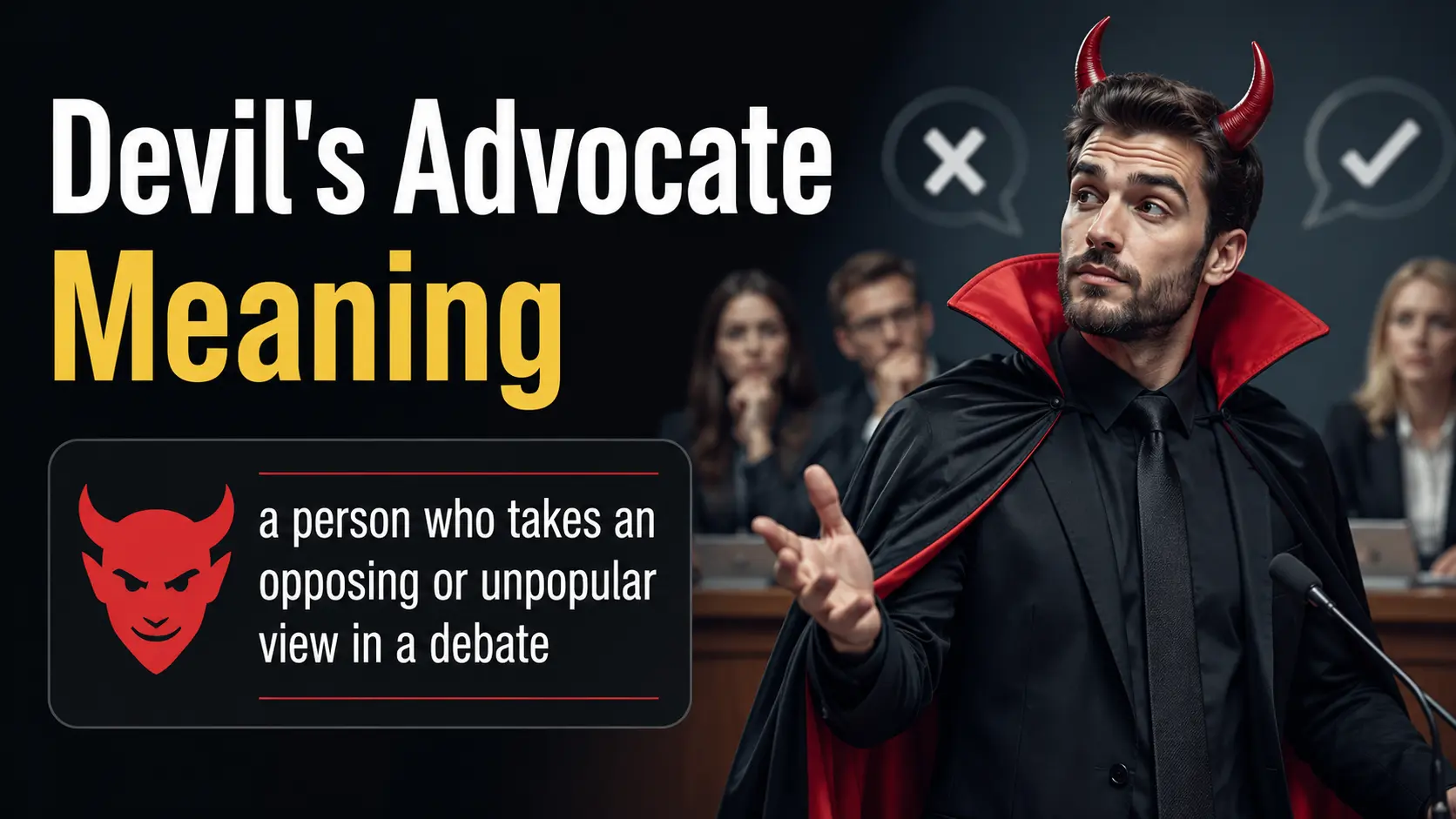
Devil’s advocate means a person who deliberately argues against an idea to test it, find weaknesses, or encourage deeper thinking, even if they do not personally disagree with it.
Quick Meaning of Devil’s Advocate
Devil’s advocate means a person who argues against an idea or position, usually to test it, uncover weaknesses, or encourage people to consider another perspective.
For example:
“Let me play devil’s advocate for a minute. What if this plan costs more than we expect?”
The speaker may actually support the plan. They are simply raising a difficult question to see whether the idea can withstand criticism.
In simple terms, it means deliberately looking at the other side of an argument.
What Does Devil’s Advocate Mean?
The expression is an English idiom. Its modern meaning is figurative rather than a literal reference to supporting the devil.
Someone who takes this role deliberately argues against an idea, even when they may not personally disagree with it. The purpose can be to test assumptions, identify risks, or make a discussion more balanced.
Imagine a company is preparing to launch a new product. Everyone at a meeting supports the idea, but one employee asks:
“What if customers don’t actually want this product?”
That person could be playing devil’s advocate. They are not necessarily against the launch. Instead, they are encouraging the team to examine an assumption before making a decision.
This distinction is important because taking the opposing side does not always mean you hold that opinion yourself.
Devil’s Advocate in Simple English
In very simple English, playing devil’s advocate means pretending to disagree so you can test an idea.
A useful way to think about it is:
“What if we’re wrong?”
For example, your friends decide to take a long road trip without a backup plan. You might say:
“I’ll play devil’s advocate. What happens if the car breaks down?”
You are not necessarily trying to cancel the trip. You are pointing out something the group may have overlooked.
The goal is to make the decision stronger by thinking about possible problems before they happen.
How Do You Use “Play Devil’s Advocate”?
Play devil’s advocate is the most common form of the expression.
You can say it before presenting another viewpoint:
“I’ll play devil’s advocate here. Are we sure this is the best option?”
You can also use it after challenging someone’s opinion:
“I don’t actually disagree with you. I was just playing devil’s advocate.”
Other natural examples include:
- “Can I play devil’s advocate for a moment?”
- “Let me play devil’s advocate.”
- “I’m only playing devil’s advocate.”
- “She played devil’s advocate during the meeting.”
- “He often plays devil’s advocate in class.”
The expression is common enough to work naturally in both casual and professional conversations.
Examples of Playing Devil’s Advocate
The meaning becomes clearer when you see how the expression works in real situations.
At Work
“Before we approve the project, I’ll play devil’s advocate. What happens if we miss the deadline?”
The employee is testing the plan for a possible weakness.
In a Classroom
“I’m going to play devil’s advocate and argue that the other side has a point.”
The student is presenting an opposing argument to encourage discussion.
Between Friends
“I’m not saying you should cancel the trip. I’m just playing devil’s advocate. What if the weather gets worse?”
The speaker is raising a possible problem without necessarily opposing the trip.
During a Business Meeting
“Let me play devil’s advocate. Do we know that our customers actually want this feature?”
The question challenges an assumption before the company commits resources.
In a Casual Conversation
“I agree with you, but I’ll play devil’s advocate for a moment.”
This tells the listener that an alternative argument is coming.
Devil’s Advocate in a Sentence
The expression is normally used as a noun phrase.
Here are some natural sentence examples:
- “She played devil’s advocate during the meeting.”
- “He often plays devil’s advocate in class discussions.”
- “Let me play devil’s advocate.”
- “I was only playing devil’s advocate.”
- “My coworker acted as the devil’s advocate during our planning session.”
One common spelling mistake is “devils advocate.” The standard expression is devil’s advocate, with an apostrophe.
Devil’s Advocate vs. Disagreeing
Playing devil’s advocate and simply disagreeing are not exactly the same.
If you disagree, you normally express your genuine opinion. If you take the opposite side for the purpose of testing an idea, you may be playing devil’s advocate.
| Expression | Main idea | Example |
|---|---|---|
| Disagree | You genuinely hold another opinion | “I don’t think this plan will work.” |
| Play devil’s advocate | You challenge an idea by taking the other side | “What if customers aren’t interested?” |
| Criticize | You point out problems or weaknesses | “This plan has several serious problems.” |
| Debate | People discuss opposing positions | “The students debated the issue.” |
The main difference is purpose. A genuine disagreement reflects what you believe, while devil’s advocacy may involve temporarily arguing a position you do not personally support.
Devil’s Advocate vs. Contrarian
A contrarian is someone who takes a position that differs from the popular or usual opinion.
A devil’s advocate may also express an unpopular view, but the reason is usually different.
Suppose everyone supports a new school rule. A contrarian might oppose it because they genuinely dislike the rule.
Someone taking the opposing role for discussion might ask:
“What problems could this rule create?”
They could still support the rule overall. Their purpose is to test it.
So, a devil’s advocate does not necessarily have to be a contrarian.
What Is a Better Term for Devil’s Advocate?
There is no single perfect replacement because the expression has a specific meaning.
Depending on the context, you could use:
- Opposing viewpoint
- Alternative perspective
- Constructive challenger
- Skeptic
- Critical thinker
- Counterargument
For example, in formal writing, instead of saying:
“I’ll play devil’s advocate.”
You might write:
“Let’s examine the opposing argument.”
However, these alternatives are not exact synonyms. The original expression specifically suggests deliberately taking the other side to test an idea.
Is Devil’s Advocate Formal or Informal?
The expression is a common idiom that appears in both casual and professional settings.
You may hear it in:
- Everyday conversations
- Classrooms
- Business meetings
- Interviews
- Debates
- Articles
- Essays
- Online discussions
It is not slang, although it is less formal than highly technical wording.
In a formal report, phrases such as “examine the opposing argument” or “test the assumptions behind this proposal” may sound more direct.
Still, using the phrase in a professional conversation is completely normal.
Pronunciation of Devil’s Advocate
In American English, the phrase is approximately pronounced:
DEV-uhlz AD-vuh-kit
The noun advocate in this expression is pronounced roughly AD-vuh-kit.
So the complete phrase sounds like:
DEV-uhlz AD-vuh-kit
Why Is It Called the Devil’s Advocate?
The expression has a historical connection to the Catholic Church’s process for examining candidates for sainthood.
The Latin phrase advocatus diaboli, meaning “devil’s advocate,” was associated with a role in the canonization process. The official was expected to raise objections and present arguments against a candidate’s canonization.
The purpose was to make sure the evidence was carefully examined rather than simply accepted.
This historical role explains why it is called the Devil’s Advocate. Over time, the idea of deliberately presenting the opposing case moved beyond its original religious setting and became a general expression for challenging an argument.
Where Did the Phrase Come From?
The modern expression developed from the Latin advocatus diaboli.
The role was connected with the Church’s examination of proposed saints. Presenting objections gave decision-makers an opportunity to consider weaknesses in the case.
Eventually, English speakers began using devil’s advocate in a much broader sense. Today, it can describe anyone who intentionally argues the opposite side of an issue to test an idea.
The expression is therefore historical in origin but very ordinary in modern conversation.
Is Playing Devil’s Advocate Gaslighting?
No. Playing devil’s advocate is not automatically gaslighting.
The two concepts have different meanings.
When someone plays devil’s advocate, they normally challenge an argument by considering another possibility. The purpose may be to test an assumption or encourage a more balanced discussion.
Gaslighting involves manipulating someone in a way that causes them to doubt their own memory, judgment, or perception of events.
For example:
“What if we’re looking at this situation from another perspective?”
That could simply be a challenging question.
However, repeatedly dismissing someone’s valid experience and trying to make them doubt what they remember is different.
The phrase “I’m just playing devil’s advocate” can also be used poorly. If someone uses it to dismiss reasonable concerns or provoke another person, the conversation may become unproductive. The phrase itself is not gaslighting; how someone uses it matters.
Is Devil’s Advocate a Negative Expression?
Not necessarily.
It can have a positive meaning when someone is helping a group think carefully.
For example:
“Our manager asked me to play devil’s advocate before we made the final decision.”
Here, challenging the plan may help the team identify problems before committing to it.
The expression can sound negative when someone argues against everything without a useful reason:
“He always plays devil’s advocate, even when there’s nothing useful to add.”
In this case, the criticism is about the person’s behavior, not the phrase itself.
So, the expression is generally neutral. The context, purpose, and tone determine whether it sounds helpful or annoying.
When Is Playing Devil’s Advocate Useful?
Taking an opposing position can be useful when a group is too quick to agree.
It can help people:
- Find weaknesses in a plan
- Test assumptions
- Consider another point of view
- Prepare for objections
- Identify possible risks
- Explore alternative explanations
- Make more careful decisions
For example, before launching a product, a team might ask one person to challenge the proposal.
That person could ask:
“What evidence do we have that customers actually want this?”
The goal is not to win an argument. It is to discover problems early enough to address them.
When Can It Become Unhelpful?
The approach becomes less useful when someone argues against every idea simply to create conflict.
Constant opposition can make conversations frustrating. It may also cause people to feel that their concerns are not being taken seriously.
Good devil’s advocacy should have a clear purpose. The person should raise meaningful questions and reasonable objections rather than inventing weak arguments just to disagree.
A simple rule is:
Challenge the idea, not the person.
That keeps the discussion focused and respectful.
Not to Play Devil’s Advocate Meaning
The phrase “not to play devil’s advocate” is often used when someone wants to make clear that they genuinely believe what they are saying.
For example:
“I’m not playing devil’s advocate. I really think we should reconsider the plan.”
Here, the speaker is saying that this is their actual opinion, not a hypothetical argument they are presenting for discussion.
This wording helps distinguish genuine disagreement from deliberately taking another side.
Devil’s Advocate Meaning in Psychology
Devil’s advocate is not a psychological diagnosis or formal psychological condition. It is an everyday expression.
However, deliberately challenging assumptions can be useful in group decision-making. It can encourage people to consider alternative explanations, identify risks, and avoid becoming overly confident just because everyone agrees.
For example, a team might ask one member to question a proposed strategy:
“What evidence supports this assumption?”
That type of constructive challenge can improve reasoning.
But if someone opposes every suggestion without a meaningful purpose, the behavior can make communication harder.
Devil’s Advocate Meaning in Spanish
A common Spanish equivalent is abogado del diablo.
You may also see jugar al abogado del diablo, which closely matches the English expression “play devil’s advocate.”
The exact wording can vary by context, but the basic idea remains the same: deliberately taking an opposing position to challenge or examine an argument.
Devil’s Advocate Meaning in Chinese
The expression can be translated into Chinese in different ways depending on the context.
One possible expression is 唱反调的人, referring to someone who takes an opposing position.
Another translation you may encounter is 魔鬼代言人, which is closer to a literal translation of “devil’s advocate.”
For an idiom like this, the intended meaning matters more than translating every word directly.
Devil’s Advocate Meaning on Urban Dictionary
Some people search for “devils advocate meaning Urban Dictionary” because they want an informal explanation.
Urban Dictionary contains user-submitted definitions and examples, so its entries can reflect casual internet usage. However, those definitions are not necessarily authoritative.
For the standard meaning, established dictionaries and language references are better sources.
Also remember that the standard spelling is devil’s advocate, with an apostrophe.
Devil’s Advocate Meaning in the Movie
The Devil’s Advocate is also the title of a well-known movie. Because of this, searches for the phrase can sometimes refer to the film rather than the everyday expression.
If someone searches for the devil’s advocate meaning movie, they may be asking about the title, its themes, or its story.
The movie title uses the established expression and connects it with ideas involving temptation, morality, power, and opposing forces.
Context therefore matters when interpreting the phrase.
Common Mistakes
One common mistake is assuming that a devil’s advocate must genuinely believe the opposing position. That is not required.
Another is using the expression for every disagreement. If you genuinely believe the other side is wrong, you are simply disagreeing.
A third mistake is spelling it as “devils advocate.” The standard form is devil’s advocate.
It is also worth remembering that taking the opposing side does not automatically make an argument useful. A good challenge should still be reasonable and relevant.
American vs. British English
There is no major difference in the basic meaning of devil’s advocate between American and British English.
The expression is understood in both varieties, and the spelling remains the same:
devil’s advocate
Unlike some words that have different American and British spellings, this expression does not require a separate version.
Frequently Asked Questions
What does devil’s advocate mean in simple terms?
It means deliberately taking the opposite side of an argument to test an idea, question an assumption, or encourage deeper thinking.
What does playing devil’s advocate mean?
It means arguing for another side of an issue, even when you may not personally agree with that position.
Is playing devil’s advocate the same as disagreeing?
No. Genuine disagreement reflects your actual opinion. Taking the opposing side for the purpose of testing an idea is different.
Is playing devil’s advocate gaslighting?
No. The expression normally describes challenging an idea, while gaslighting involves manipulating someone into doubting their own memory, judgment, or perception.
What is an example of a devil’s advocate?
If everyone supports a new business plan, someone might say, “Let me play devil’s advocate. What if customers don’t want this product?” They are testing the plan rather than necessarily rejecting it.
What is a better term for devil’s advocate?
Depending on the situation, you could say opposing viewpoint, alternative perspective, constructive challenger, skeptic, or counterargument. These are related expressions rather than exact replacements.
Why is it called the Devil’s Advocate?
The expression comes from the Latin advocatus diaboli and is connected with a historical role in the Catholic Church’s canonization process. The person in that role presented objections to help examine a candidate’s case carefully.
Is devil’s advocate an idiom?
Yes. It is an established English idiom with a figurative modern meaning.
Is devil’s advocate formal or informal?
It is a common idiom used in both casual and professional conversations. It is not slang, but formal writing may sometimes use more direct wording.
Is devil’s advocate the same as a contrarian?
No. A contrarian generally takes an unpopular position as a matter of genuine opinion, while a devil’s advocate may take the opposing side temporarily to test an argument.
What does “not to play devil’s advocate” mean?
It usually means the speaker is expressing their genuine opinion rather than deliberately arguing the opposite side.
Conclusion
Devil’s advocate means deliberately taking the opposite side of an argument to test an idea or explore another perspective.
You may not actually disagree you are simply challenging the idea to make the discussion stronger.
So, when someone says “I’ll play devil’s advocate,” they are usually inviting you to consider a different point of view.
Used respectfully, it can lead to better questions, stronger arguments, and smarter decisions.

Hi, I’m Mia Walker, a Content Research Writer at Hublioo.com with 3+ years of experience in creating educational language content.
I enjoy breaking down complex words, internet slang, abbreviations, and everyday expressions into clear, practical explanations that anyone can understand.
My focus is on delivering original, easy-to-read, and well-organized content that helps readers expand their vocabulary and use English with greater confidence.