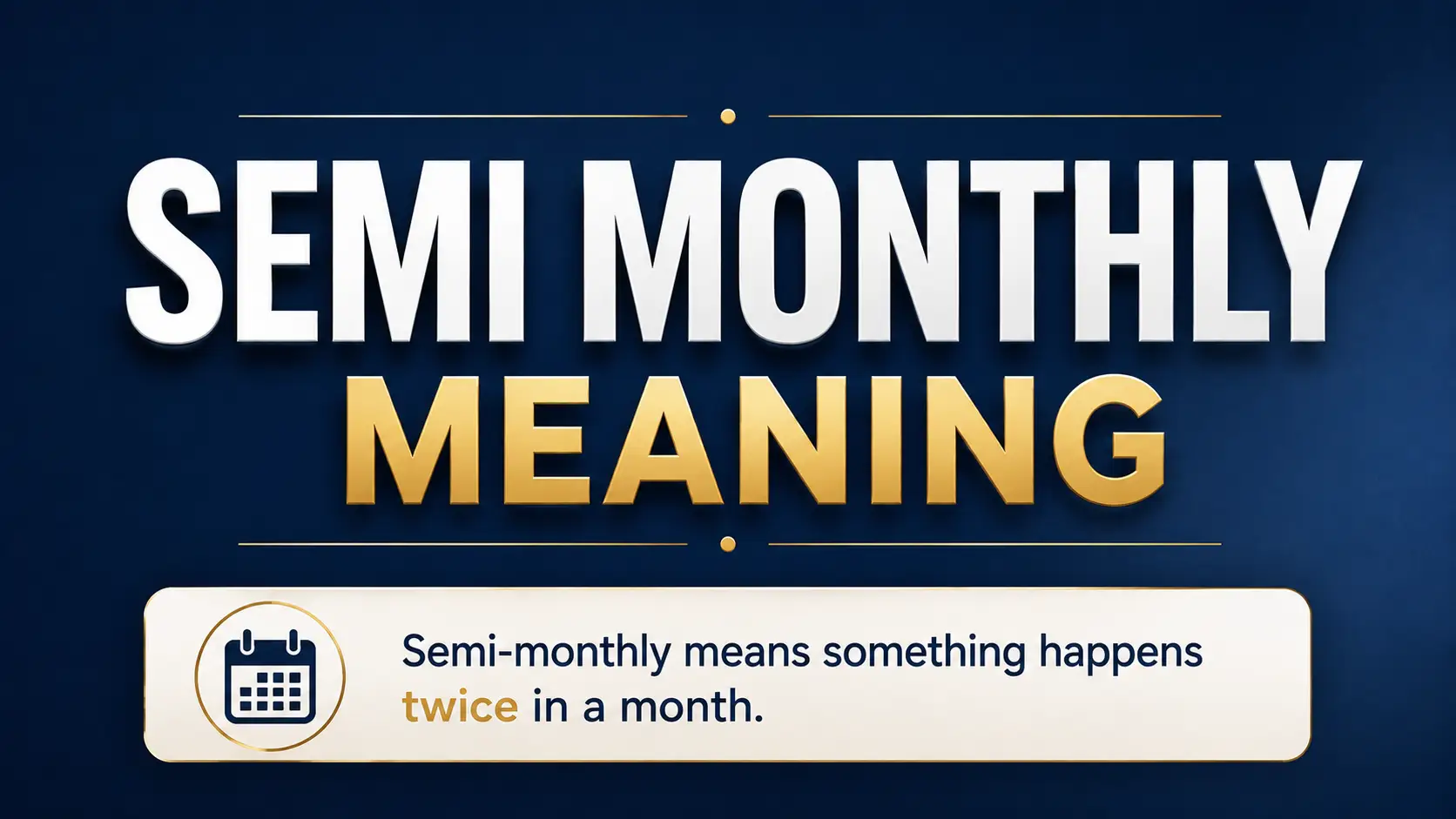
Quick Answer: Semi-monthly means twice a month – for example, paychecks on the 1st and 15th (24 times a year). It is not the same as biweekly (every two weeks, 26 times a year) or bimonthly (which confusingly can mean either).
| Quick Fact | Detail |
|---|---|
| Term | Semi-monthly (also: semimonthly) |
| Meaning | Twice a month |
| Frequency | 24 times per year |
| Common use | Pay schedules, meetings, bills, publications |
| Not to confuse with | Biweekly (every 2 weeks) · Bimonthly (ambiguous) |
Does “Semi-Monthly” Mean Twice a Month or Every Two Weeks?
Twice a month. Full stop. This is the single most important fact in this article, because mixing it up with “every two weeks” causes real payroll headaches.
Here’s why the confusion happens: “twice a month” and “every two weeks” feel similar but produce different results. A semi-monthly schedule is anchored to the calendar month – paydays fall on fixed dates like the 1st and 15th. The gap between paydays isn’t always 14 days; it stretches and shrinks with the month’s length. February’s second half is short; a 31-day month’s is long.
“Every two weeks” (biweekly), by contrast, is anchored to a fixed 14-day cycle – paydays drift through the calendar, landing on different dates each month. Over a year, that’s the difference between 24 paychecks (semi-monthly) and 26 (biweekly). Two extra paychecks is not a rounding error.
What Does “Semi-Monthly” Mean in Simple English?
In plain terms: something that happens two times in every calendar month. A semi-monthly meeting might fall on the 1st and 3rd Tuesday; a semi-monthly magazine publishes two issues monthly; a semi-monthly bill arrives twice per month.
The classic example is payroll. A company paying semi-monthly typically pays on the 1st and 15th (or the 15th and last day) of each month. Employees get 24 paychecks a year, and each check covers roughly half a month’s work. Merriam-Webster defines semimonthly simply as “occurring twice a month.”
Spelling note: both semi-monthly (hyphenated) and semimonthly (closed) are correct. American payroll documents tend toward the closed form; general writing uses the hyphen. Pick one and stay consistent.
“Semi-Monthly” vs. “Biweekly”: What’s the Difference?
| Feature | Semi-Monthly | Biweekly |
|---|---|---|
| Meaning | Twice a month | Every two weeks |
| Paychecks/year | 24 | 26 |
| Schedule anchor | Calendar dates (1st & 15th) | 14-day cycle |
| Gap between events | Varies (13–16 days) | Always exactly 14 days |
| Payday consistency | Same dates monthly | Drifts through the month |
Memory trick: semi- means “half” – semi-monthly is half-monthly, i.e., twice within one month. Bi- means “two” – biweekly is two-weekly, i.e., every two weeks. The prefixes tell you exactly what to count: months versus weeks.
“Semi-Monthly” vs. “Bimonthly”: What’s the Difference?
Welcome to English’s most annoying ambiguity. Bimonthly can mean either twice a month or every two months – the dictionary literally lists both. This is why careful writers and payroll departments avoid it.
- Semi-monthly = unambiguously twice a month. Safe.
- Bimonthly = ambiguous. Avoid in contracts, pay stubs, and anywhere money is involved.
- Biennial (for comparison) = every two years, unambiguous – because biannual took the “twice a year” slot. English solved it there but never did for months.
If you ever receive a “bimonthly” bill or paycheck schedule, ask which meaning they intend. Seriously – it determines whether you get paid 24 times or 6 times a year – and getting that wrong on a contract would be a minor travesty. When precision matters this much, persistent questioning beats polite confusion.
How Do You Use “Semi-Monthly” in a Sentence?
- “Employees are paid on a semi-monthly basis, on the 1st and 15th.”
- “The committee holds semi-monthly meetings to review progress.”
- “Our newsletter switched from weekly to semi-monthly.”
- “She receives a semi-monthly invoice for the service.”
- “The magazine publishes semi-monthly, with issues on the 5th and 20th.”
Why Do Companies Use Semi-Monthly Pay?
Because it aligns neatly with monthly accounting. Rent, loan payments, and most bills run monthly – two paychecks per month map cleanly onto that rhythm. Payroll processing also runs 24 times a year instead of 26, slightly reducing administrative cost versus biweekly.
The trade-off for employees: paycheck amounts vary a bit in hourly roles (since half-months aren’t equal), and there’s no “third paycheck month” bonus that biweekly workers enjoy twice a year. Salaried workers barely notice – the annual salary just divides by 24 instead of 26. If you’re budgeting around a semi-monthly schedule, plan by dates (1st/15th), not by weeks – that’s the mental shift that makes it click.
Frequently Asked Questions
Is semi-monthly the same as twice a month?
Yes – that’s exactly what it means. “Semi-monthly” and “twice a month” are interchangeable. A semi-monthly event happens two times in each calendar month, 24 times per year.
Does semi-monthly mean every two weeks?
No. Every two weeks is biweekly (26 times a year on a rolling 14-day cycle). Semi-monthly is tied to calendar dates (like the 1st and 15th), so the gaps between occurrences vary slightly.
Is it “semi-monthly” or “semimonthly”?
Both are correct. The hyphenated form is common in general writing; the closed form appears often in payroll and HR documents. Consistency matters more than which you choose.
How many paychecks is semi-monthly per year?
24 – two per month times twelve months. Compare: biweekly is 26, weekly is 52, and monthly is 12.
What does “bimonthly” mean then?
Ambiguously, either twice a month or every two months. Because of this, avoid it wherever clarity matters – contracts, pay schedules, subscriptions. See the dictionary definition of semimonthly.
Key Takeaways
- Semi-monthly means twice a month – 24 times per year, on fixed calendar dates.
- It is not every two weeks (that’s biweekly, 26 times a year).
- Bimonthly is ambiguous – avoid it where money or schedules matter.
- Semi- = half (of a month); bi- = two (weeks). The prefix tells you what to count.
- Both “semi-monthly” and “semimonthly” spellings are correct.
Read More Articles
🔮Brick and Mortar Meaning: Definition, Examples & Business Guide
🔮Intricate Meaning: Definition, Intricate vs Complex & Beautiful Examples

Hi, I’m Mia Walker, a Content Research Writer at Hublioo.com with 3+ years of experience in creating educational language content.
I enjoy breaking down complex words, internet slang, abbreviations, and everyday expressions into clear, practical explanations that anyone can understand.
My focus is on delivering original, easy-to-read, and well-organized content that helps readers expand their vocabulary and use English with greater confidence.