
Home / Word Meanings / Vosotros Meaning: What Does “Vosotros” Mean in Spanish?

Vosotros Meaning: What Does “Vosotros” Mean in Spanish?

Vosotros Meaning

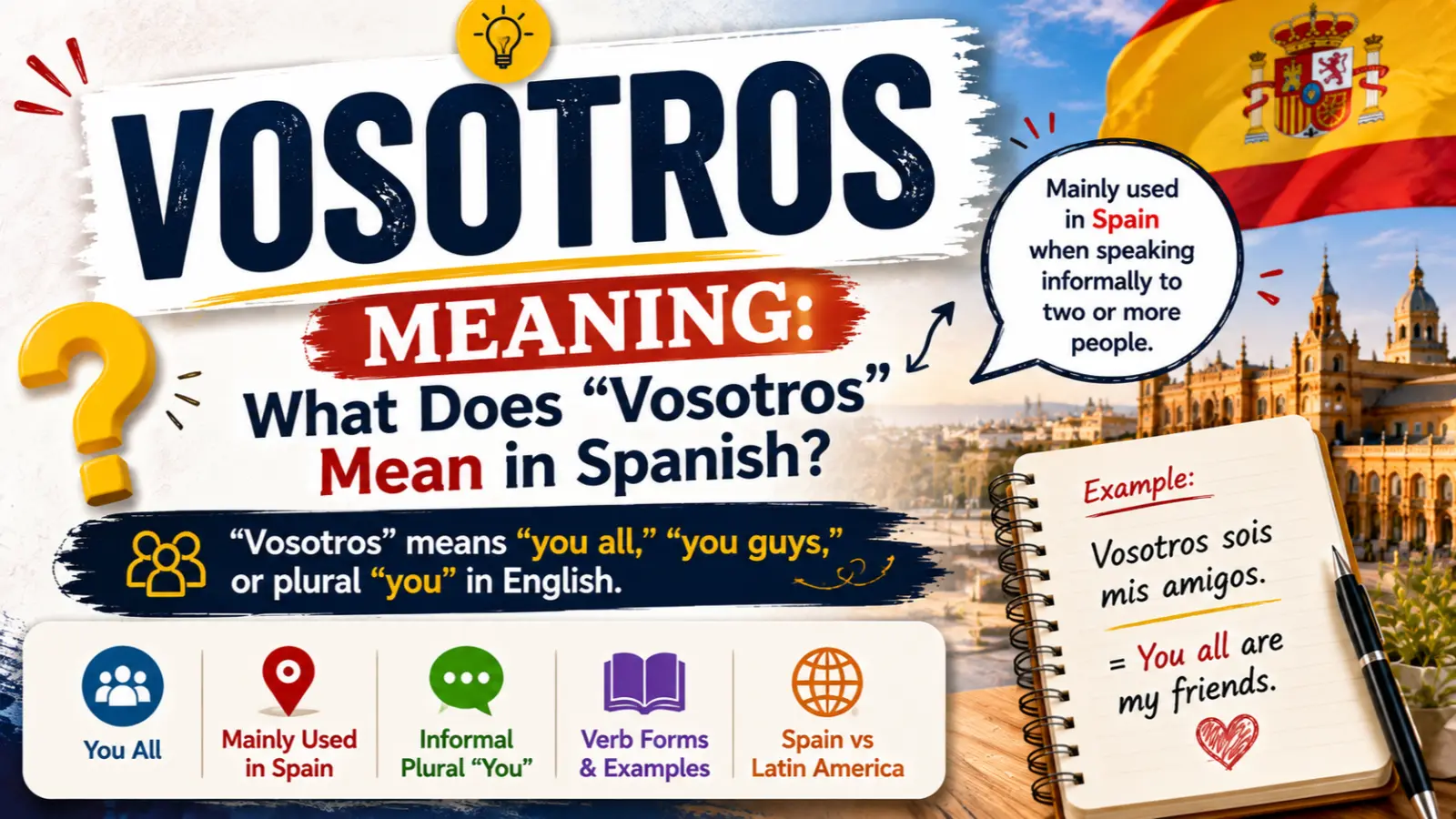
If you are learning Spanish, vosotros means “you all,” “you guys,” or plural “you” in English.

It is mainly used in Spain when speaking informally to two or more people. In most Latin American countries, ustedes is normally used instead. Learning vosotros also means understanding its verb forms, pronunciation, regional use, and difference from words such as tú, ustedes, nosotros, and ellos.

Spanish can feel confusing because English uses “you” for both one person and a group. Spanish has several pronouns that make these differences clearer. Once you understand where vosotros fits, many Spanish sentences become much easier to recognize.

This guide explains the vosotros meaning in English and Spanish, shows real examples, explains why Mexicans usually do not use it, and answers common questions such as whether vosotros means “y’all” or “they.”

Quick Answer: What Does Vosotros Mean?

Vosotros means “you all,” “you guys,” or “you” when talking informally to two or more people. It is mainly used in Spain.

For example:

Vosotros sois mis amigos.
= You all are my friends.

The word refers directly to the people you are talking to. It does not mean “they.”

A simple way to remember it is:

Spanish wordSimple English meaningMain use
youOne person, informal
vosotrosyou all / you guysSeveral people, informal, mainly Spain
ustedesyou allSeveral people; standard in Latin America
nosotroswe / usThe speaker and others
ellostheyOther people, not the people being addressed

So, if you are talking directly to three friends in Spain, vosotros can mean “you guys.”

Vosotros Meaning in English

The closest English translations of vosotros are:

  • you all
  • you guys
  • all of you
  • you (plural)

There is no single English pronoun that matches vosotros perfectly in every situation.

For example:

¿Vosotros habláis inglés?
= Do you all speak English?

¿Vosotros venís mañana?
= Are you guys coming tomorrow?

Vosotros sois muy amables.
= You all are very kind.

In American English, “you guys” is often a natural translation in casual conversation. In some parts of the United States, people also use “y’all” to mean plural “you.” However, these English expressions do not mean that vosotros is an American slang word. Vosotros is a Spanish grammatical pronoun.

The important point is that vosotros addresses a group directly.

What Does Vosotros Mean in Spanish?

In Spanish grammar, vosotros is the second-person plural informal pronoun.

That sounds technical, but the idea is simple. It means you are:

  1. Speaking directly to people.
  2. Talking to more than one person.
  3. Using an informal or familiar form.
  4. Mainly speaking Spanish as used in Spain.

For example, imagine four friends are planning dinner.

¿Vosotros queréis pizza?

This means:

Do you guys want pizza?

The speaker is talking directly to the four friends, so vosotros fits the situation.

If the speaker were talking about those friends to someone else, vosotros would not be correct.

For example:

Ellos quieren pizza.
= They want pizza.

That difference between vosotros and ellos is important.

Does Vosotros Mean “Y’all”?

Yes, roughly speaking.

The English expression “y’all” means “you all” and is used in some varieties of American English, especially in the Southern United States. It refers to more than one person.

Vosotros can serve a similar grammatical purpose in Spanish from Spain.

For example:

Y’all are ready.
Vosotros estáis listos.

Both sentences address a group directly.

However, they are not exactly the same type of expression. Y’all is an English contraction, while vosotros is a standard Spanish pronoun with its own verb forms.

So if someone asks, “Does vosotros mean y’all?”, the simplest answer is:

Yes. Vosotros can be translated as “y’all,” “you all,” or “you guys,” depending on the context.

When Is Vosotros Used?

Vosotros is mainly used in Spain, especially in informal situations.

People may use it when speaking to:

  • Friends
  • Family members
  • Classmates
  • Children
  • Close coworkers
  • Groups of people they address informally

For example:

¿Vosotros vais al cine esta noche?
= Are you guys going to the movies tonight?

¿Vosotros tenéis hambre?
= Are you all hungry?

¿Vosotros vivís aquí?
= Do you all live here?

Vosotros is not an outdated word in Spain. It is part of normal everyday Spanish there.

However, Spanish varies greatly from one country to another. A form that is completely normal in Spain may be uncommon in another Spanish-speaking country.

Vosotros vs Ustedes

One of the most important things to understand is the difference between vosotros and ustedes.

Both can refer to a group of people being addressed, but their regional and social use is different.

FeatureVosotrosUstedes
MeaningYou all / you guysYou all
NumberTwo or moreTwo or more
Main regionSpainLatin America and Spain
Informal useCommon in SpainStandard in Latin America
Formal useNot normally used for formal plural addressUsed for formal plural address in Spain
Verb examplevosotros habláisustedes hablan

For example, in Spain:

Vosotros habláis español.
= You all speak Spanish.

In Mexico:

Ustedes hablan español.
= You all speak Spanish.

The basic meaning is similar, but the grammar is different.

Why Don’t Mexicans Say “Vosotros”?

Mexicans generally do not use vosotros in ordinary everyday conversation because Mexican Spanish uses ustedes as the normal plural form of “you.”

For example, a Mexican speaker would normally say:

¿Ustedes quieren comer?
= Do you all want to eat?

A speaker from Spain might say:

¿Vosotros queréis comer?

Neither form is “more correct.” They belong to different regional varieties of Spanish.

This is an important point for Spanish learners. Vosotros is not bad Spanish, and ustedes is not bad Spanish. The best choice depends on the variety of Spanish you are learning or speaking.

If your goal is to communicate naturally in Mexico, using ustedes is usually the better choice. If you are learning Spanish from Spain, you should learn vosotros.

Why Shouldn’t You Say Vosotros?

There is no general rule saying that you should never say vosotros.

The real issue is regional usage.

If you use vosotros in Spain, it is completely normal in informal speech. But if you use it in Mexico or most of Latin America, it may sound unusual because people there normally use ustedes.

For example, a Spanish learner in Mexico who says:

¿Vosotros queréis café?

will probably be understood, especially by educated Spanish speakers who know different varieties of Spanish. However, it may sound like the speaker learned Spanish from Spain.

A more natural Mexican-style sentence would be:

¿Ustedes quieren café?

Therefore, the better rule is:

Use vosotros when following Spanish from Spain. Use ustedes when following most Latin American Spanish.

Vosotros vs Tú

The difference between and vosotros is mainly the number of people.

is used for one person.

Vosotros is used for two or more people.

Compare:

Tú eres mi amigo.
= You are my friend.

Vosotros sois mis amigos.
= You all are my friends.

Another example:

Tú tienes tiempo.
= You have time.

Vosotros tenéis tiempo.
= You all have time.

This distinction is easy to remember:

tú = one informal person

vosotros = several informal people

Vosotros vs Nosotros

The difference between vosotros and nosotros is very important because the two words look similar.

Vosotros means you all.

Nosotros means we or us.

The key difference is who is included in the group.

PronounEnglish meaningWho is included?
vosotrosyou allThe people being spoken to
nosotroswe / usThe speaker and at least one other person
ustedesyou allThe people being spoken to
ellostheyOther people being talked about

Imagine that you and your friends are going to a restaurant.

If you are talking to your friends, you could say:

Vosotros vais al restaurante.
= You all are going to the restaurant.

If you are talking about yourself and your friends to someone else, you could say:

Nosotros vamos al restaurante.
= We are going to the restaurant.

The easiest memory trick is:

vosotros = you

nosotros = we

The nos- part is connected to the idea of “us,” while vosotros refers to the people being addressed.

Does Vosotros Mean “They”?

No. Vosotros does not mean “they.”

This is a common question among Spanish beginners.

Vosotros means you all because you are speaking directly to the group.

For “they,” Spanish normally uses:

ellos for a male or mixed group

ellas for a group of females

Compare:

Vosotros coméis.
= You all eat.

Ellos comen.
= They eat.

The difference becomes especially clear when you look at the verb:

vosotros coméis

ellos comen

The verb ending helps show which subject is being used.

Vosotros and Vosotras

Spanish also has the feminine form vosotras.

Vosotros is generally used for a male group or a mixed-gender group.

Vosotras is generally used when speaking to a group made up entirely of females.

For example:

Vosotros sois mis amigos.
= You all are my friends.

If you are speaking to several female friends:

Vosotras sois mis amigas.
= You all are my female friends.

The basic meaning remains “you all.” The difference is grammatical gender.

How Vosotros Changes Spanish Verbs

Vosotros Changes Spanish Verbs

One of the most useful things about learning vosotros is learning its common verb endings.

Regular present-tense verbs often follow these patterns:

Verb groupInfinitiveVosotros formEnglish
-arhablarhabláisyou all speak
-ercomercoméisyou all eat
-irvivirvivísyou all live

The endings are:

-ar → -áis

-er → -éis

-ir → -ís

For example:

Vosotros habláis español.
= You all speak Spanish.

Vosotros coméis juntos.
(You all eat together)

Vosotros vivís en España.
= You all live in Spain.

These endings are especially useful when the pronoun itself is left out.

Common Vosotros Examples

Here are some everyday examples that show how vosotros works in real sentences.

¿Vosotros habláis inglés?
= Do you all speak English?

¿Vosotros estudiáis español?
= Do you all study Spanish?

Vosotros trabajáis mucho.
= You all work a lot.

¿Vosotros coméis aquí?
= Do you all eat here?

Vosotros vivís cerca.
= You all live nearby.

¿Vosotros escribís cartas?
= Do you all write letters?

Vosotros aprendéis rápido.
= You all learn quickly.

Notice how the verb changes with the subject.

Vosotros in a Sentence

If you are searching for vosotros in a sentence, these examples make the usage clear.

Vosotros sois mis mejores amigos.
= You all are my best friends.

¿Vosotros vais a la fiesta?
= Are you guys going to the party?

Vosotros tenéis mucho trabajo.
= You all have a lot of work.

¿Dónde vivís vosotros?
= Where do you all live?

Vosotros no habláis francés.
= You all do not speak French.

The pronoun can appear at the beginning or end of a sentence. Spanish often leaves subject pronouns out because the verb ending already provides useful information.

For example:

¿Habláis español?

can mean:

Do you all speak Spanish?

The -áis ending tells us that the subject is vosotros.

Vosotros With Common Spanish Verbs

Some common vosotros forms are irregular, so they are worth memorizing.

For example:

Vosotros sois estudiantes.
= You all are students.

¿Vosotros estáis cansados?
= Are you all tired?

¿Vosotros tenéis tiempo?
= Do you all have time?

Vosotros vais a Madrid.
= You all are going to Madrid.

Learning these common forms can make Spanish from Spain much easier to understand.

Vosotros in Questions

Vosotros is very common in questions.

For example:

¿Vosotros queréis café?
= Do you all want coffee?

¿Vosotros venís mañana?
= Are you all coming tomorrow?

¿Vosotros tenéis hambre?
= Are you all hungry?

¿Vosotros conocéis a María?
= Do you all know María?

The pronoun can also be omitted:

¿Queréis café?

The sentence still means:

Do you all want coffee?

This is because queréis identifies the vosotros form.

Vosotros in Negative Sentences

Negative sentences usually place no before the verb.

For example:

Vosotros no habláis inglés.
= You all do not speak English.

Vosotros no tenéis tiempo.
You all do not have time.

Vosotros no vivís aquí.
= You all do not live here.

The basic pattern is:

vosotros + no + verb

You can also leave out vosotros:

No tenéis tiempo.

This still means:

You all do not have time.

Is Vosotros Formal or Informal?

Vosotros is informal.

It is mainly used in Spain when speaking to a group in a familiar or casual way.

For formal plural address in Spain, ustedes can be used. However, actual use can vary by region and social setting.

In most of Latin America, ustedes is used for plural “you” in both informal and formal situations.

This gives learners a useful basic rule:

Spain: vosotros = informal plural “you”

Latin America: ustedes = normal plural “you”

The details can vary by country, but this rule works well for beginners.

Is Vosotros Used in Latin America?

In most Latin American Spanish, vosotros is not part of normal everyday speech.

Instead, speakers generally use ustedes.

For example, in many Latin American settings:

Ustedes son mis amigos.
= You all are my friends.

In Spain:

Vosotros sois mis amigos.
= You all are my friends.

There are historical and regional reasons for these differences, but learners do not need to memorize every detail to use the language correctly.

The important thing is to recognize that Spanish is not exactly the same in every country.

What Does “Vosotros Meaning Bad” Refer To?

If you have seen searches such as “vosotros meaning bad,” there is an important clarification to make.

Vosotros does not have a standard bad, rude, or offensive meaning in Spanish.

It is an ordinary grammatical pronoun.

The word can seem strange or “bad” to a learner if they have been taught Latin American Spanish and suddenly see vosotros in Spanish from Spain. However, that is a regional difference, not a negative meaning.

For example:

Vosotros sois amigos.

There is nothing rude or negative about the word vosotros itself.

How Do You Pronounce Vosotros?

For an English speaker, a rough pronunciation is:

vosotros → boh-SOH-trohs

The exact sound can vary depending on the speaker and region.

The feminine form vosotras is roughly:

boh-SOH-trahs

Do not worry if your pronunciation is not perfect at first. Listening to native speakers from Spain is one of the best ways to become comfortable with the sound.

Common Mistakes With Vosotros

A common mistake is thinking vosotros means “they.” It does not. Remember that vosotros addresses the people you are speaking to.

Another mistake is using vosotros with a singular person. For one informal person, use .

Learners also sometimes assume vosotros should be used in every Spanish-speaking country. That is not true. Regional differences matter.

Another common mistake is using the wrong verb ending. For example:

Vosotros habláis is correct.

Vosotros hablan is not the standard present-tense vosotros form.

Similarly:

Vosotros coméis is correct.

Vosotros comen belongs to another grammatical form.

Finally, do not assume that vosotros is “better” or “more correct” than ustedes. Both are correct in the varieties where they are used.

Should You Learn Vosotros?

Yes, even if you plan to study Latin American Spanish.

If your goal is to speak Spanish in Mexico, Colombia, or most other Latin American countries, you will normally use ustedes rather than vosotros.

Still, understanding vosotros can help you read books, watch Spanish television, listen to Spanish music, understand Spanish grammar lessons, and communicate with people from Spain.

If you plan to live, study, or travel in Spain, learning to use vosotros is especially useful.

You do not need to master every verb form immediately. Start with the most common patterns:

habláis, coméis, vivís, sois, estáis, tenéis, vais, and queréis.

Once these forms become familiar, you will start recognizing vosotros naturally.

Frequently Asked Questions About Vosotros

Why don’t Mexicans say “vosotros”?

Mexicans generally do not use vosotros in everyday speech because Mexican Spanish normally uses ustedes for plural “you.” Vosotros is mainly associated with informal Spanish from Spain.

Does “vosotros” mean “y’all”?

Yes, approximately. Vosotros can be translated as “y’all,” “you all,” or “you guys.” It refers to more than one person being addressed informally, mainly in Spain.

Why shouldn’t you say “vosotros”?

You can say vosotros when speaking Spanish from Spain. There is no general rule against it. However, if you want to sound natural in Mexico or most of Latin America, ustedes is normally the better choice.

What is the difference between vosotros and nosotros?

Vosotros means “you all” and refers to the people you are speaking to. Nosotros means “we” or “us” and includes the speaker. For example, vosotros coméis means “you all eat,” while nosotros comemos means “we eat.”

Does vosotros mean “they”?

No. Vosotros means “you all,” not “they.” Spanish normally uses ellos or ellas for “they.” Compare vosotros habláis (“you all speak”) with ellos hablan (“they speak”).

What is the difference between vosotros and ustedes?

Both can mean plural “you,” but vosotros is mainly the informal plural form in Spain. Ustedes is the normal plural “you” form throughout Latin America and is also used for formal plural address in Spain.

Conclusion

The simplest vosotros meaning is “you all,” “you guys,” or plural “you.” It is mainly used in Spain when speaking informally to two or more people. The word does not mean “they,” and it does not have a bad or offensive meaning.

The biggest thing to remember is the regional difference. People in Spain commonly use vosotros, while people in Mexico and most of Latin America normally use ustedes. Both are correct within their usual varieties of Spanish.

If you are learning Spanish, start by connecting tú = you (one person), vosotros = you all (informal, Spain), ustedes = you all, and nosotros = we. Then practice common forms such as habláis, coméis, vivís, sois, estáis, and tenéis. Once these patterns become familiar, recognizing vosotros in Spanish conversations and writing becomes much easier.

Leave a Reply

Your email address will not be published. Required fields are marked *