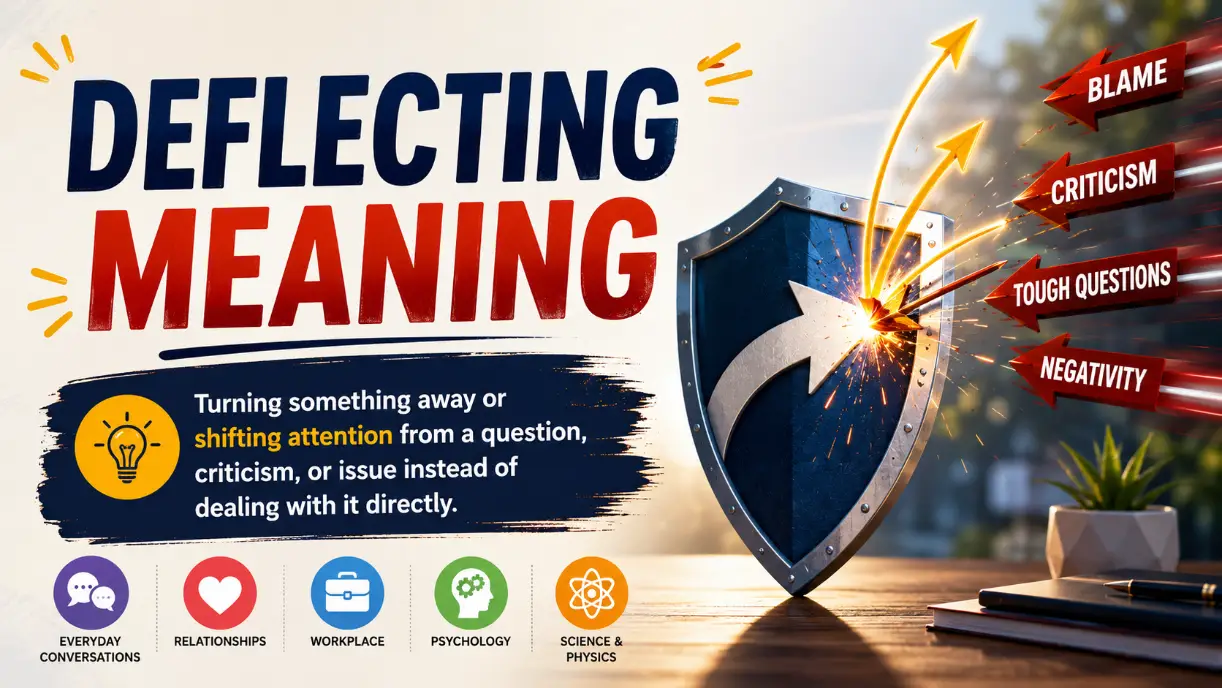
Deflecting means avoiding a question, criticism, or uncomfortable issue by shifting attention somewhere else.
For example, if someone asks, “Did you make that mistake?” and you respond, “Why were you checking my work?” instead of answering, you may be deflecting.
The word can also have a literal meaning, such as a ball changing direction after hitting something.
In this guide, you’ll learn the deflecting meaning in simple English, with clear examples, synonyms, everyday usage, and the difference between deflecting and reflecting.
What Does Deflecting Mean?
Deflecting is the -ing form of the verb deflect. In simple English, it means turning something away or changing its direction.
The word can describe a physical object or an idea in a conversation.
There are two main meanings:
- Physical meaning: Something changes direction after hitting or being affected by something else.
- Figurative meaning: Someone avoids a question, criticism, blame, or issue by shifting attention somewhere else.
For example:
The ball was deflecting off the player’s foot.
Here, the ball physically changes direction.
Now consider:
He kept deflecting when I asked him about the mistake.
Here, deflecting means avoiding the question instead of dealing with it directly.
The figurative meaning is especially common when people talk about relationships, arguments, interviews, workplace conversations, politics, and communication.
Deflecting in Simple English
The easiest way to understand deflecting is:
Deflecting means turning something away instead of dealing with it directly.
Imagine that someone throws a ball toward you. You use your hand to send the ball in another direction. You have deflected the ball.
The same basic idea can happen during a conversation.
Someone asks:
“Why didn’t you finish your work?”
You answer:
“Why are you always criticizing me?”
You did not answer the original question. Instead, you moved the conversation toward the other person’s behavior.
That can be called deflecting.
Deflecting does not always mean lying. Someone might deflect because they feel embarrassed, uncomfortable, defensive, confused, or simply do not know how to respond.
The key idea is that the original issue gets pushed aside or redirected.
The Two Main Meanings of Deflecting
Context usually tells you which meaning of deflecting is intended.
| Meaning | Simple explanation | Example |
|---|---|---|
| Physical | Something changes direction | The ball deflected off his knee. |
| Figurative | Attention or an issue is redirected | She kept deflecting the question. |
The physical meaning is common in sports, physics, science, and technical writing.
The figurative meaning is common in everyday conversations, relationships, interviews, news, and workplace discussions.
Deflecting Meaning in Physics
In physics, deflecting means changing the direction of an object, particle, wave, or other physical thing because of an interaction or force.
For example:
The ball deflected after hitting the wall.
The ball was moving in one direction and then changed direction.
Another example is:
The metal surface deflected the incoming object.
In physics and science, deflection can happen because of forces, collisions, electric or magnetic fields, or contact with another object.
The basic idea remains simple:
Something is moving in one direction, and its path changes.
This is different from the conversational meaning, but both meanings come from the same basic idea of turning something away from its path.
Deflecting Meaning in Science
The deflecting meaning in science is similar to its meaning in physics. It generally describes something being pushed, bent, or moved away from its original path or direction.
For example:
The force caused the object to deflect from its original path.
You may also see words such as deflection and deflected in scientific or technical writing.
The exact meaning depends on the subject. In one situation, an object may physically change direction. In another, a beam, particle, wave, or structure may move away from its original position or path.
So, when you see deflecting in science, think:
changing direction or moving away from the original path.
Figurative Meaning of Deflecting
The figurative meaning of deflecting is about redirecting something that is aimed at a person or issue.
That “something” might be:
- A question
- Criticism
- Blame
- Responsibility
- Attention
- An accusation
- An uncomfortable topic
For example:
The manager kept deflecting questions about the delayed project.
The manager is not physically moving anything. Instead, the manager is avoiding the questions or shifting attention elsewhere.
This is why someone might say:
“You’re deflecting.”
They usually mean:
“You’re avoiding the issue and moving the focus somewhere else.”
Deflecting Meaning in a Conversation
The deflecting meaning in a conversation is usually avoiding a direct response by changing the focus.
For example:
“Did you send the email?”
A direct answer would be:
“No, I forgot.”
A deflecting answer might be:
“Why didn’t you remind me?”
The second answer does not directly answer the question.
Here is another example:
“You hurt my feelings yesterday.”
A direct response could be:
“I’m sorry. I didn’t realize I hurt you.”
A deflecting response might be:
“You’re too sensitive.”
The second response shifts attention from the person’s behavior to the other person’s reaction.
That is why deflecting in a conversation can make an issue difficult to resolve.
Deflecting Meaning in Relationships
The deflecting meaning in relationships usually refers to shifting attention away from a concern instead of addressing it directly.
For example:
“I felt ignored when you didn’t answer my messages.”
The other person says:
“You ignore me all the time.”
That response may be deflecting because it introduces another complaint instead of first responding to the original concern.
Another example:
“You promised you would help me.”
“You never appreciate anything I do.”
The second statement may describe a real feeling, but it does not directly answer the original concern.
Deflecting can make communication harder because the first issue may never be discussed.
However, not every disagreement is deflecting. A person may bring up another issue because it is genuinely relevant.
For example:
“I felt ignored yesterday.”
“I’m sorry. I was dealing with an emergency, and I should have told you.”
This is not necessarily deflecting. The person is explaining what happened while still responding to the concern.
Context is important.
Deflecting Meaning in Psychology
The phrase deflecting meaning in psychology is often used in everyday discussions about behavior and communication.
In this context, deflecting generally describes a behavior where someone moves attention away from themselves, a difficult issue, criticism, or responsibility.
For example:
“Why did you say that to her?”
“Why are you always judging me?”
The second person has shifted attention away from the original question.
People may deflect for many reasons. They might feel:
- Defensive
- Embarrassed
- Uncomfortable
- Threatened
- Ashamed
- Unprepared to answer
- Concerned about privacy
Deflecting by itself does not prove that someone is dishonest or intentionally manipulative.
It is better to look at the whole pattern of communication rather than label someone based on one response.
What Does “You’re Deflecting” Mean?
When someone says “You’re deflecting,” they usually mean:
“You are avoiding my question or concern and shifting the focus somewhere else.”
For example:
“Why did you cancel the appointment?”
“Why do you always question my decisions?”
“You’re deflecting. I’m asking why you canceled the appointment.”
The speaker believes the other person has avoided the original question.
However, the accusation may not always be correct. A person may be explaining their answer, correcting a false assumption, or bringing up an important related issue.
So, saying “You’re deflecting” does not automatically prove that someone is avoiding responsibility.
Examples of Deflecting
Here are some simple examples of deflecting in everyday situations.
At work:
“Why was the report late?”
“The other team was late too.”
The answer shifts attention to another team.
Between friends:
“You didn’t call me back yesterday.”
“You never call me first.”
The response changes the focus from yesterday’s missed call to the other person’s behavior.
During an interview:
“Did your company make a mistake?”
“Our competitors have made much bigger mistakes.”
The answer focuses on competitors instead of the original question.
In a family conversation:
“Did you break the lamp?”
“Why does everyone always blame me?”
The person responds to the blame rather than answering the question.
Online:
“Your post contains incorrect information.”
“You don’t know anything about this subject.”
The response attacks the other person’s knowledge instead of addressing the information.
In all of these examples, the conversation moves away from the original issue.
Deflecting in a Sentence
Here are natural examples of deflecting in a sentence:
He kept deflecting when I asked about the missing money.
She was deflecting questions about the decision.
The employee tried to deflect blame onto a coworker.
The player was deflecting the ball away from the goal.
The official appeared to be deflecting questions from reporters.
I wasn’t trying to deflect; I was explaining what happened.
Stop deflecting and answer the question.
Notice that deflecting can describe both physical movement and conversational behavior.
You can say:
- deflecting the ball
- deflecting criticism
- deflecting blame
- deflecting questions
- deflecting attention
Common Phrases With Deflecting
Some phrases with deflecting are especially common.
Deflecting blame means trying to make another person appear responsible.
The employee tried to deflect blame onto his coworker.
Deflecting criticism means moving attention away from criticism instead of addressing it.
The company was accused of deflecting criticism.
Deflecting questions means avoiding a direct answer.
The candidate kept deflecting questions about the policy.
Deflecting attention means moving people’s attention away from a person, subject, or problem.
The announcement seemed designed to deflect attention from the main issue.
These phrases all connect to the basic idea of turning something away.
Deflecting vs Avoiding
Deflecting and avoiding are closely related, but they are not exactly the same.
Avoiding means staying away from something.
Deflecting often suggests actively redirecting it.
For example:
She avoided the question.
This simply means she did not answer it.
But:
She deflected the question by asking about someone else’s behavior.
This explains how she avoided it: she redirected the conversation.
| Word | Simple meaning | Example |
|---|---|---|
| Avoid | Stay away from something | He avoided the subject. |
| Deflect | Redirect something away | He deflected the question. |
So, deflecting can be a form of avoidance, but it usually gives the idea of shifting the focus somewhere else.
Deflecting vs Diverting
Diverting means changing the direction or course of something.
Deflecting has a similar meaning, especially when something is turned away from a target.
For example:
The road was closed, so traffic was diverted.
Traffic was sent along another route.
Compare that with:
The defender deflected the ball.
The ball changed direction.
Both words can describe redirection, but deflecting is often used when something is turned away from a direct path, target, question, or criticism.
Deflecting vs Changing the Subject
Changing the subject and deflecting may look similar, but they are not always the same.
Changing the subject is a normal part of conversation.
For example:
“What movie did you watch?”
“I watched a comedy. By the way, did you see the new restaurant downtown?”
That is simply a topic change.
Deflecting is more likely when someone changes the subject to avoid dealing with an important question or issue.
For example:
“Did you spend the money?”
“Speaking of money, have you seen how expensive groceries are now?”
That could be an attempt to deflect the question.
The main difference is context and purpose.
Deflecting vs Projecting
Deflecting and projecting are sometimes confused, especially during arguments.
Deflecting means shifting attention away from yourself or the original issue.
Projecting can mean attributing your own feelings, thoughts, or behavior to another person.
For example:
“You’re being selfish!”
If the person making the accusation is actually behaving selfishly, that may be described as projection.
If someone is asked about their own behavior and responds by attacking the other person’s behavior instead, that may be deflection.
The two behaviors can occur together, but they do not mean the same thing.
Deflecting vs Reflecting
The words deflecting and reflecting look and sound somewhat similar, but their meanings are different.
Deflecting means turning something away or changing its direction.
Reflecting usually means sending something back, showing an image, or thinking carefully about something.
For example:
The shield is deflecting the ball.
The ball is being turned away.
But:
The mirror is reflecting the light.
The light is being sent back from the surface.
This distinction also helps answer searches such as “define reflect,” “definition of reflect,” “reflect meaning,” “reflected definition,” and “reflects definition.”
In simple English:
- Deflect = turn something away
- Reflect = send something back or think deeply about something
Synonyms for Deflecting
The best synonym depends on the context.
| Synonym | Simple meaning |
|---|---|
| Avoiding | Staying away from something |
| Dodging | Avoiding something, often deliberately |
| Evading | Avoiding a question or issue |
| Diverting | Sending something in another direction |
| Redirecting | Moving attention somewhere else |
| Shifting | Moving focus from one thing to another |
For example:
He’s dodging the question.
This is a casual way to say that someone is avoiding the question.
The witness was evading the question.
This sounds more formal.
She redirected the conversation.
This sounds more neutral.
Deflecting often suggests that something was directed toward a person or issue and then pushed away.
Antonyms of Deflecting
There is no single perfect opposite of deflecting in every situation.
Depending on the context, useful opposites include:
- Addressing
- Answering
- Acknowledging
- Facing
- Confronting
- Accepting
- Taking responsibility
For example:
He kept deflecting the criticism.
An opposite idea would be:
He acknowledged the criticism and responded to it.
Or:
She stopped deflecting blame and accepted responsibility.
The best opposite depends on what the person is expected to do.
Is Deflecting Always Bad?
No. Deflecting is not always bad.
In a physical situation, deflecting can be useful.
For example:
The shield deflected the blow.
That is a protective action.
In conversation, avoiding a question can also be reasonable in some situations.
For example:
“Why did you miss work because of your medical condition?”
Someone might answer:
“I’d rather keep my medical information private.”
That is not necessarily dishonest. The person may simply be setting a reasonable boundary.
Deflecting becomes more problematic when someone repeatedly uses it to avoid reasonable questions, escape responsibility, or stop an important conversation from moving forward.
How to Tell If Someone Is Deflecting
One change of subject does not automatically mean someone is deflecting.
Look at the entire conversation and watch for a repeated pattern.
Possible signs include:
- They repeatedly avoid the original question.
- They answer a different question.
- They quickly blame another person.
- They turn a specific issue into a personal attack.
- They keep changing the topic when responsibility comes up.
- They focus on someone else’s mistakes instead of their own.
- They respond to criticism without addressing the actual concern.
For example:
“Did you send the file?”
“You never trust me.”
“That’s not what I asked. Did you send it?”
“You always make everything into a big deal.”
If this pattern continues, the behavior may reasonably be described as deflecting.
Still, context matters. Someone could be stressed, confused, or trying to explain an important part of the situation.
How to Respond When Someone Is Deflecting
If you believe someone is deflecting, staying calm can help keep the conversation productive.
Instead of saying:
“You’re impossible.”
Try:
“I understand that, but I’d still like to answer the original question.”
You can also separate the two issues:
“We can talk about that next. First, can you answer what I asked?”
Another option is:
“That may be a separate concern, and I’m willing to discuss it. Right now, I’m asking about what happened yesterday.”
These responses keep the conversation focused without creating another argument.
Deflecting Grammar and Correct Usage
Deflecting is the present participle and gerund form of deflect.
| Form | Example |
|---|---|
| Base form | deflect |
| Third person | deflects |
| Past tense | deflected |
| Past participle | deflected |
| -ing form | deflecting |
Examples:
He deflects criticism easily.
She deflected the question.
They have deflected attention from the issue.
He is deflecting again.
The word can be followed by different objects depending on the context:
deflecting the ball
deflecting criticism
deflecting blame
deflecting questions
deflecting attention
How Do You Pronounce Deflecting?
Deflecting is pronounced approximately:
di-FLEK-ting
The stress is on FLEK.
The base word deflect is pronounced approximately di-FLEKT.
In phonetic notation, deflect is commonly represented as:
/dɪˈflekt/
The pronunciation is essentially the same in American and British English, although individual accents can vary.
Is Deflecting Formal or Informal?
Deflecting is a standard English word. It can be used in both formal and informal situations.
You may see it in:
- Everyday conversations
- Workplace discussions
- News reports
- Interviews
- Sports writing
- Academic writing
- Technical writing
- Political discussions
For example:
The official was accused of deflecting questions.
In casual English, people may use simpler expressions such as:
“He’s avoiding the question.”
“She’s dodging the issue.”
“He’s changing the subject.”
So, deflecting is not slang.
Deflecting Meaning in French
The English word deflecting can be translated into French in different ways depending on the context.
For physical movement, dévier can be used.
For example:
The ball was deflected.
A French translation may use:
Le ballon a dévié.
For the figurative meaning, such as shifting attention or avoiding an issue, expressions involving détourner may be more natural depending on the sentence.
So, the best French translation depends on whether deflecting is being used physically or figuratively.
Deflecting Meaning in Arabic
The Arabic translation of deflecting also depends on the context.
For the physical meaning of turning something away, words such as:
يَصُدّ or يُحَرِّف
may be appropriate depending on what is being described.
For the conversational meaning, phrases involving تحويل الانتباه can express the idea of shifting attention.
For example, the idea of deflecting attention can be expressed as:
تحويل الانتباه
The important point is that there is not always one Arabic word that works perfectly in every context. The best translation depends on the sentence.
Where Does the Word Deflect Come From?
The word deflect comes from Latin and is connected with the idea of bending or turning away.
That basic idea explains both modern meanings.
A physical object can be turned away from its path.
A question or criticism can also be turned away from a person by shifting the conversation.
So, even though the physical and figurative meanings are different, they share the same central idea:
something is directed one way and then turned somewhere else.
Common Mistakes With Deflecting
One common mistake is thinking that deflecting always means lying.
It does not.
Someone can deflect without saying anything false. They may simply avoid the question or move the focus elsewhere.
Another mistake is assuming that every topic change is deflecting.
People naturally change topics during conversations. A topic change becomes more clearly deflective when it avoids dealing with the issue being discussed.
Another common mistake is confusing deflecting with deflating.
These words have completely different meanings.
Deflecting means turning something away or shifting focus.
Deflating can mean letting air out of something or making someone feel less confident.
For example:
The goalkeeper was deflecting the ball.
But:
The criticism left him feeling deflated.
These sentences describe very different ideas.
Frequently Asked Questions About Deflecting Meaning
What does deflecting mean in simple words?
Deflecting means turning something away or shifting attention somewhere else. In conversation, it often means avoiding a question, criticism, blame, or uncomfortable issue instead of addressing it directly.
What does it mean when someone is deflecting?
It usually means the person is moving attention away from the original issue. They may avoid a question, blame another person, or introduce a different topic instead of responding directly.
What is deflecting in a relationship?
Deflecting in a relationship usually means shifting attention away from a concern instead of addressing it. For example, when one partner raises a problem and the other immediately brings up a different complaint, that may be deflecting.
What does deflecting mean in psychology?
In everyday psychology-related discussions, deflecting usually refers to shifting attention away from criticism, responsibility, an uncomfortable issue, or a difficult question. It does not automatically mean that someone is lying or being manipulative.
Is deflecting the same as avoiding?
They are closely related, but they are not exactly the same. Avoiding means staying away from something, while deflecting often involves actively redirecting attention or the issue somewhere else.
What is an example of deflecting?
If someone asks, “Why were you late?” and you answer, “You’re always criticizing me,” you may be deflecting because you did not directly answer why you were late.
What are synonyms for deflecting?
Common related words include avoiding, dodging, evading, diverting, redirecting, and shifting. The best choice depends on the context.
What is the difference between deflecting and reflecting?
Deflecting means turning something away or changing its direction. Reflecting can mean sending something back, such as light, or thinking carefully about something.
Is deflecting always a bad thing?
No. A physical object can be deflected in a useful way, such as a shield deflecting a blow. In conversation, refusing to answer can also be reasonable when someone is protecting private information or setting a boundary.
What does “you’re deflecting” mean?
It usually means, “You’re avoiding my question or concern and shifting the focus somewhere else.”
Conclusion
The simplest deflecting meaning is turning something away from its original direction. In physical situations, a ball or another object can deflect after hitting something. In conversations, deflecting usually means shifting attention away from a question, criticism, blame, or uncomfortable issue.
The word is useful because it means more than simply avoiding. It often suggests that someone is actively redirecting the focus somewhere else. However, context matters. Not every change of subject is deflection, and deflecting does not automatically mean someone is lying.
Whether you see deflecting in relationships, psychology, conversations, physics, or science, the central idea remains the same: something is being turned away from its original path or focus.
If you remember that simple idea, it becomes much easier to understand and use deflecting correctly.

Hi, I’m Mia Walker, a Content Research Writer at Hublioo.com with 3+ years of experience in creating educational language content.
I enjoy breaking down complex words, internet slang, abbreviations, and everyday expressions into clear, practical explanations that anyone can understand.
My focus is on delivering original, easy-to-read, and well-organized content that helps readers expand their vocabulary and use English with greater confidence.