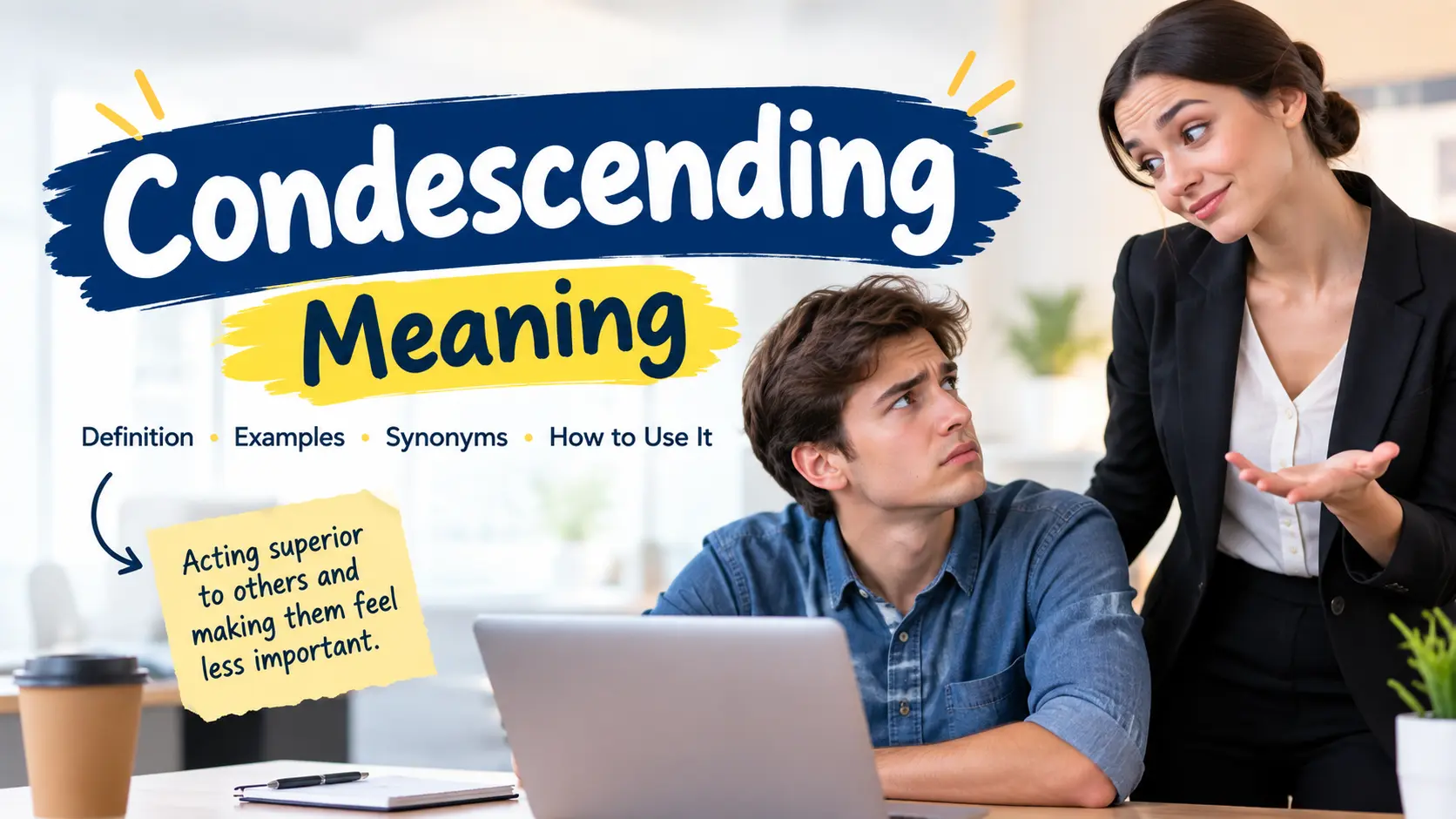
Quick answer: Condescending means treating someone as inferior — talking down through a superior tone, over-explaining, or dismissive remarks. It’s often unintentional (experts do it while trying to help), but the impact stings regardless. Ironically, the word once meant gracious humility.
| Element | Detail |
|---|---|
| Word | Condescending |
| Part of speech | Adjective |
| Simple meaning | Talking down to someone; treating them as inferior |
| Tone | Standard word for rude behavior |
| Origin | Latin condescendere — “to stoop down” (once positive!) |
| Signs | Over-explaining, “well actually,” dismissive praise |
| Closest synonym | Patronizing |
What Does “Condescending” Mean?
Condescending describes behavior or speech that treats someone as inferior — talking down to them as if they’re less intelligent, less experienced, or less important. The classic signs: over-explaining simple things, a patronizing tone, calling adults “sweetie” in a meeting, or saying “well, actually…” before every sentence.
Here’s the twist: condescension is often unintentional. Experts explaining their field, parents talking to teens, seniors briefing juniors — the knowledge gap is real, but the tone turns guidance into insult. Intent doesn’t erase impact, which is why the word stings even when no offense was meant.
What Are Examples of Condescending Behavior?
Realistic examples — spot the pattern:
- At work: “Let me explain this slowly so even you can follow.”
- In conversation: “Oh, that’s cute — you actually read the whole report?”
- Over-explaining: “A budget is, and I know this is complex, a plan for money.”
- Dismissive: “Don’t worry your pretty little head about the numbers.”
- Digital: Replying “per my last email 🙄” to a genuine question.
- Subtle: “I’m sure you did your best.” (praise that lands as pity)
Is “Condescending” Formal or Rude? Tone and Register
The word itself is standard English — formal enough for HR reports and essays. The behavior it describes is universally rude, whether intended or not. Being called condescending is one of the sharper social criticisms because it attacks not what you said but how you see the other person.
Tone check: labeling someone condescending is itself confrontational. In feedback, describe the behavior (“when you re-explained my own slide to me, it felt dismissive”) rather than the label — it lands better and starts a conversation instead of a fight.
Condescending vs. Patronizing: What’s the Difference?
Nearly synonyms, with a hair of difference. Condescending emphasizes talking down from above — the superior position. Patronizing emphasizes falsely kind treatment — the pitying pat on the head. “Let me simplify this for you” is condescending; “oh, you tried so hard, bless” is patronizing. Most real-world moments are a bit of both.
Both differ from mansplaining, which is specifically condescension across a gender dynamic. And a charlatan can sound condescending too — false expertise loves a superior tone.
Condescending Word Family: The Whole Superior Clan
Verb: condescend (“he condescended to answer”). Adjective: condescending. Noun: condescension (“an air of condescension”). Adverb: condescendingly (“she smiled condescendingly”). Note: “condescend” can also neutrally mean “to agree graciously” in very formal contexts — though the insult sense dominates.
Common mistake: calling explanations condescending when they’re just thorough. The difference is the assumption of inferiority: explaining clearly respects the listener; explaining down — with sighs, simplifications nobody asked for, and “well, actually” — is condescension. Tone, not content, is the tell.
Where Does the Word “Condescending” Come From?
Condescending comes from the Latin condescendere — “to descend together, to stoop to another’s level.” Originally it was positive: a noble person “condescending” to speak with commoners was showing gracious humility. Royal proclamations praised a monarch’s “condescension.”
The meaning flipped as equality became the ideal: what was once gracious stooping is now insulting superiority. The word kept its shape and reversed its moral — a neat fossil of changing social values.
What Are the Synonyms and Antonyms of “Condescending”?
Synonyms:
- Patronizing — the closest match
- Supercilious — formal, “eyebrow-raised” superiority
- Disdainful — contempt-flavored superiority
- Snobbish — class-flavored superiority
- Arrogant — broader overconfidence
Antonyms: humble, respectful, modest, egalitarian — all treat others as equals.
How Do You Respond to Someone Being Condescending?
Three options, escalating: 1) Name it lightly: “I know this stuff — you can skip the 101.” Humor defuses. 2) Ask a sharp question: answering with expertise (“actually, the Q3 numbers show…”) corrects the power dynamic without a lecture. 3) Address it directly: “When you explain my own work back to me, it feels dismissive — I need us to drop that.”
What not to do: match their tone. Out-condescending a condescending person just proves you both enjoy the game. Stay level, stay specific, and most people course-correct.
Further Reading
- Merriam-Webster — condescending
- Cambridge Dictionary — condescending
FAQs
What does condescending mean in simple words?
Treating someone as less intelligent or less important than you — “talking down” to them through tone, over-explaining, or dismissive remarks.
What is an example of condescending?
“Let me explain this slowly so even you can understand” — or explaining someone’s own job back to them. Tone and assumption of superiority are the giveaways.
Is condescending the same as rude?
It’s a specific flavor of rudeness: superiority-flavored. All condescension is rude, but not all rudeness is condescending.
Can you be condescending without meaning to?
Yes — very commonly. Experts, parents, and managers often sound condescending while trying to help. Impact matters more than intent here.
What is the difference between condescending and patronizing?
Condescending = talking down from above; patronizing = falsely kind, pitying treatment. They overlap heavily in practice.
How do I stop sounding condescending?
Ask before explaining (“do you want the quick version?”), skip what they already know, and watch for “well, actually” and over-simplification.
Key Takeaways
- Condescending = treating someone as inferior; talking down.
- Often unintentional — experts, parents, and managers do it while trying to help.
- From Latin condescendere, “to stoop down” — once a compliment, now an insult.
- Condescending = superior position; patronizing = pitying kindness.
- Respond: name it lightly, answer with expertise, or address it directly — never match the tone.
Read More Articles
🔮Brick and Mortar Meaning: Definition, Examples & Business Guide
🔮Intricate Meaning: Definition, Intricate vs Complex & Beautiful Examples

Hi, I’m Mia Walker, a Content Research Writer at Hublioo.com with 3+ years of experience in creating educational language content.
I enjoy breaking down complex words, internet slang, abbreviations, and everyday expressions into clear, practical explanations that anyone can understand.
My focus is on delivering original, easy-to-read, and well-organized content that helps readers expand their vocabulary and use English with greater confidence.