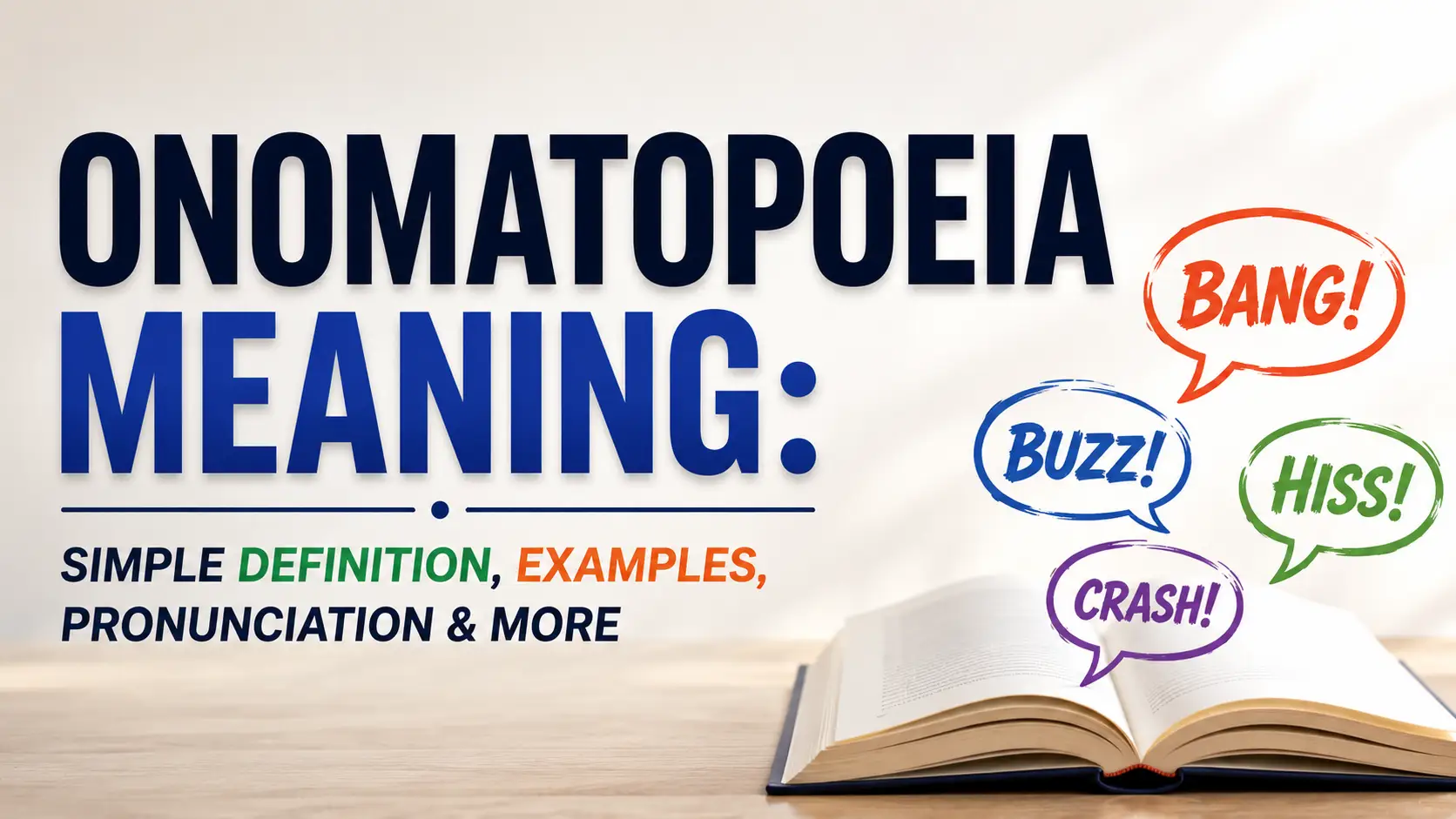
If you have ever written “buzz,” “bang,” “hiss,” or “crash” to describe a sound, you have already seen onomatopoeia in action. But what does onomatopoeia meaning really refer to?
Onomatopoeia means a word or expression that imitates, resembles, or suggests the sound connected with what it describes. Common examples include “buzz” for the sound of a bee, “hiss” for a snake, and “pop” for a quick bursting sound.
The word may look difficult to pronounce, but the idea is simple. Onomatopoeia uses language to help a reader or listener almost hear the sound being described. It is common in stories, poems, comic books, children’s books, advertising, and everyday speech.
In this guide, you will learn what this term means, how to pronounce it, where it comes from, common examples, how it works in literature, and how to use it correctly in a sentence.
Quick Meaning of Onomatopoeia
Onomatopoeia is a word that imitates or suggests the sound it describes.
For example:
- Buzz — the sound associated with a bee
- Hiss — the sound of a snake or escaping air
- Bang — a loud, sudden noise
- Splash — the sound of something hitting water
- Tick-tock — the repeated sound of a clock
The key idea is simple: the word itself helps the reader imagine the sound. These sound-based words can make writing more vivid and engaging.
What Does Onomatopoeia Mean?
Onomatopoeia is closely connected to sound. It describes language that imitates or suggests a real-world noise.
Consider the sentence:
The bees buzzed around the garden.
The word buzzed does more than tell us that bees were flying. It also suggests the sound they make.
Now compare it with:
The bees flew around the garden.
This sentence gives us information about the action, but it does not create the same sense of sound.
That is why onomatopoeia can make writing more vivid. Instead of simply telling readers what happened, it helps them imagine how the scene sounded.
Onomatopoeia is a noun. The adjective form is onomatopoeic, which means relating to or formed from a sound-imitating word.
Onomatopoeia in Simple English
In very simple English, onomatopoeia means a word that sounds like the noise it describes.
Imagine a balloon suddenly bursting.
You might write:
Pop!
The word “pop” is short, but it immediately suggests the sound.
Imagine someone dropping a heavy box.
You might write:
Thud!
Again, the word helps the reader hear the action in their mind.
This is especially useful for children because sound words can make stories easier and more fun to imagine. It is also useful for writers who want a scene to feel active rather than flat.
A useful way to remember the idea is:
Sound → word → meaning
The sound inspires a word, and the word helps communicate that sound to the reader.
Common Examples of Onomatopoeia
English has many words that imitate or suggest sounds. Some describe animal noises, while others describe sounds made by people, objects, movement, or nature.
| Onomatopoeic word | Sound or action it suggests |
| Buzz | A steady humming sound |
| Hiss | A sharp, breath-like sound |
| Bang | A loud sudden noise |
| Pop | A short bursting sound |
| Crack | A sharp breaking sound |
| Splash | A sound made when something hits water |
| Thud | A dull sound caused by something heavy hitting a surface |
| Tick-tock | The repeated sound of a clock |
| Whoosh | A fast rushing sound |
| Roar | A deep, powerful sound |
| Chirp | A short sound made by some birds or insects |
| Meow | The sound associated with a cat |
| Quack | The sound associated with a duck |
| Moo | The sound associated with a cow |
Not every sound word reproduces a noise perfectly. Languages represent sounds differently, so a word may suggest a sound rather than copy it exactly. That distinction is important when understanding this word.
Examples of Onomatopoeia in Everyday Sentences
Onomatopoeic words are not limited to poetry or children’s stories. They can appear naturally in everyday writing.
The door slammed with a loud bang.
Here, “bang” helps communicate the sudden noise.
The bacon began to sizzle in the pan.
“Sizzle” suggests the sound produced while the food cooks.
Rain pitter-pattered against the window.
“Pitter-pattered” creates a gentle picture of repeated raindrop sounds.
The balloon went pop.
“Pop” represents the quick sound of the balloon bursting.
The old floorboards creaked as she walked upstairs.
“Creaked” suggests the long, rough sound made by the floor.
These examples show why sound words are useful. They can give a sentence an extra sensory detail without requiring a long explanation.
Onomatopoeia in a Sentence
The word onomatopoeia is usually used when talking about language, writing, or words that represent sounds.
Here are some natural examples:
- “Buzz” is a common example of onomatopoeia.
- The writer used it to make the battle scene feel more dramatic.
- Children often enjoy stories that contain words such as “boom” and “crash.”
- The poem uses sound-imitating words to suggest the sounds of rain and wind.
- “Hiss” is an example of an onomatopoeic word.
The key difference is simple: onomatopoeia names the language feature, while words such as “buzz,” “boom,” and “hiss” are examples of it.
Is version mein repetition kam hai aur semantic coverage bhi strong hai: sound-related words, sound-imitating words, language feature, onomatopoeic word.
Onomatopoeia in Literature
Writers use onomatopoeia to make descriptions more vivid and memorable. It can help readers imagine sounds instead of only reading about them.
For example, imagine these two sentences:
The car moved quickly down the road.
Now compare:
Whoosh! The car sped down the road.
The second version creates a stronger sense of movement and sound.
In poetry, It can also contribute to rhythm and mood. A soft word such as whisper or rustle can create a quiet feeling, while words such as crash, boom, or bang can make a scene feel loud or dramatic.
Onomatopoeia is also common in comic books and graphic storytelling. Words such as BAM!, CRASH!, and POW! can appear as visual sound effects. In this setting, the sound word becomes part of the artwork as well as the text.
Cambridge notes that onomatopoeia can appear as a literary device alongside features such as alliteration and rhythm.
Onomatopoeia for Kids
For kids, onomatopoeia can be explained very simply: it is a word that sounds like the noise it represents.
For example:
Dog: woof
Cat: meow
Duck: quack
Bee: buzz
Clock: tick-tock
Water: splash
These words can make reading more interactive. A child can say the sound aloud and connect the word with the action or object.
For example:
The duck went “quack!”
The reader can immediately understand what sound the duck is making.
Teachers may also use onomatopoeia when teaching vocabulary, descriptive writing, poetry, or figurative language. It gives students an easy way to make simple sentences more expressive.
Onomatopoeia vs Similar Literary Terms
Onomatopoeia can sometimes be confused with other forms of descriptive language. They are not all the same.
| Term | Meaning | Example |
| Onomatopoeia | A word that imitates or suggests a sound | “The bee buzzed.” |
| Alliteration | Repetition of beginning sounds in nearby words | “Peter picked purple plums.” |
| Simile | A comparison using “like” or “as” | “The water moved like glass.” |
| Metaphor | A direct comparison between unlike things | “The city was a jungle.” |
| Personification | Giving human qualities to nonhuman things | “The wind whispered.” |
The key difference is sound. If the word itself imitates or strongly suggests the noise being described, onomatopoeia may be involved.
For example, “buzz” is onomatopoeic because its sound is connected to the buzzing noise. “Bright” is descriptive, but it is not onomatopoeia.
Is Onomatopoeia a Noun or Adjective?
Onomatopoeia is a noun.
You can use it when naming the language feature:
The poem contains onomatopoeia.
The author uses onomatopoeia effectively.
The related adjective is onomatopoeic.
For example:
“Hiss” is an onomatopoeic word.
This means that “hiss” has the quality of imitating or suggesting a sound.
Another useful word is onomatopoeic, which describes something connected with onomatopoeia.
How Do You Pronounce Onomatopoeia?
For many English learners, pronunciation is one of the hardest parts of the word.
In American English, Cambridge gives the pronunciation as approximately:
/ˌɑː.noʊˌmæt̬.oʊˈpiː.ə/
A simple learner-friendly guide is:
on-uh-MAT-uh-PEE-uh
The strongest stress is near PEE.
Try saying it slowly:
on uh MAT uh PEE uh
Then say the parts together:
onomatopoeia
The spelling can look intimidating, but regular practice makes the word easier to say.
Where Does the Word Onomatopoeia Come From?
The word onomatopoeia comes through English from a Greek term connected with the idea of making or creating a name or word that imitates a sound.
The exact historical path of a word can involve several stages and languages, so it is best not to treat the English word as if it were simply invented in modern English.
The central idea behind its history, however, matches its modern meaning: creating or using language that is connected to the sound being represented.
Is Onomatopoeia the Same in Every Language?
Not always.
Different languages may represent the same sound with different words. This happens because languages have different sound systems and spelling conventions.
For example, the sound associated with a cat may be represented differently across languages. Even when people are trying to describe the same real-world noise, the written form does not have to be identical.
This is one reason onomatopoeia should not always be understood as a perfect copy of a sound. It is better to think of it as a word that imitates or suggests a sound within a particular language.
Cambridge also lists onomatopoeia in many different languages, showing that sound imitation is a feature found across languages, even though the actual words can differ.
Common Mistakes With Onomatopoeia
One common mistake is thinking that every word connected with a sound is automatically onomatopoeia.
For example, the sentence:
The music was loud.
contains information about sound, but “loud” does not imitate the sound itself.
Another mistake is assuming that an onomatopoeic word must reproduce a sound perfectly. It does not. The written word only needs to imitate or suggest the sound.
People also sometimes confuse onomatopoeia with onomatopoeic.
Use onomatopoeia when naming the language feature:
The story uses onomatopoeia.
Use onomatopoeic when describing a word:
“Crash” is an onomatopoeic word.
Keeping this distinction in mind makes your writing more accurate.
Is Onomatopoeia Formal or Informal?
Onomatopoeia is a standard English term, not slang. It is commonly used in education, literary studies, language discussions, and writing instruction.
The individual sound words can have different levels of formality depending on context.
For example, “buzz,” “crash,” “bang,” and “hiss” are ordinary English words that can appear in everyday conversation and writing.
More playful forms, especially exaggerated spellings such as “BOOM!” or “POW!”, are especially common in comics, children’s writing, advertising, and informal creative writing.
So the term itself is perfectly suitable for academic discussion, while particular sound effects may be more creative or casual.
Synonyms and Related Words for Onomatopoeia
There is no single perfect everyday synonym for onomatopoeia. Some related terms can help explain the idea, but they are not always exact replacements.
Sound imitation is a simple descriptive phrase for the concept.
Sound word is an informal way to describe words such as “buzz” or “hiss,” although it is broader than the technical term.
Onomatopoeic word refers to an individual word that has an onomatopoeic quality.
For example, “buzz” is an onomatopoeic word, while onomatopoeia refers to the broader language feature or process.
FAQs
What is the simple meaning of onomatopoeia?
Onomatopoeia means using a word that imitates or suggests the sound it describes. Examples include “buzz,” “hiss,” “bang,” and “pop.”
What is an example of onomatopoeia?
“Buzz” is a common example. The word suggests the humming sound associated with a bee or another buzzing object.
What is onomatopoeia for kids?
For kids, it can be explained as a word that sounds like the noise it represents. Words such as “meow,” “woof,” “quack,” and “splash” are easy examples.
How do you use onomatopoeia in a sentence?
You can write, “The door slammed with a loud bang.” Here, “bang” helps the reader imagine the sound of the door closing.
Is onomatopoeia a literary device?
Yes. It is commonly used as a literary device because writers can use sound-related words to make descriptions more vivid and expressive.
What is the difference between onomatopoeia and an onomatopoeic word?
Onomatopoeia is the language feature or use of sound-imitating language. An onomatopoeic word is an individual word, such as “buzz” or “hiss,” that imitates or suggests a sound.
Conclusion:
The onomatopoeia meaning is simple once you focus on sound. It refers to the use of words that imitate or suggest the noises they describe.
Words such as buzz, hiss, bang, pop, splash, crack, and thud can help readers imagine sounds more clearly.
It is useful in everyday descriptions, children’s books, poetry, stories, comics, and other creative writing.
It can make a sentence feel more active because the reader is not only told what happened but is also given a sense of how it sounded.
The main point to remember is that an onomatopoeic word does not have to copy a sound perfectly. It simply connects its form or sound with the noise it represents. Once you understand that idea, recognizing and using onomatopoeia becomes much easier.

Hi, I’m Mia Walker, a Content Research Writer at Hublioo.com with 3+ years of experience in creating educational language content.
I enjoy breaking down complex words, internet slang, abbreviations, and everyday expressions into clear, practical explanations that anyone can understand.
My focus is on delivering original, easy-to-read, and well-organized content that helps readers expand their vocabulary and use English with greater confidence.