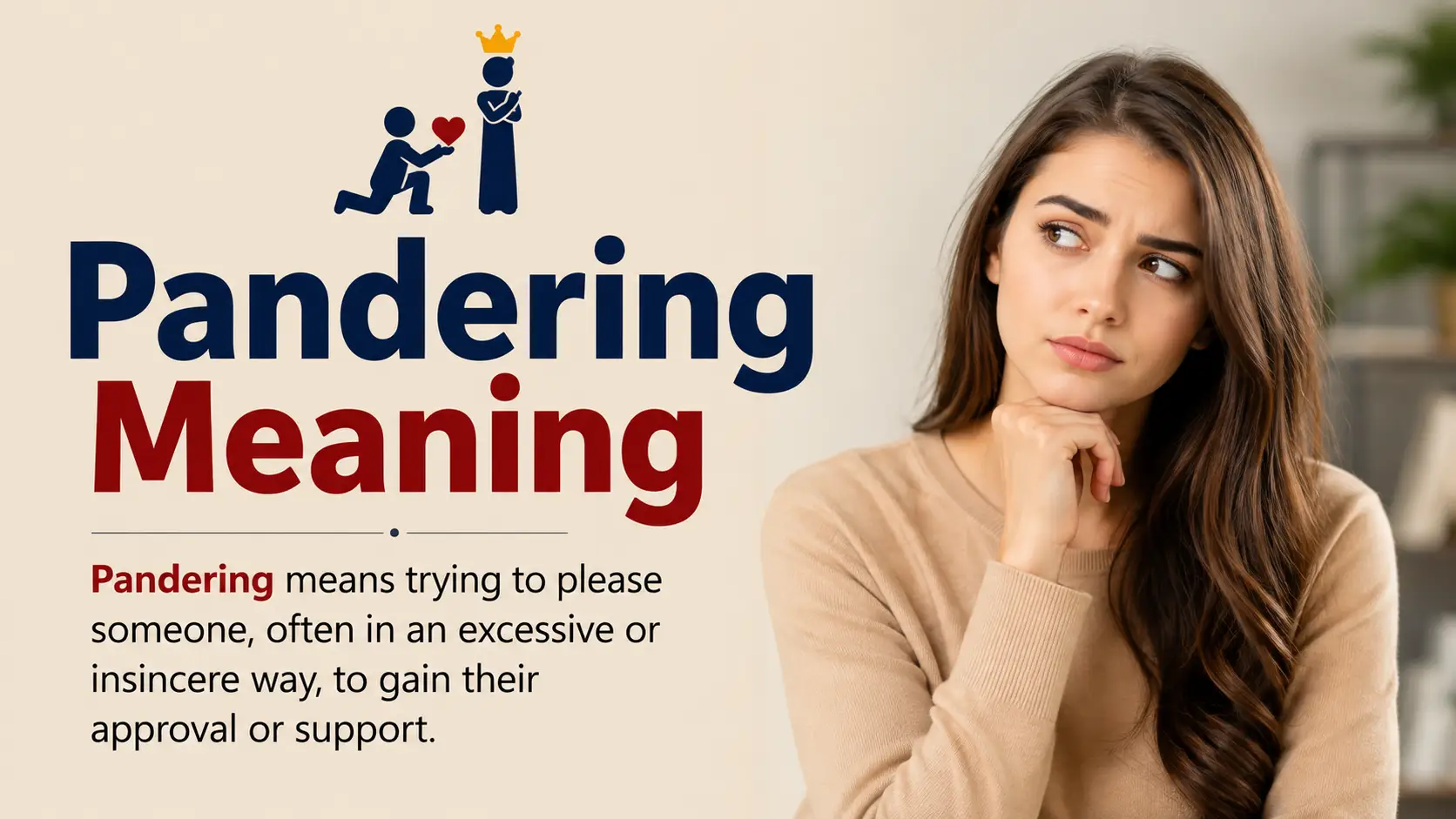
Short answer: Pandering means saying or doing what an audience wants — even when it is not right, true, or good — just to win their favor. “Pandering to voters” means telling voters what they want to hear to get their votes. It is always a criticism.
Here is Pandering at a glance:
| Detail | Info |
|---|---|
| Term | Pandering |
| Part of speech | Noun / verb (pander) |
| Core meaning | Saying or doing what an audience wants to hear, even when it’s wrong — to win favor |
| Tone | Critical / negative |
| You’ll see it in | Politics, media criticism, entertainment, debates |
FAQs About Pandering
What does pandering mean in simple terms?
Saying or doing what people want to hear — even when it’s wrong — just to win their favor. “Pandering to voters” = telling voters what they want to hear to get votes.
What is political pandering?
When politicians adopt positions or make promises mainly to please a voting bloc, rather than from genuine conviction — e.g., reversing a stance to match the crowd.
What is the difference between pandering and flattery?
Flattery targets an individual with excessive compliments; pandering targets a group, catering to its desires at truth’s expense. Pandering is broader and more cynical.
Where does the word pander come from?
From Pandarus, the go-between in Chaucer’s and Shakespeare’s Troilus stories — literally a character who arranged love affairs. The “pimp” sense came first; the political sense followed.
Is pandering illegal?
The everyday sense (political/people-pleasing) is not illegal — just criticized. But “pandering” is also a legal term for crimes related to prostitution, which is illegal. Related: malice meaning.
Common Mistakes People Make With Pandering
- Using pandering as a compliment. It never is — it always accuses someone of cynical people-pleasing.
- Confusing it with “pondering.” Pondering = thinking deeply; pandering = pleasing cynically. One letter apart, worlds apart!
- Forgetting the literary root. The pimp/go-between history explains why the word feels so sleazy — it’s baked in.
Where Did the Word Pandering Come From?
Pander comes from Pandarus, a character in Chaucer’s Troilus and Criseyde (and Shakespeare’s Troilus and Cressida) who acts as a go-between arranging the lovers’ affair — essentially a pimp. By the 1500s, “pander” meant a go-between or pimp; by the 1600s it had broadened to anyone who caters basely to others’ desires. The political sense — telling audiences what they want to hear — is the dominant modern use, first recorded in the 1600s and thriving ever since.
What Does Pandering Mean? The Full Definition
Pandering (from the verb pander) means gratifying someone’s desires to win favor, especially when it means abandoning what is right, reasonable, or true. “The candidate was accused of pandering to special interests.” It is used most in politics (“pandering for votes”), media (“TV that panders to the worst in us”), and entertainment.
Note the darker corners: as a noun, a pander historically meant a go-between in love affairs — and still means a pimp. In law, “pandering” is a criminal offense related to prostitution. But in everyday use, pandering = shameless people-pleasing for gain. For another critical political-adjacent word, see our malice meaning guide.
For the full dictionary entry, see Merriam-Webster’s definition of pandering.
Is Pandering Rude? Tone & Register Check
Is pandering rude? The word is always critical — it accuses someone of cynical, self-serving people-pleasing. About politicians and media, it is standard (if pointed) criticism. About a specific person you know, it is an insult to their sincerity. Register check: neutral-to-formal, always negative. At home in news, essays, and debates.
Key Takeaways
- 🌟 Pandering = telling audiences what they want to hear to win favor, truth optional.
- From Pandarus, Chaucer’s go-between — the sleaze is centuries old.
- Always critical — it accuses cynical, self-serving people-pleasing.
- Flattery targets a person; pandering targets a crowd.
- Don’t confuse with pondering (thinking deeply)!
How Do You Use Pandering in a Sentence?
Six examples:
- “Critics accused the senator of pandering to voters with empty promises.”
- “The show was pandering to its audience instead of challenging them.”
- “He’s not leading — he’s just pandering for applause.”
- “The sequel felt like shameless pandering to fans.”
- “She refused to pander to the committee and told the hard truth.”
- “Pandering politicians say whatever the crowd wants to hear.”
What Are the Synonyms and Antonyms of Pandering?
- Synonyms: brown-nosing, kowtowing, sycophancy, currying favor, playing to the gallery
- Antonyms: principled stand, integrity, candor, frankness, conviction
Sycophancy is the formal noun for the same behavior; “playing to the gallery” captures the performance aspect. The opposite of pandering is saying the unpopular true thing. More critical vocabulary: irreverent meaning.
How Can You Use Pandering in Everyday Conversation?
“Pandering” is a sharp political and cultural criticism — use it when someone sacrifices principle for popularity: “That speech was pure pandering.” It is common in debates, op-eds, group chats about politics, and media criticism.
Because it accuses someone of insincerity, aim it at public figures and works — not at friends. Telling a friend they are “pandering” lands as an attack on their integrity.
Pandering vs. Flattery: What’s the Difference?
Pandering vs. flattery: both involve saying nice things for gain, but the scope differs. Flattery is personal and one-to-one — excessive compliments to win over an individual (“flattering the boss”). Pandering is broader and more cynical — catering to a group’s desires, prejudices, or appetites, often at the expense of truth (“pandering to the base”). Flattery wants a person to like you; pandering wants a crowd to follow you. Flattery can be harmless social grease; pandering is almost always portrayed as a betrayal of principle.
Read More Articles
🔮Brick and Mortar Meaning: Definition, Examples & Business Guide
🔮Intricate Meaning: Definition, Intricate vs Complex & Beautiful Examples

Hi, I’m Mia Walker, a Content Research Writer at Hublioo.com with 3+ years of experience in creating educational language content.
I enjoy breaking down complex words, internet slang, abbreviations, and everyday expressions into clear, practical explanations that anyone can understand.
My focus is on delivering original, easy-to-read, and well-organized content that helps readers expand their vocabulary and use English with greater confidence.