Home / Word Meanings / Frivolous Meaning: Definition, Examples, Synonyms, and Usage

Frivolous Meaning: Definition, Examples, Synonyms, and Usage

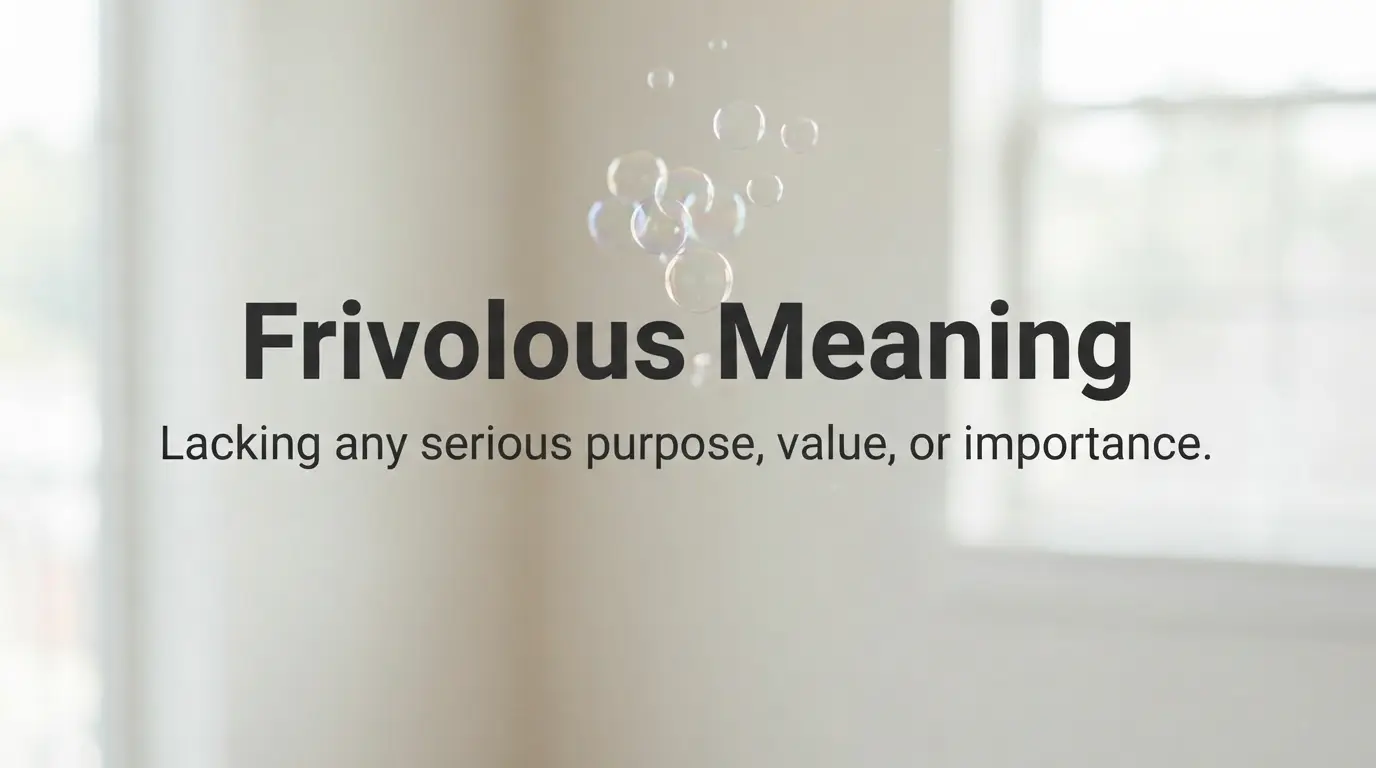
Frivolous Meaning

The word frivolous means not serious, important, useful, or sensible.

It can describe unnecessary spending, silly behavior, unimportant matters, or a legal claim without a reasonable basis.

In this guide, you’ll learn the frivolous meaning, simple examples, synonyms, antonyms, and how to use the word correctly.

Quick Meaning of Frivolous

Frivolous means not serious, important, useful, or sensible, especially when something is unnecessary or lacks a good purpose.

For example:

“He spent his money on frivolous things.”

This means he spent money on things that were unnecessary or had little practical value.

Another example is:

“Her frivolous comments were inappropriate during the meeting.”

Here, frivolous means too playful or unserious for the situation.

In legal English, the meaning is more specific:

“The judge dismissed the frivolous claim.”

In this context, the claim lacks a reasonable basis in fact or law.

What Does Frivolous Mean?

Frivolous is an adjective used to describe something that lacks seriousness, importance, usefulness, or good reason.

The exact meaning depends on the situation. A frivolous purchase is usually unnecessary or wasteful, while frivolous behavior may be silly or too playful for a serious situation.

For example:

“That was a frivolous purchase.”

The speaker probably means the purchase was unnecessary or not a sensible use of money.

However:

“They had a frivolous conversation about which actor would make the best superhero.”

Here, the conversation is simply lighthearted and unimportant. It does not necessarily mean anything harmful happened.

So, frivolous does not always mean foolish or bad. Context determines how strongly negative the word sounds.

Frivolous in Simple English

In simple English, frivolous means not important or serious, especially when something should have more value or purpose.

Imagine someone spending their entire paycheck on decorations while struggling to pay important bills. You might describe that spending as frivolous because the money could have been used for something more necessary.

Similarly, imagine someone making jokes during an emergency meeting. Their behavior could be called frivolous because the situation requires attention and seriousness.

The main idea is that something is too unimportant, unnecessary, playful, or careless for the circumstances.

What Does It Mean If Someone Is Frivolous?

If someone is described as frivolous, it usually means they behave in a way that seems overly playful, unserious, careless, or focused on unimportant things.

For example:

“He can be frivolous when discussing important matters.”

This suggests that the person does not always take serious topics seriously enough.

Calling a person frivolous can sound critical. However, it does not necessarily mean the person is foolish or irresponsible in every part of their life. It may simply describe their attitude or behavior in a particular situation.

For example:

“She has a frivolous personality and enjoys joking around.”

Here, the word may describe someone who likes fun and does not always take things seriously.

What Is Frivolous Behavior?

Frivolous behavior is behavior that seems too playful, silly, careless, or inappropriate for the situation.

For example:

“His frivolous behavior during the ceremony upset the organizers.”

The problem is not necessarily that he was having fun. Instead, his behavior may have seemed inappropriate because the ceremony called for seriousness or respect.

Another example:

“The manager’s frivolous attitude made it difficult to discuss the problem.”

Here, frivolous behavior suggests a lack of seriousness when seriousness was needed.

It is important to remember that playful behavior is not automatically frivolous. The word becomes more negative when someone’s behavior does not fit the situation.

Frivolous Activities

A frivolous activity is generally something done for fun or entertainment without much practical or serious purpose.

For example:

“They spent the afternoon doing frivolous activities.”

This could refer to harmless entertainment, games, jokes, or other activities that are simply meant to pass the time.

Being frivolous is not always bad. People need entertainment, relaxation, and time away from serious responsibilities. The word usually becomes negative when the speaker thinks the activity is unnecessary or inappropriate at a particular time.

For example:

“Playing games after finishing your work is harmless.”

But:

“Playing games instead of preparing for an important exam was frivolous.”

The second sentence suggests that the activity was inappropriate because something more important needed attention.

Frivolous Spending and Money

Frivolous spending means spending money on things that are unnecessary, wasteful, or of little practical value.

For example:

“I am trying to reduce my frivolous spending.”

This means the person wants to stop making unnecessary purchases.

Another example:

“Buying expensive clothes you never wear can become frivolous spending.”

The item itself is not necessarily frivolous. The word describes the spending because the purchase may not have been necessary or sensible.

This is why frivolous meaning in money is closely connected with unnecessary or wasteful spending.

For example:

“She avoided frivolous purchases and saved her money for a new car.”

Here, frivolous means unnecessary compared with the person’s more important financial goal.

Frivolous Meaning in Law

In legal language, frivolous has a more specific meaning.

A frivolous claim or lawsuit generally lacks a reasonable basis in fact or law. It does not simply mean that a judge or lawyer thinks the case is silly.

For example:

“The attorney argued that the lawsuit was frivolous.”

The attorney is saying that the lawsuit does not have a reasonable factual or legal foundation.

Another example:

“The court rejected the frivolous claim.”

Here, the word is being used in a technical legal sense.

This is an important distinction because the everyday meaning and the frivolous meaning in law are related but not identical.

Examples of Frivolous

Here are some natural examples showing how the word works in different situations:

“Buying another expensive watch when you already own ten seems frivolous.”

The purchase appears unnecessary.

“His frivolous attitude made it difficult to have a serious conversation.”

His attitude was too light or unserious.

“She decided to avoid frivolous spending and save for a house.”

She wanted to stop spending money on unnecessary things.

“The committee rejected the frivolous suggestion.”

The suggestion was considered unimportant or lacking serious value.

“They had a frivolous conversation about their favorite celebrities.”

The conversation was playful and not serious.

“The lawyer argued that the case was frivolous.”

The lawyer believed the case lacked a reasonable legal or factual basis.

Frivolous Meaning in a Sentence

The most common grammatical pattern is frivolous + noun.

For example:

“He made a frivolous complaint.”

“She bought several frivolous items.”

“They spent money on frivolous purchases.”

“The discussion became frivolous.”

You can also use frivolously, the adverb form:

“He spent his money frivolously.”

This means he spent it in an unnecessary or careless way.

Another related form is frivolousness, which refers to the quality of being frivolous. However, it is less common in everyday American English.

If you are learning how to use the word, the simplest pattern to remember is:

frivolous + noun

Examples include frivolous spending, frivolous behavior, frivolous claims, frivolous purchases, and frivolous comments.

Is Frivolous Positive or Negative?

Frivolous is usually a negative word, but its tone depends on the context.

When someone describes a purchase as frivolous, they usually mean it was unnecessary or wasteful.

“That was a frivolous purchase.”

When someone describes behavior as frivolous, they may mean it was too playful or careless.

“His behavior was frivolous during the meeting.”

However, a frivolous conversation can simply mean a lighthearted conversation with no serious purpose.

“We had a frivolous conversation about our favorite movies.”

So, is frivolous positive or negative? In most situations, it has a negative or critical tone. But in some contexts, it can simply describe something light, playful, or unimportant.

Synonyms for Frivolous

There are several useful frivolous synonyms, but they are not exact replacements in every sentence.

Silly means lacking good sense or seriousness and is more common in casual conversation.

Trivial means not important or significant. It focuses mainly on a lack of importance.

Foolish suggests poor judgment or a lack of good sense.

Unimportant directly describes something that has little importance.

Careless focuses on a lack of attention or thought.

Flippant describes someone treating a serious matter too casually.

Superficial describes something that lacks depth or deals mainly with surface-level matters.

For example:

“The issue is trivial.”

This mainly means the issue is unimportant.

But:

“His response was frivolous.”

This may suggest that his response was not only unimportant but also too playful, careless, or unserious.

What Is a Synonym for Frivolous?

If you are looking for a simple synonym for frivolous, silly or trivial may work depending on the sentence.

For example:

“That was a frivolous comment.”

Could become:

“That was a silly comment.”

But these words do not always have exactly the same meaning.

For spending:

“frivolous spending”

could be described as:

“unnecessary spending”

For behavior:

“frivolous behavior”

might be described as:

“silly” or “flippant behavior.”

For a legal claim, however, frivolous has a specialized meaning, so ordinary synonyms may not communicate the same legal idea.

Antonyms of Frivolous

The best opposite of frivolous depends on the context.

Common antonyms include:

  • Serious
  • Important
  • Meaningful
  • Practical
  • Sensible
  • Thoughtful
  • Purposeful
  • Responsible

For example:

“He made a frivolous decision.”

An opposite could be:

“He made a thoughtful decision.”

For spending:

“She avoided frivolous purchases and made practical ones.”

For behavior:

“His frivolous attitude changed into a serious one.”

These examples show why there is no single perfect antonym for every use of the word.

Frivolous vs Trivial

Frivolous and trivial are sometimes used similarly, but they have different shades of meaning.

Trivial mainly means something is unimportant or insignificant.

Frivolous can also mean unimportant, but it may suggest unnecessary spending, silliness, waste, or a lack of seriousness.

For example:

“We discussed a trivial issue.”

This means the issue was not important.

“He made a frivolous comment during the meeting.”

This suggests that his comment was not serious or appropriate for the situation.

Therefore, trivial focuses more on importance, while frivolous can focus on seriousness, usefulness, or sensible behavior.

Frivolous vs Foolish

Foolish usually suggests poor judgment or a lack of good sense.

Frivolous focuses more on a lack of seriousness, importance, or practical purpose.

For example:

“It was foolish to drive without checking the weather.”

This suggests poor judgment.

But:

“Buying five expensive decorations for a small party was frivolous.”

This suggests unnecessary spending rather than necessarily poor intelligence or judgment.

The two words can overlap, but they emphasize different ideas.

Frivolous vs Careless

Careless means failing to give enough attention, thought, or caution to something.

Frivolous does not necessarily involve carelessness.

For example:

“He was careless with the documents.”

This means he did not handle them carefully.

But:

“He made a frivolous complaint.”

This means the complaint was unimportant, unreasonable, or lacking seriousness.

A person can be frivolous without being careless, and someone can be careless without being frivolous.

Frivolous vs Playful

Playful is often positive or neutral. It describes someone or something that is fun, lighthearted, or full of humor.

Frivolous can also describe something lighthearted, but it often adds a sense that the behavior is unnecessary or lacks seriousness.

For example:

“The children were playful.”

This sounds positive.

But:

“The manager was frivolous during the emergency.”

This sounds negative because the situation required seriousness.

Therefore, playful is not always a good synonym for frivolous.

Is Frivolous Formal or Informal?

Frivolous is a standard English word used in both everyday and formal communication.

You may hear it in casual conversation:

“That was a frivolous thing to buy.”

It is also common in professional, financial, academic, and legal writing:

“The company reduced frivolous expenses.”

“The court considered the claim frivolous.”

The word can sound more formal than simple alternatives such as silly or unnecessary, which makes it useful when you want to express the idea precisely.

How Do You Pronounce Frivolous?

Frivolous is pronounced approximately:

FRIV-uh-luhs

In American English, the pronunciation is represented as:

/ˈfrɪv.ə.ləs/

The stress is on the first syllable:

FRIV-uh-luhs

The first part sounds similar to “friv,” followed by a soft “uh” sound and then “luhs.”

Frivolous Meaning in Farsi, Chinese, and Arabic

The word frivolous can have different translations depending on the context.

In Farsi, it may be translated as:

  • بیهوده
  • بی‌اهمیت
  • سبک‌سرانه

In Chinese, possible translations include:

  • 轻浮的
  • 琐碎的
  • 不重要的

In Arabic, possible translations include:

  • تافه
  • غير جاد
  • عبثي

These translations are not always exact because frivolous can describe something unnecessary, unimportant, playful, or lacking seriousness.

Origin and History of Frivolous

The word frivolous comes from Latin frivolus, meaning something like “silly” or “trifling.”

It entered English through earlier forms of the language and has been used in English for centuries. Its basic idea has remained connected with things that have little importance or seriousness.

Over time, frivolous developed several common uses. Today, you can use it when discussing behavior, spending, activities, conversations, arguments, and legal claims.

Common Mistakes With Frivolous

One common mistake is assuming that frivolous always means fun. It does not.

A fun activity can be completely reasonable:

“We watched a funny movie after work.”

Calling something frivolous adds the idea that it may be unnecessary, unimportant, or lacking a serious purpose.

Another mistake is assuming that frivolous always means wrong. In everyday English, something frivolous may simply be lighthearted or unimportant.

The legal use is different. A frivolous legal claim generally lacks a reasonable basis in fact or law.

It is also important to remember that frivolous is an adjective:

“a frivolous purchase”

The adverb form is frivolously:

“He spent the money frivolously.”

FAQs About Frivolous Meaning

What does frivolous mean in simple words?

Frivolous means not serious, important, useful, or sensible. It can describe unnecessary spending, silly behavior, lighthearted activities, or something with little value.

What does it mean if someone is frivolous?

If someone is frivolous, they may behave in a playful, unserious, careless, or overly casual way, especially when the situation calls for more seriousness.

What is frivolous behavior?

Frivolous behavior is behavior that seems too playful, silly, or unserious for the situation. For example, joking during an important meeting could be described as frivolous behavior.

Is frivolous positive or negative?

Frivolous is usually negative, especially when it describes unnecessary spending, careless behavior, or an unimportant matter. In some contexts, such as a frivolous conversation, it can simply mean playful or lighthearted.

What is a synonym for frivolous?

Common synonyms include silly, trivial, foolish, unimportant, careless, flippant, and superficial. The best choice depends on the context.

What does frivolous mean in law?

In law, a frivolous claim or lawsuit generally lacks a reasonable basis in fact or law. This is more specific than the everyday meaning of the word.

What does frivolous mean in money?

When used with money, frivolous usually describes unnecessary or wasteful spending. A frivolous purchase is something considered nonessential or of little practical value.

What is the opposite of frivolous?

Common opposites include serious, important, meaningful, practical, sensible, thoughtful, and purposeful.

Conclusion

The frivolous meaning is closely connected to something that lacks seriousness, importance, usefulness, or a sensible purpose.

In everyday English, it can describe unnecessary spending, silly behavior, lighthearted conversations, or activities that have little practical value. The word is usually negative, but its tone depends on the context.

The meaning becomes more specific in certain situations. Frivolous spending refers to unnecessary use of money, while frivolous behavior can describe someone acting too casually or playfully. In law, a frivolous claim generally lacks a reasonable factual or legal basis.

The easiest way to remember frivolous is to think of something as unimportant, unnecessary, or not serious when greater importance, purpose, or seriousness is expected.

Understanding this distinction will help you use the word naturally in both casual and formal American English.

Leave a Reply

Your email address will not be published. Required fields are marked *