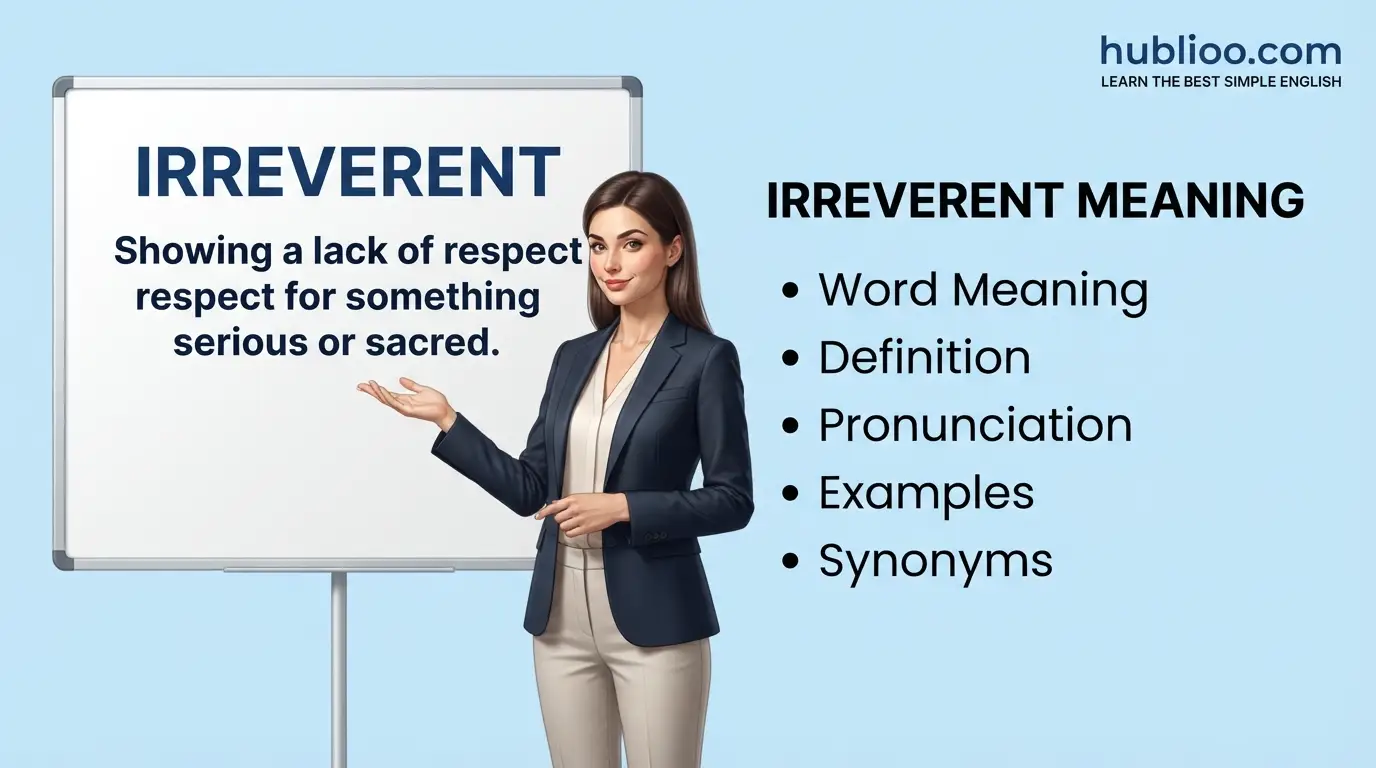
If you have seen the word irreverent and wondered what it means, the simple answer is: irreverent means showing less respect than expected toward something that is usually considered serious, sacred, traditional, or important.
The word can describe a person, joke, comment, attitude, movie, writing style, or type of humor. An irreverent comment may be playful, bold, sarcastic, or unconventional rather than openly rude.
For example, an irreverent joke may make fun of a serious topic in a playful way. Depending on the situation, irreverent can have either a positive or negative meaning.
In this guide, you will learn the irreverent meaning, pronunciation, examples, synonyms, antonyms, word forms, origin, and the important difference between irreverent and irrelevant.
Quick Answer: What Does Irreverent Mean?
Irreverent means not showing the usual level of respect toward something that is considered serious, sacred, traditional, or important.
For example:
“His irreverent jokes made everyone laugh.”
This means his jokes treated serious subjects in a playful or less respectful way.
An irreverent person may question traditions, make jokes about serious subjects, or challenge ideas that people normally treat with great respect.
The word is not always negative. An irreverent comedian may be praised for being funny, bold, and willing to challenge social expectations. In another situation, an irreverent comment may be criticized for being offensive or inappropriate.
Irreverent Meaning and Definition
Irreverent is an adjective that describes a lack of expected respect for something serious, sacred, traditional, or important.
The word comes from reverent, which means showing deep respect. The prefix ir- gives the word a negative meaning, so irreverent essentially means “not reverent.”
The word can be used for many things, including:
- An irreverent joke
- An irreverent attitude
- An irreverent comment
- An irreverent comedian
- An irreverent movie
- An irreverent writing style
- An irreverent approach to tradition
For example:
“Her irreverent attitude toward the old rules surprised the committee.”
Here, irreverent means that she did not treat the traditional rules with the level of respect that was expected.
However, irreverence does not automatically mean cruelty or hatred. Someone can be irreverent simply because they use humor or a fresh perspective to question something people normally take seriously.
What Does Irreverent Mean in Simple English?
In simple English, irreverent means not treating something as seriously or respectfully as people normally expect.
A quick way to remember it is:
Reverent = deeply respectful
Irreverent = not showing the expected respect
Imagine a very formal ceremony where everyone is expected to behave seriously. If someone makes playful jokes about the ceremony, their behavior could be described as irreverent.
The word can describe humor that is funny, shocking, bold, sarcastic, or unconventional. Whether it sounds positive or negative depends on the context.
Irreverent Pronunciation
Irreverent is commonly pronounced:
ih-REV-er-ent
The main stress is on the REV sound.
The pronunciation can be easier to remember by breaking the word into parts:
ih + REV + er + ent
How to Use Irreverent in a Sentence
Irreverent is an adjective, so it describes a person, thing, behavior, attitude, or style.
Here are some natural examples:
- “The comedian is known for his irreverent humor.”
- “She has an irreverent attitude toward traditional rules.”
- “His irreverent comments surprised the audience.”
- “The movie has an irreverent style.”
- “The writer took an irreverent approach to a serious subject.”
- “Her humor is often irreverent.”
You would normally use irreverent before a noun or after a linking verb.
Common combinations include:
- irreverent humor
- irreverent joke
- irreverent attitude
- irreverent comment
- irreverent comedian
- irreverent style
- irreverent approach
The noun form is irreverence.
Is Irreverent Positive or Negative?
Irreverent can be either positive or negative. The meaning depends on the situation and the speaker’s attitude.
For example:
“He has an irreverent sense of humor.”
This may be positive. It can suggest that he is funny, bold, and comfortable challenging traditional ideas.
Now consider:
“His irreverent comments offended the audience.”
Here, the word has a negative meaning because the comments were seen as disrespectful or inappropriate.
So, irreverent does not automatically mean rude. Context is important.
Irreverent vs. Disrespectful
Irreverent and disrespectful are closely related, but they are not exact synonyms.
Disrespectful means showing a lack of respect toward a person, rule, authority, idea, or other subject.
Irreverent usually describes a lack of expected respect toward something that is treated as serious, sacred, traditional, or important.
Compare these examples:
“His disrespectful behavior toward his teacher was unacceptable.”
This directly describes behavior that lacks respect for another person.
“Her irreverent humor challenged traditional ideas.”
This may simply mean that she used humor to question something people usually treat seriously. It does not necessarily mean that she wanted to insult anyone.
Therefore, disrespectful is generally more clearly negative, while irreverent can be humorous, creative, playful, or critical.
Irreverent vs. Irrelevant
One of the most common mistakes is confusing irreverent with irrelevant. Although the words look and sound somewhat similar, they have completely different meanings.
Irreverent means lacking the expected respect for something serious, sacred, traditional, or important.
Irrelevant means not related or connected to the subject being discussed.
For example:
“His irreverent joke offended some people.”
The joke was considered less respectful toward a serious subject.
“Her comment was irrelevant to the question.”
The comment was not related to the question.
A simple memory trick is:
Irreverent = respect
Irrelevant = relation
If you are talking about whether something is connected to a topic, use irrelevant.
If you are talking about a lack of respect toward something serious or sacred, use irreverent.
Irreverent Humor: What Does It Mean?
Irreverent humor is humor that treats a serious, traditional, respected, or important subject in a playful or less respectful way.
This type of humor may question authority, traditions, social expectations, or cultural rules.
For example, a comedian might make jokes about the strict rules of a formal workplace. A writer might use sarcasm to question an old tradition.
Irreverent humor can make people laugh or encourage them to look at a familiar subject differently. However, it can also offend people when the subject is sensitive or deeply respected.
That is why the meaning of irreverent humor depends heavily on context and audience.
Common Examples of Irreverent Behavior
Here are some simple examples that show how the word can be used:
An irreverent joke:
A comedian makes a playful joke about a subject that people normally treat seriously.
An irreverent writer:
In their writing, a person may use sarcasm or humor to question traditional ideas.
irreverent movie:
Some movies make fun of familiar traditions or present serious subjects in unexpected ways.
An irreverent attitude:
This attitude involves refusing to automatically treat traditional rules or authority with the expected seriousness.
An irreverent comment:
A bold or playful remark about a serious subject can be described as irreverent.
The common idea in all these examples is a different or less respectful approach to something that normally receives serious treatment.
Irreverent Synonyms
The best synonym depends on the exact context.
- Disrespectful — showing a lack of respect
- Impertinent — too bold or rude, especially toward someone in authority
- Insolent — boldly rude or disrespectful
- Unconventional — different from what is usual, without necessarily being disrespectful
- Playful — light and fun, which can sometimes describe irreverent humor
- Sacrilegious — showing disrespect toward something considered sacred
- Blasphemous — showing serious disrespect toward God, religion, or sacred beliefs
These words overlap with irreverent, but they are not interchangeable in every sentence.
Irreverent Antonyms
The main opposite of irreverent is reverent, which means showing deep respect.
Other related antonyms include:
- Respectful
- Solemn
- Serious
- Honoring
- Devoted
For example:
“Her reverent attitude toward the ceremony was clear.”
This means she treated the ceremony with great respect.
In contrast:
“His irreverent attitude toward the ceremony surprised everyone.”
This means he did not treat the ceremony with the expected seriousness or respect.
Irreverent Word Forms
Here are the most useful related forms of the word:
Irreverent — adjective; showing a lack of expected respect
Irreverence — noun; a lack of respect or reverence
Reverent — adjective; showing deep respect
Reverence — noun; deep respect or admiration
For example:
“His irreverence toward the tradition surprised everyone.”
Here, irreverence refers to the lack of respect itself.
Origin and History of Irreverent
Irreverent is formed from reverent with the negative prefix ir-.
The word reverent comes from Latin roots associated with respect, awe, and fear. In English, it became especially connected with showing deep respect toward religious or sacred subjects.
Over time, irreverent developed a broader meaning. Today, it can describe humor, writing, entertainment, art, criticism, and everyday behavior that challenges serious or traditional expectations.
Although the word can still be used in religious contexts, modern English often uses irreverent to describe bold or unconventional humor and ideas.
Common Mistakes With Irreverent
The most common mistake is confusing irreverent with irrelevant.
Another mistake is assuming that every irreverent comment is intentionally offensive. An irreverent remark can simply be playful, humorous, or unconventional.
For example:
“Her irreverent style made the serious presentation more entertaining.”
This does not necessarily mean she wanted to offend anyone.
It is also incorrect to use irreverent simply to mean “different.” Something unusual is not automatically irreverent.
For instance, wearing an unusual shirt is unconventional, but it is not necessarily irreverent. The idea of respect or seriousness needs to be part of the context.
FAQs ❓
What is the simple meaning of irreverent?
Irreverent means showing less respect than expected toward something that is normally considered serious, sacred, traditional, or important.
Is irreverent a bad word?
No. Irreverent can be positive or negative. It may describe rude behavior, but it can also describe clever, playful, or bold humor.
What is an example of irreverent?
A comedian making a playful joke about a serious tradition is an example of irreverent humor. The joke treats the subject in a less serious or respectful way than people normally expect.
What is the difference between irreverent and irrelevant?
Irreverent relates to a lack of respect, while irrelevant means something is not related to the topic being discussed.
What is the opposite of irreverent?
The main opposite of irreverent is reverent, which means showing deep respect. Other related opposites include respectful, solemn, serious, and honoring.
What does irreverent humor mean?
Irreverent humor treats serious, traditional, or respected subjects in a playful, bold, or less respectful way. It can be funny and creative, but it may also offend some people depending on the topic and audience.
Conclusion: Irreverent Meaning in Everyday English 💥
The irreverent meaning is easy to remember when you connect it with respect. Irreverent describes a person, comment, joke, attitude, or style that does not show the usual level of respect toward something serious, sacred, traditional, or important.
The word can be negative when behavior is considered inappropriate, but it can also describe playful, bold, or creative humor.
Most importantly, do not confuse irreverent with irrelevant. Irreverent is about respect, while irrelevant is about whether something is connected to a topic.
When you see irreverent in a sentence, look at what is being treated casually or without the expected respect. That context will usually make the meaning clear.

Hi, I’m Mia Walker, a Senior Language Content Specialist at Hublioo.com. I have 5+ years of experience creating clear and easy-to-understand content about word meanings, slang, acronyms, phrases, and modern English usage. My goal is to simplify complex language and help readers understand words with confidence through accurate, well-researched, and reader-friendly explanations.