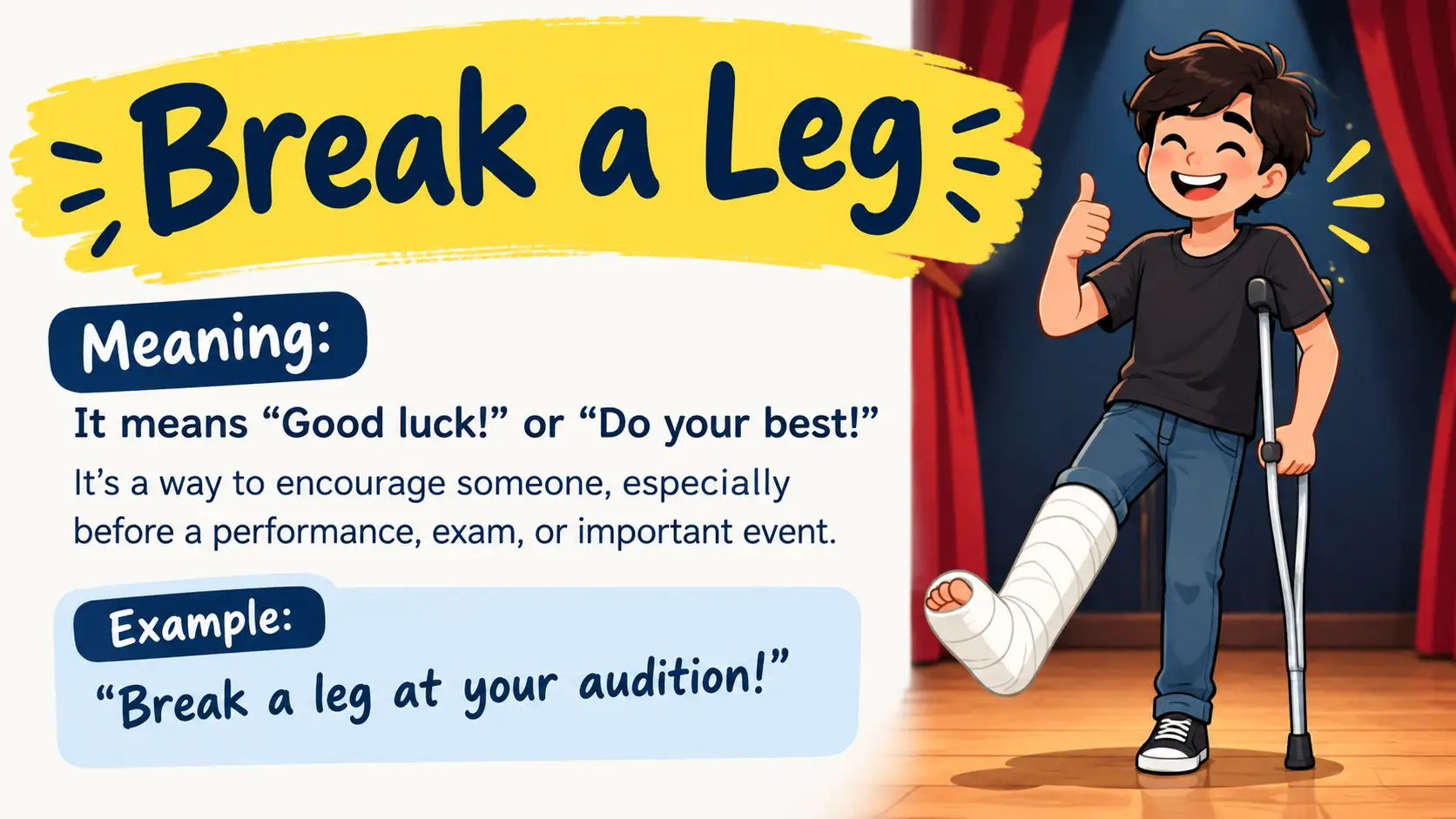
If someone tells you to “break a leg,” they are not asking you to hurt yourself. The phrase is a common way to wish someone good luck, especially before a performance, audition, speech, or show. Break a leg’s meaning is simply “good luck,” but the phrase has a long and interesting history.
You may hear it backstage at a theater, before a school play, or even before a big performance. It can sound strange because the words seem to mean the opposite of what the speaker intends. That is what makes this expression an idiom.
In this guide, you will learn what “break a leg” means, where the phrase may have come from, how to use it correctly, and why performers often prefer it to saying “good luck.”
Quick Answer: What Does “Break a Leg” Mean?
“Break a leg” means “good luck.” It is especially common when speaking to someone who is about to perform on stage, take part in an audition, or give an important performance.
For example, if your friend is acting in a school play, you might say:
“You’re going to do great tonight. Break a leg!”
You are not wishing them an injury. You are giving them a friendly and encouraging good-luck wish.
The phrase is an example of an idiom, which is a group of words whose meaning is different from the literal meaning of the individual words.
Break a Leg Meaning and the Literal Meaning
The literal meaning of “break a leg” is very different from its idiomatic meaning.
Literally, breaking a leg means suffering a serious bone injury. But when people use the phrase before a performance, they mean “I hope you do very well.”
This type of expression can be confusing for English learners because the words themselves do not give you the real meaning.
Consider these two uses:
Literal: “He broke his leg while playing soccer.”
Here, “broke his leg” means he actually injured his leg.
Idiomatic: “Break a leg at your audition!”
Here, “break a leg” means good luck at your audition.
The situation tells you which meaning is intended.
Why Do People Say “Break a Leg” Instead of “Good Luck”?
The exact reason performers began saying “break a leg” is not known with certainty. Several theories have been suggested over the years, but no single origin has been proven beyond doubt.
One common explanation is linked to theater superstition. In some performance traditions, directly saying “good luck” was considered unlucky. Performers therefore used a different phrase to wish one another success.
The idea is similar to other traditions in which people avoid saying something positive directly because they fear it might bring bad luck.
Another theory connects the expression with actors taking repeated bows after a successful performance. Some explanations suggest that “breaking a leg” could refer to bending or moving the leg during a bow.
There are also theories involving theater curtains and older stage traditions. However, these explanations are debated, so they should not be presented as proven facts.
The safest conclusion is that “break a leg” became established as a theatrical good-luck expression, while its exact origin remains uncertain.
The History and Origin of “Break a Leg”
The history of breaking a leg is not completely settled, which is important to understand.
The phrase is often connected with the theater world, where unusual ways of wishing someone luck became part of performance culture. Written examples of the expression appear in English during the 20th century.
Some people claim that the phrase has roots much earlier than this. Various stories connect it to actors, stage curtains, bows, or even historical political events. Many of these stories are entertaining, but strong evidence for them is limited.
Because of this, it is better to say that the phrase has several proposed origins rather than one confirmed origin.
What is clear is that the expression became widely associated with performers and eventually entered everyday American English.
Today, you do not need to know its historical origin to understand it. When someone says “break a leg” before a performance, they are usually giving encouragement.
How to Use “Break a Leg” Correctly
“Break a leg” is normally used before an event or performance.
You can say it to someone who is about to:
Perform in a play.
Go on stage to sing.
Take part in a dance performance.
Attend an audition.
Give a speech.
Perform in a concert.
Take part in a show.
For example:
“Your audition starts in ten minutes. Break a leg!”
“Everyone is ready for the school play. Break a leg!”
“You’ve practiced your speech all week. Break a leg!”
It is usually said directly to the person who is about to perform.
You can also use it in a written message:
“Good luck with your concert tonight. Break a leg!”
The expression is casual, friendly, and encouraging.
Real-Life Examples of “Break a Leg”
Imagine your sister is performing in a musical tonight. You could say:
“Have fun tonight. Break a leg!”
Your friend has an important theater audition:
“You’ve prepared really well. Break a leg at your audition!”
A classmate is giving a speech:
“I know you’re nervous, but you’ll do great. Break a leg!”
A dancer is about to compete:
“Go out there and have fun. Break a leg!”
In each example, the phrase means good luck or I hope your performance goes well.
It can also be used jokingly outside the theater. For example, you might tell a friend before a big presentation, “Break a leg!” Even though the phrase is strongly connected with performance, modern speakers sometimes use it more broadly.
Is “Break a Leg” Only Used in Theater?
No. Theater is the setting most strongly associated with the expression, but the phrase is not limited to actors.
People may use it before many kinds of performances or important public events. A singer, dancer, musician, comedian, speaker, or student giving a presentation might hear “break a leg.”
For example:
“Break a leg at your piano recital!”
“Break a leg during your presentation!”
“You’re ready for the concert. Break a leg!”
However, “break a leg” may sound less natural when someone is simply taking a test, going to work, or doing an ordinary task.
For everyday situations, “good luck” is usually more natural.
Is “Break a Leg” American or British English?
“Break a leg” is widely understood in both American and British English. It is especially connected with English-speaking theater traditions.
The expression does not have a major difference in meaning between the two varieties of English. In both, it generally means good luck, particularly before a performance.
You may hear it in American movies, British theater settings, schools, concerts, and other English-speaking communities.
The important point is that it is an idiomatic expression, not a literal instruction.
Common Mistakes With “Break a Leg”
One common mistake is taking the phrase literally.
If someone says, “Break a leg!” before your play, they are not telling you to injure yourself.
Another mistake is using it in every situation where you want to say “good luck.” While it can sometimes be used playfully in everyday life, its strongest connection is with performances and important appearances.
A third mistake is assuming that the phrase has one confirmed origin. The history contains several theories, and the exact origin is uncertain.
Finally, remember that “break a leg” is normally a friendly expression. Its unusual wording can make it sound harsh to someone who has never heard it before, so context matters.
Why “Break a Leg” Is an Idiom
“Break a leg” is an idiom because its intended meaning cannot be understood by simply adding the meanings of the individual words.
If you know only the words “break” and “leg,” you might think the expression means causing an injury.
But English speakers understand the phrase differently when it appears before a performance.
This is common in English. Other idioms include:
“Piece of cake” is something that is easy.
“Hit the books” study.
“Under the weather” feeling sick or unwell.
“Spill the beans” reveals a secret.
Learning idioms helps English learners understand natural conversations, movies, books, and everyday speech.
What Should You Say Instead of “Break a Leg”?
If you are speaking to someone who may not know the expression, simply saying “Good luck!” is perfectly fine.
You could also say:
“You’ve got this!”
“You’re going to do great!”
“Have a great performance!”
“I’m cheering for you!”
“I hope it goes well!”
Still, if you are talking with performers or theater fans, “break a leg” is a fun and familiar way to show support.
FAQs About Break a Leg Meaning
What does “break a leg” mean?
“Break a leg” is an idiom that means “good luck.” It is most often said to someone before a performance, audition, show, concert, or other public appearance.
Why do actors say “break a leg”?
Actors often use the phrase because of an old theater tradition in which directly wishing someone “good luck” was considered unlucky. The exact origin of the expression is uncertain.
Is “break a leg” a bad thing to say?
No. In a performance setting, it is normally a positive and friendly expression. It means that you hope the person performs well.
Can I say “break a leg” to a singer?
Yes. You can say it to a singer before a concert or performance. The phrase is not limited to actors.
Can I use “break a leg” outside the theater?
Yes, especially in a playful way. It can be used before speeches, presentations, concerts, auditions, and other performances. For ordinary situations, “good luck” may sound more natural.
What is another way to say “break a leg”?
The simplest alternative is “good luck.” You can also say “You’ve got this,” “Do your best,” or “I hope your performance goes well.”
Conclusion
The break a leg meaning is simple: it means “good luck,” especially before a performance.
Although the phrase sounds strange when taken literally, it is a well-known English idiom with a long connection to theater and performance culture.
The exact origin of “break a leg” is uncertain. Several explanations have been suggested, but none should be treated as a proven single source. What matters today is how the expression is used.
If an actor, singer, dancer, musician, or speaker is about to perform, saying “Break a leg!” is a friendly way to encourage them.
If you are speaking to someone who may not know the phrase, “Good luck!” works just as well.
Once you understand the idiom, the strange wording makes much more sense. It is not about breaking a bone. It is simply a fun way to wish someone success.

Hi, I’m Mia Walker, a Content Research Writer at Hublioo.com with 3+ years of experience in creating educational language content.
I enjoy breaking down complex words, internet slang, abbreviations, and everyday expressions into clear, practical explanations that anyone can understand.
My focus is on delivering original, easy-to-read, and well-organized content that helps readers expand their vocabulary and use English with greater confidence.