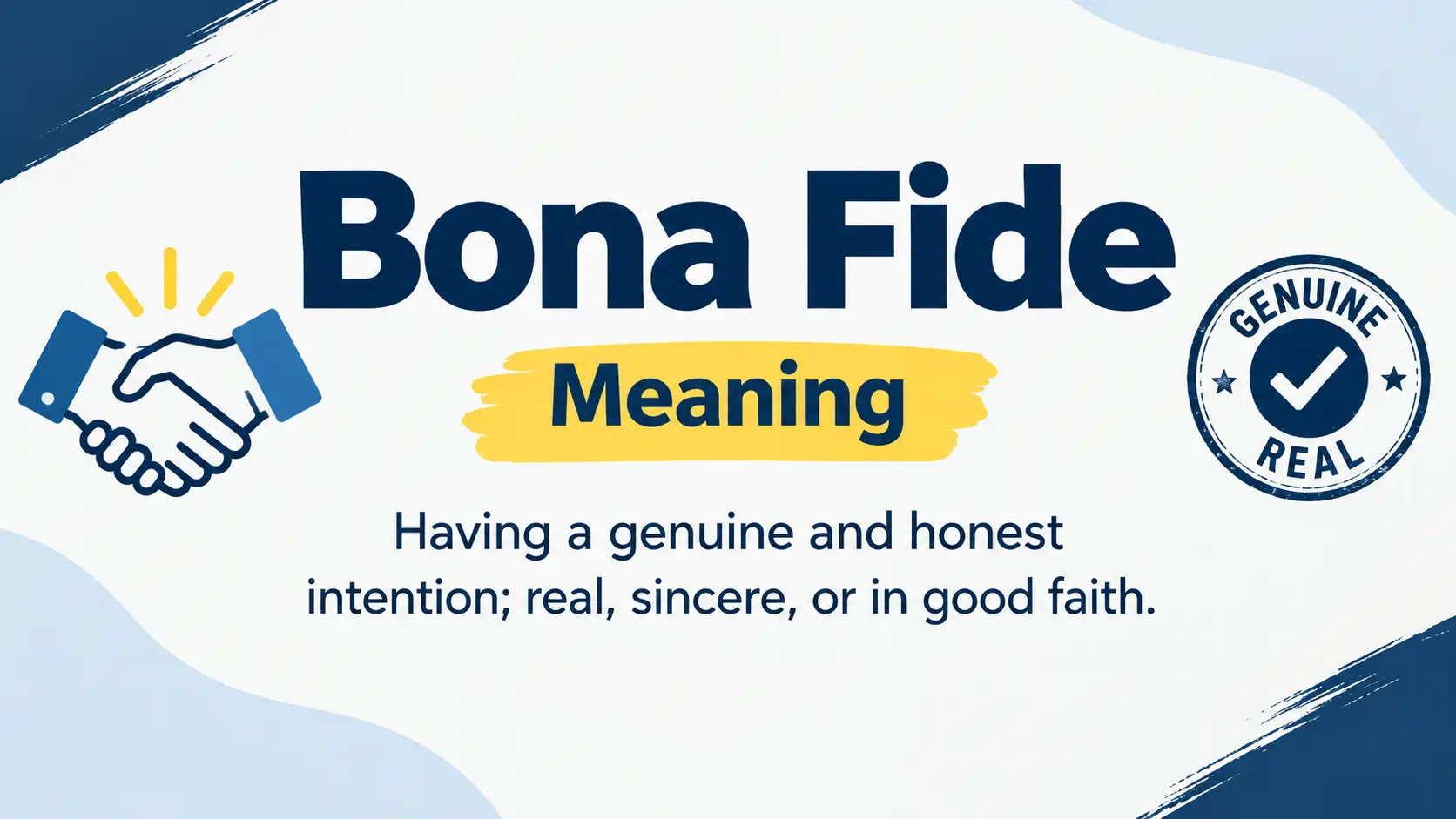
If you have seen the phrase bona fide in a job ad, legal document, business article, or everyday conversation, you may wonder what it means. Bona fide means real, genuine, authentic, or honestly intended. It can describe something that is not fake or an action that is sincere and made in good faith.
For example, if someone says, “She is a bona fide expert,” they mean she is a real and qualified expert. In legal or business settings, a bona fide agreement or offer is generally one made honestly and without fraud.
This guide explains the bona fide meaning, pronunciation, grammar, origin, common uses, examples, common mistakes, and the difference between bona fide and bona fides.
Quick Answer: What Does Bona Fide Mean?
Bona fide means real, genuine, authentic, or honestly intended. It comes from Latin and literally means “in good faith.”
In modern English, bona fide is usually used as an adjective to describe something that is genuine or real.
For example:
“She’s a bona fide movie star.”
This means she is a real or genuine movie star, not someone who is simply being described that way.
The phrase can also describe an honest or serious action:
“They made a bona fide offer to buy the house.”
Here, the offer was genuine and seriously intended.
Bona Fide Meaning and Definition
The simplest bona fide meaning is “real and genuine.”
Depending on the context, the phrase can have a few closely related meanings.
First, bona fide can mean something is authentic or truly what it claims to be.
“She is a bona fide professional.”
This means she is a genuine professional with real experience or qualifications.
Second, bona fide can mean sincere, serious, or honestly intended.
“He made a bona fide attempt to solve the problem.”
This suggests that he made a real and honest effort.
Third, bona fide is common in legal and business writing. In these settings, it often carries the idea of good faith and can describe someone or something that is genuine rather than fraudulent.
So, depending on the sentence, you can often understand bona fide as:
real + genuine + authentic + honest + sincere
However, it does not always mean that something is officially approved or legally valid. The exact meaning depends on the context.
What Does Bona Fide Mean in Simple English?
In simple English, bona fide means “real, not fake.”
It can also mean “honest and serious.”
Here are some easy examples:
- A bona fide company — a real or legitimate company.
- A bona fide expert — a genuine expert.
- A bona fide offer — a serious and genuine offer.
- A bona fide reason — a real or sincere reason.
- A bona fide customer — a genuine customer.
A simple way to remember it is:
Bona fide = the real thing or something done in good faith.
How to Pronounce Bona Fide
In American English, bona fide is commonly pronounced approximately:
BOH-nuh FIDE
The word fide rhymes with wide.
A common American pronunciation is represented by Merriam-Webster as ˈbō-nə-ˌfīd. You may also hear pronunciations that are closer to the original Latin form.
The standard English spelling is:
bona fide
It is normally written as two words.
How to Use Bona Fide in a Sentence
Bona fide is most often used as an adjective. It usually comes before a noun to describe someone or something as genuine, real, or honestly intended.
Here are some natural examples:
“She is a bona fide artist.”
This means she is a real or genuine artist.
“He became a bona fide celebrity.”
This means he became a genuine celebrity.
“We are looking for a bona fide buyer.”
This means they want a real and serious buyer.
“The company is a bona fide business.”
This means the company is genuine or legitimate.
“She made a bona fide effort to help.”
This means she made a sincere and serious effort.
“The lawyer presented evidence of a bona fide claim.”
Here, the phrase suggests that the claim was genuine rather than fraudulent.
One important grammar point is that bona fide does not change form when it describes a plural noun.
For example:
“They are bona fide experts.”
Not:
“They are bonas fides experts.”
Bona Fide in Law and Business
You may see bona fide especially often in legal, financial, and business writing.
In these settings, the phrase can carry the idea of good faith. It may suggest that someone acted honestly and without fraud or deception.
For example:
“The buyer made a bona fide offer.”
This means the offer was genuine and seriously intended.
“The company is a bona fide employer.”
This suggests that it is a real employer rather than a fake operation.
“The court considered whether the buyer acted in good faith.”
You may also encounter phrases such as bona fide purchaser, bona fide offer, and bona fide claim.
In legal writing, the exact meaning and legal effect of these terms can depend on the law and the facts of a particular case. Therefore, bona fide should not automatically be treated as meaning “legally approved” or “official.”
In general English, the main idea remains genuine, honest, or made in good faith.
Bona Fide vs. Bona Fides
Bona fide and bona fides look similar, but they are generally used differently.
Bona fide
Bona fide is usually an adjective meaning genuine, real, or honestly intended.
“She is a bona fide expert.”
Here, bona fide describes the noun expert.
Bona fides
Bona fides is a noun. In modern English, it can refer to someone’s qualifications, credentials, experience, or evidence of being genuine.
“His professional bona fides are impressive.”
This means his qualifications and experience are impressive.
Another example:
“The candidate has strong academic bona fides.”
This means the candidate has strong academic qualifications or credentials.
An easy way to remember the difference is:
bona fide = genuine or real
bona fides = credentials, qualifications, or evidence of genuineness
The two expressions have the same Latin roots, but their meanings and uses in modern English are not identical.
The Origin of Bona Fide
Bona fide comes directly from Latin.
The Latin phrase literally means “in good faith.”
The words help explain the phrase. Bona is related to the Latin word for “good,” while fide comes from a Latin word connected with faith, trust, or good faith.
The expression entered English through formal and legal use, where acting in good faith was important. Over time, its use expanded beyond legal writing.
Today, you may see bona fide in news articles, business writing, professional communication, and everyday speech.
For example:
“She is a bona fide superstar.”
Here, the phrase simply emphasizes that she is a real or genuine superstar.
Although the phrase has Latin roots, its main idea is easy to understand:
something genuine, sincere, or truly what it claims to be.
Common Mistakes With Bona Fide
One common mistake is spelling bona fide as one word.
The standard form is:
bona fide
For example:
Correct: “She is a bona fide expert.”
Another common mistake is assuming that bona fide always means “official.”
It can suggest that something is genuine or legitimate, but the exact meaning depends on the context.
For example, a bona fide expert is a genuine expert. The phrase does not automatically mean that a government agency has officially certified that person.
Another mistake is confusing bona fide with bona fides.
Use bona fide when describing someone or something:
“He is a bona fide musician.”
Use bona fides when talking about credentials, qualifications, or evidence of genuineness:
“She has excellent bona fides as a musician.”
Finally, remember that bona fide is not limited to legal English. It is also common in everyday and professional writing and can simply mean real, genuine, or sincere.
Real-Life Examples of Bona Fide
Here are some examples showing how bona fide works in different situations:
“That restaurant is a bona fide local favorite.”
The restaurant is genuinely popular with local people.
“He is a bona fide genius.”
The speaker believes he is truly a genius.
“We need a bona fide reason for the delay.”
They need a genuine or legitimate reason.
“She received a bona fide job offer.”
The offer was real and seriously intended.
“The company checked that the seller was bona fide.”
The company checked that the seller was genuine or legitimate.
“After years of work, she became a bona fide expert.”
She became a real expert through her experience and knowledge.
“The lawyer questioned the buyer’s bona fides.”
The lawyer questioned whether the buyer was genuine or had the necessary qualifications or credentials.
These examples show why context matters. The same basic idea—genuine, honest, or real—can appear in casual, professional, business, and legal writing.
Synonyms for Bona Fide
The best synonym depends on the sentence.
- Genuine — truly what it claims to be.
- Real — not fake or imaginary.
- Authentic — genuine or original.
- Legitimate — valid, lawful, or genuine.
- Sincere — honest in feelings or intentions.
- True — accurate or real.
- Credible — believable or trustworthy.
For example:
“She is a bona fide expert.”
could become:
“She is a genuine expert.”
or:
“She is a real expert.”
However, these words are not always exact substitutes. Bona fide can emphasize both genuineness and the idea of good faith or sincere intention, depending on the context.
Is Bona Fide Formal or Casual?
Bona fide can be used in both formal and casual English.
It is common in legal and business writing, but it also appears in everyday speech.
For example:
“He’s a bona fide rock star.”
This sounds fairly casual.
“The parties entered into a bona fide agreement.”
This sounds more formal.
In casual conversation, simpler words such as real, genuine, or legit may sound more natural.
For example:
“She is a bona fide expert.”
could become:
“She is a real expert.”
Both are understandable, but bona fide can sound more polished or emphatic.
Because the phrase comes from Latin, it may sometimes make writing sound more formal. Use it when it fits the audience and sentence rather than using it only to sound sophisticated.
People Also ASK ❓
What does bona fide mean in simple terms?
Bona fide means real, genuine, authentic, or honestly intended. In simple English, you can often replace it with “real” or “genuine,” depending on the sentence.
Is bona fide one word or two words?
The standard spelling is two words: bona fide. It is commonly used as an adjective, such as “a bona fide expert.”
What is an example of bona fide?
“She is a bona fide doctor” means she is a real or genuine doctor. The phrase can also describe an honest or serious action, such as “a bona fide offer.”
What is the difference between bona fide and bona fides?
Bona fide is usually an adjective meaning genuine, real, or honestly intended. Bona fides is a noun that can refer to someone’s qualifications, credentials, or evidence of genuineness.
Does bona fide mean legitimate?
It can mean legitimate in some contexts, especially when describing something genuine or honest. However, legitimate and bona fide are not always exact synonyms. The meaning depends on the sentence.
Is bona fide a legal term?
It is widely used in law, where it often relates to good faith, honesty, or lack of fraud. However, bona fide is not limited to legal language. It is also common in everyday and professional English.
Conclusion 📌
The bona fide meaning is simple once you know its main idea: real, genuine, authentic, or made in good faith. The phrase comes from Latin and literally means “in good faith.”
Today, it is used in legal, business, professional, and everyday English.
You might describe someone as a bona fide expert, meaning they are a genuine expert. A bona fide offer is a real and serious offer.
Meanwhile, bona fides is a related noun that can refer to a person’s qualifications, credentials, or evidence that they are genuine.
When you see bona fide, think “the real thing” or “honestly meant.” That simple idea will help you understand most uses of the phrase.
If you use it in your own writing, remember to spell it as two words: bona fide.

Hi, I’m Mia Walker, a Senior Language Content Specialist at Hublioo.com. I have 5+ years of experience creating clear and easy-to-understand content about word meanings, slang, acronyms, phrases, and modern English usage. My goal is to simplify complex language and help readers understand words with confidence through accurate, well-researched, and reader-friendly explanations.