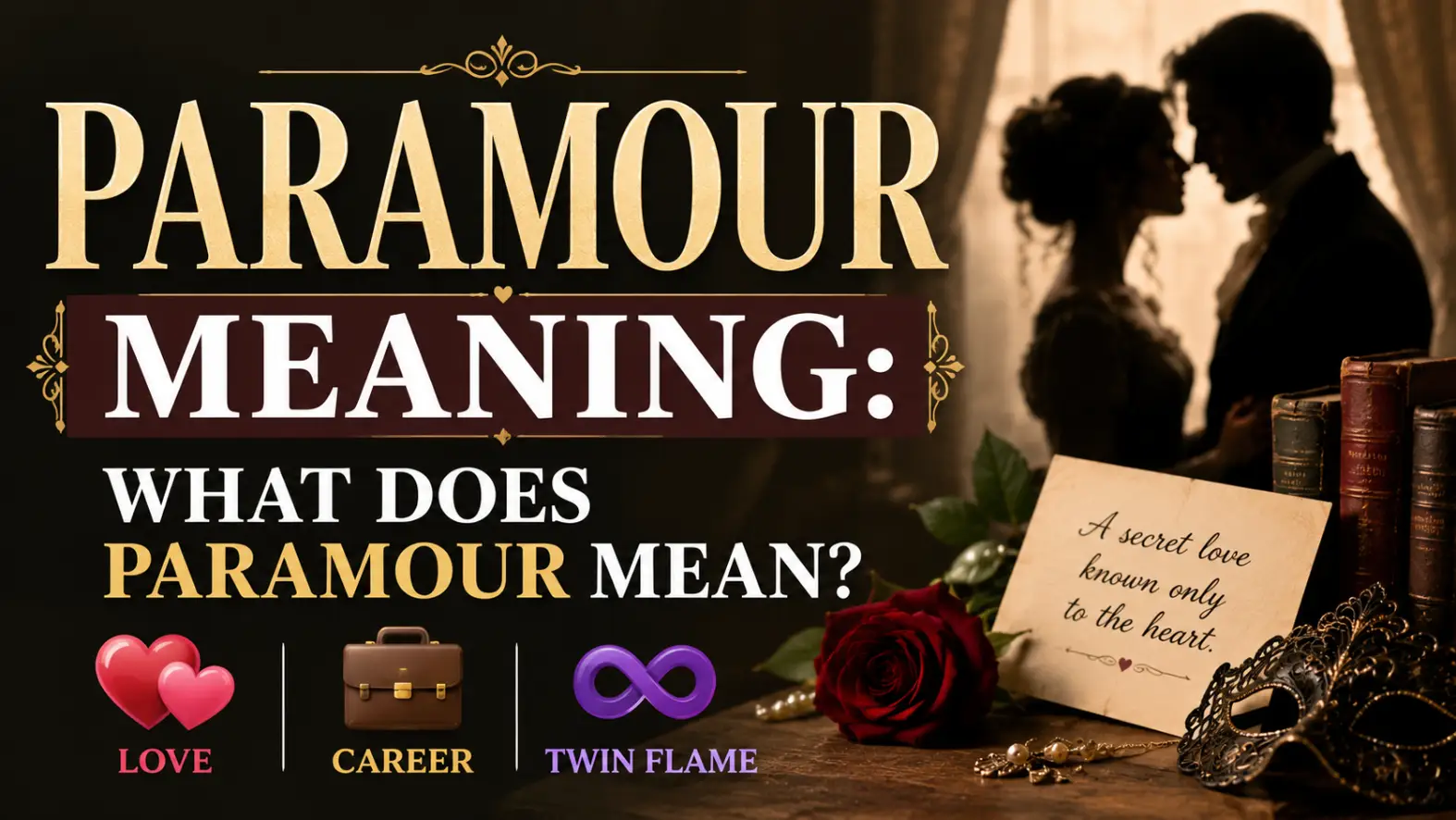
The word paramour means a person who has a romantic or sexual relationship with someone, especially when the relationship is outside marriage.
It is an old-fashioned or literary word that often suggests a secret or socially disapproved lover.
Today, you are most likely to see paramour in books, historical writing, news reports, or dramatic descriptions rather than everyday conversation.
Quick Answer: What Does Paramour Mean?
Paramour means a lover, especially someone involved in a romantic or sexual relationship outside marriage.
For example:
“Everyone in the village knew that the wealthy man had a secret paramour.”
In this sentence, paramour refers to the person’s secret romantic partner.
The word can describe a man or a woman. Unlike modern words such as “boyfriend,” “girlfriend,” or “partner,” paramour often carries an old-fashioned, secretive, or negative feeling. Cambridge Dictionary labels the word as old use or literary.
Paramour Meaning and Definition
The simplest definition of paramour is a lover, especially a secret or unmarried lover.
The word usually describes a person who has a romantic or sexual relationship with another person. In many uses, one or both people are married to someone else. Because of this, the word can suggest an affair.
For example:
“She left town with her paramour.”
Here, the word tells us that she left with her lover. The choice of paramour can make the relationship sound secret, scandalous, or dramatic.
Another example is:
“The king secretly met his paramour at night.”
This sentence has a historical or literary tone. A modern speaker might simply say, “The king secretly met his lover.”
The important point is that paramour is not normally a neutral everyday word for any romantic partner. It often adds a sense of secrecy, forbidden love, or an affair.
Is Paramour a Positive or Negative Word?
The meaning of paramour depends on the context, but the word often has a negative or suspicious tone.
If someone says “my partner,” the phrase sounds neutral. If someone says “my paramour,” the word may suggest that the relationship is hidden or outside an existing marriage.
Consider these two sentences:
“She introduced her partner to her friends.”
“She secretly visited her paramour.”
The first sentence sounds normal and neutral. The second sounds secretive and dramatic.
This difference is important when choosing the right word. Paramour is usually better suited to stories, historical writing, literature, or situations where an affair is part of the meaning.
Grammar and Correct Usage of Paramour
Paramour is a countable noun. You can use it with articles such as “a” and “the.”
Correct examples include:
“He met a paramour while traveling.”
“The actress was rumored to have a paramour.”
“She left with her paramour.”
“They discovered that he had a secret paramour.”
The plural form is paramours.
For example:
“The novel tells the stories of several powerful men and their paramours.”
The word can refer to either gender. It does not mean only a woman or only a man.
Because paramour is formal, literary, or old-fashioned, it may sound unusual in casual speech. In everyday American English, words such as “lover,” “partner,” “boyfriend,” or “girlfriend” are usually more natural, depending on the situation.
Examples of Paramour in Real Life and Writing
You may encounter paramour in different kinds of writing.
In a historical story, you might read:
“The queen secretly wrote letters to her paramour.”
In a mystery novel:
“The detective discovered that the victim had been meeting a paramour.”
In a newspaper-style account:
“The investigation revealed that the politician had been seeing a longtime paramour.”
In ordinary conversation, however, a person would more likely say:
“She was seeing someone else.”
“He had an affair.”
“She was meeting her lover.”
These examples show why the word matters. Paramour gives writing a particular tone. It can make a sentence sound more dramatic, formal, old-fashioned, or secretive.
Paramour vs. Lover
Paramour and lover can both refer to someone involved in a romantic or sexual relationship, but they do not always carry the same feeling.
Lover is a common word and can be neutral. It can describe someone with whom a person has a romantic or sexual relationship.
Paramour is less common and often suggests a secret or illicit relationship.
For example:
“She met her lover after work.”
This sounds fairly direct.
“She met her paramour after work.”
This sounds more dramatic and may suggest an affair.
The word lover also has other meanings. Someone can be called a “lover of music” or a “lover of animals.” Paramour does not normally have these broader meanings.
Paramour vs. Partner
The words paramour and partner should not usually be treated as exact synonyms.
A partner can be a spouse, romantic companion, business associate, or teammate, depending on context. When used for a relationship, it is generally neutral.
A paramour, by contrast, usually refers specifically to a lover and often suggests that the relationship is outside marriage or otherwise secret.
For example:
“My partner and I went on vacation.”
This gives no suggestion of wrongdoing.
“He secretly visited his paramour.”
This strongly suggests a hidden romantic relationship.
So, if you simply mean someone’s romantic companion, partner is usually the better modern word.
Paramour vs. Mistress
Mistress and paramour overlap in meaning, but they are not identical.
A mistress traditionally means a woman who has a sexual or romantic relationship with a married man. The word can also have several completely different meanings, such as a female teacher or a woman in a position of authority, especially in older usage.
Paramour is broader because it can refer to a man or woman.
For example:
“The duke’s mistress lived in another part of the city.”
“The duke’s paramour lived in another part of the city.”
Both can suggest an affair, but paramour does not specify the gender of the lover.
Origin and History of the Word Paramour
The history of paramour is especially interesting because its meaning has changed over time.
The word comes from the Old French and Anglo-French expression par amour, meaning roughly “with love” or “passionately.” Etymological records trace the expression to amor, meaning “love,” from Latin amare, meaning “to love.”
The noun paramour appeared in English in the early 14th century. At first, it could simply mean lover or wooer and did not necessarily have today’s negative meaning. Historical records also show earlier uses connected with affectionate or beloved people.
Over time, the word developed a stronger association with a mistress, concubine, or secret lover. By the 17th century, that later sense had become the main meaning outside poetic use.
This history explains why paramour can still sound romantic while also suggesting secrecy or forbidden love.
Common Mistakes When Using Paramour
One common mistake is using paramour as if it were simply a modern synonym for “boyfriend” or “girlfriend.” Although the words can overlap, paramour usually has a more dramatic meaning.
For example, saying “This is my paramour” at a casual dinner could sound deliberately theatrical.
Another mistake is assuming that a paramour must be a woman. The word can describe a lover of either gender.
It is also incorrect to assume that every paramour is necessarily unmarried. The word strongly suggests a romantic or sexual relationship outside normal expectations, but the exact relationship depends on context.
Finally, avoid using paramour when you simply mean “someone who loves something.” A person who loves books is a “book lover,” not a “book paramour.”
How to Pronounce Paramour
In American English, paramour is commonly pronounced roughly like:
PAIR-uh-moor
The final part sounds similar to “moor.”
Cambridge Dictionary gives the U.S. pronunciation as /ˈper.ə.mʊr/.
The word has a different pronunciation pattern in British English, so you may hear it pronounced differently depending on the speaker.
When Should You Use the Word Paramour?
Use paramour when you want to describe a lover in a formal, literary, historical, or dramatic way.
It works especially well when secrecy or an affair is important to the story.
For example:
“The detective followed the woman’s mysterious paramour.”
“The novel centers on a forbidden romance between a noblewoman and her paramour.”
“The king’s paramour became a powerful figure at court.”
For everyday conversation, simpler words are usually clearer. You might say “lover,” “partner,” “boyfriend,” “girlfriend,” or “romantic partner,” depending on what you mean.
The best word depends on the tone you want.
FAQs:
What does paramour mean in simple words?
Paramour means a lover, especially a secret or unmarried romantic partner. The word often suggests an affair or relationship that is not socially accepted.
Is a paramour the same as a lover?
Not exactly. A paramour can be a lover, but the word usually has a more old-fashioned or dramatic tone and may suggest a secret or improper relationship.
Can paramour refer to a man?
Yes. Paramour can refer to a lover of any gender. It does not specifically mean a woman.
Is paramour a negative word?
It often has a negative or suspicious feeling because it can suggest an affair or secret relationship. However, the exact tone depends on how the word is used.
Is paramour still used today?
Yes, but it is uncommon in everyday speech. It is more often found in literature, historical writing, formal descriptions, and dramatic contexts. Cambridge classifies it as old use or literary.
What is a modern synonym for paramour?
Depending on the context, modern alternatives include “lover,” “romantic partner,” “partner,” or “secret lover.” If an affair is involved, “lover” or “affair partner” may be clearer.
Conclusion:
The paramour meaning is easiest to remember as a lover, especially a secret or unmarried lover. The word can describe either a man or a woman and often carries a literary, old-fashioned, or dramatic tone.
Its history goes back to the Old French expression par amour, connected with the idea of loving passionately.
Over the centuries, the word developed from a broader meaning of lover into the more specific sense commonly associated with a secret or illicit relationship.
Today, paramour is not usually the best choice for casual conversation.
Words such as “partner” or “lover” are more natural in most modern situations.
However, if you are reading a novel, studying older English, or writing about a secret romance, knowing the meaning of paramour can help you understand the exact tone of the text.

Hi, I’m Mia Walker, a Senior Language Content Specialist at Hublioo.com. I have 5+ years of experience creating clear and easy-to-understand content about word meanings, slang, acronyms, phrases, and modern English usage. My goal is to simplify complex language and help readers understand words with confidence through accurate, well-researched, and reader-friendly explanations.