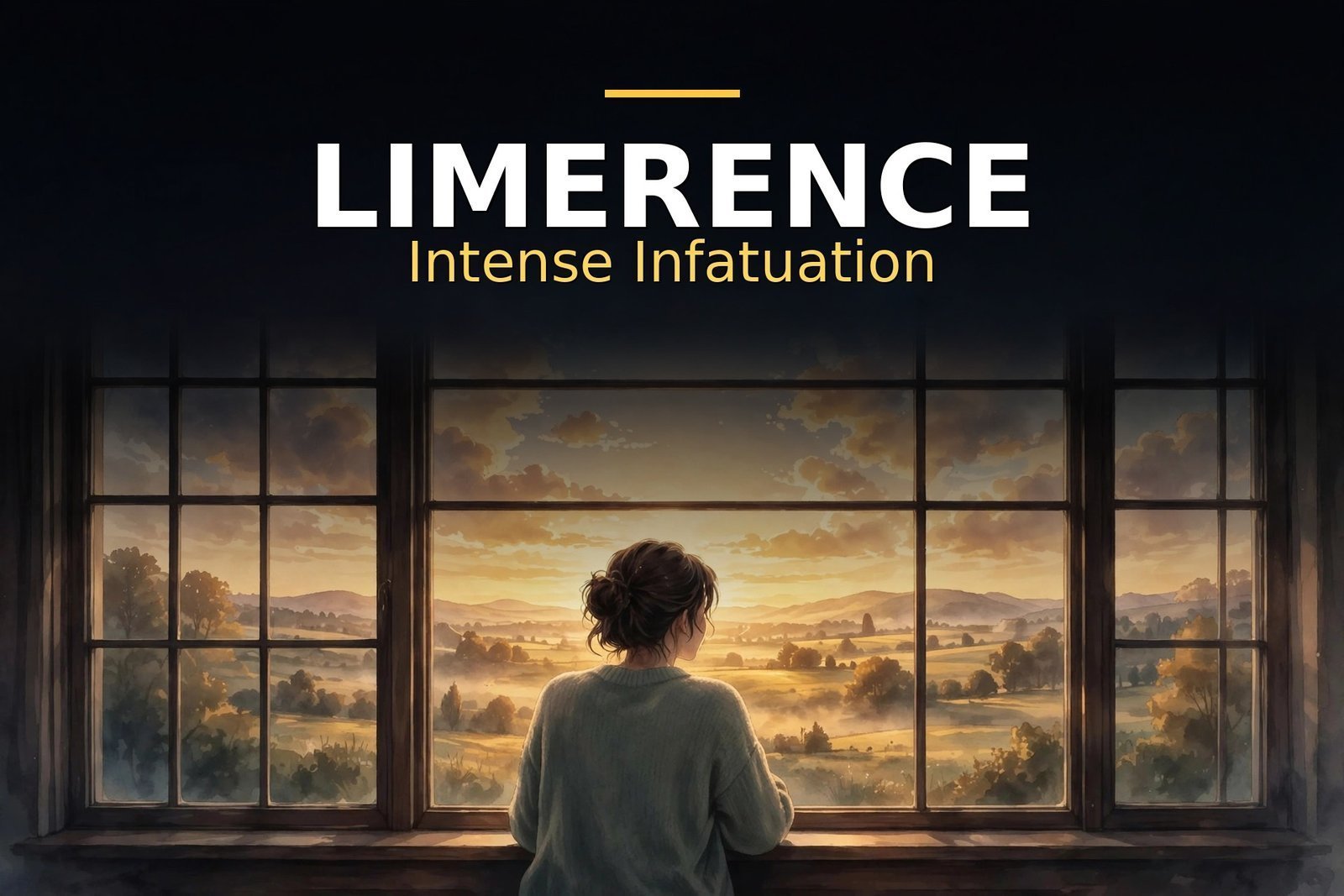
Short meaning: Limerence is a state of intense, intrusive infatuation – an all-consuming romantic longing for another person, marked by obsessive thoughts and emotional dependence on being loved back.
The Psychology Behind Limerence
The full definition of limerence goes deeper than “a really big crush.” Psychologists describe it as an involuntary cognitive and emotional state with three hallmark features:
- Intrusive thinking – the person (called the “limerent object”) occupies your mind constantly, uninvited. You replay conversations, analyze texts, and rehearse future encounters on loop.
- Acute longing for reciprocation – happiness hinges entirely on perceived signs of interest. A delayed reply ruins the day; a small kindness electrifies it.
- Emotional volatility – euphoria and despair alternate with the other person’s attention, like a mood thermostat controlled by someone else.
Unlike ordinary attraction, limerence is compulsive and destabilizing. It hijacks sleep, appetite, and concentration. It is not a formal clinical diagnosis, but it is a widely recognized psychological concept – and naming it is often the first step toward loosening its grip.
Signs You Might Be Experiencing Limerence
- You think about the person constantly and can’t switch it off, even when you try.
- You “read into” tiny signals – a like, a glance, a tone of voice – and your whole mood swings on them.
- You’ve idealized them: flaws are invisible, and they can do no wrong.
- Fear of rejection shapes your daily decisions – what you wear, where you go, what you say.
- You’ve started monitoring them: checking profiles, re-reading old messages, asking mutual friends casual questions that aren’t casual at all.
- Your emotional highs and crashes map perfectly onto their attention toward you.
If several of these feel uncomfortably familiar, what you’re feeling has a name – and it’s limerence, not simply love.

Etymology: A Word Invented on Purpose
Here’s what makes limerence unusual among English words: it was deliberately invented. Psychologist Dorothy Tennov coined it in her 1979 book Love and Limerence, after interviewing hundreds of people about the lovesick state she kept encountering. She wanted a term with no prior associations – nothing poetic, nothing clinical-sounding – so the concept could be studied without baggage. The word has no Latin or Greek root; Tennov simply crafted something that sounded appropriately scientific.
For decades it lived quietly in psychology circles. Then, in the 2020s, therapy-speak flooded social media, and limerence went viral – suddenly everyone had a precise word for the obsessive almost-relationships of modern dating.
Limerence vs. Love
This is the comparison that matters most, because confusing the two causes real pain:
| Limerence | Love |
|---|---|
| Obsessive, intrusive thoughts | Calm, secure thinking |
| Idealizes the person | Sees them realistically, flaws included |
| Needs constant reciprocation | Comfortable with independence |
| Anxiety-driven | Trust-driven |
| Crashes or evaporates | Deepens with time |
Limerence can mature into love – but only when idealization gives way to reality and anxiety gives way to trust. Until then, it’s infatuation with the volume at maximum.
Limerence vs. a Crush: Clearing Up the Confusion
People often use these interchangeably, but they differ in intensity and control:
- A crush is light, pleasant, and mostly voluntary – you enjoy the daydream and can put it aside.
- Limerence is heavy, distressing, and involuntary – the thoughts intrude whether you want them or not, and your functioning suffers.
Think of it this way: a crush is background music; limerence is a song stuck at full volume that you can’t turn off.
Words That Orbit Limerence
Synonyms (3–5):
– Infatuation – intense but usually shorter-lived passion
– Lovesickness – the folk term for the same ache
– Obsession – stronger, clinical-adjacent compulsive fixation
– Besottedness – (literary) being blindly, foolishly in love
Antonyms (2–3):
– Secure attachment – calm, stable, trusting love
– Indifference – the complete absence of romantic charge
– Companionate love – deep affection without obsession
How People Actually Use the Word
- “I’ve checked their profile twenty times today – this isn’t a crush anymore, it’s limerence.” (casual, self-aware)
- “The study examined limerence as a predictor of anxious attachment behaviors.” (academic)
- “I finally realized it was limerence, not love – and that realization set me free.” (reflective)
- “Therapists note that limerence typically fades with distance, time, or disillusionment.” (clinical)
- “Three months of limerence taught me more about myself than three years of dating.” (conversational)
- “Unlike love, limerence thrives on uncertainty; reciprocation often dissolves it.” (formal)
Tone and Register
Limerence sits at an interesting crossroads of register. In psychology and therapy contexts, it’s a precise technical term. In everyday speech – especially online – it’s become therapy-speak: casual, self-diagnosing, sometimes used loosely. It is never slang in the playful sense; even casual use carries a note of seriousness, because the experience it names is genuinely distressing.

Frequently Asked Questions
What does limerence mean in simple terms?
An intense, obsessive crush – intrusive thoughts about one person and emotional dependence on their reciprocation.
What is the psychology definition of limerence?
An involuntary state of intrusive romantic preoccupation with a “limerent object,” marked by longing for reciprocation and mood instability tied to perceived signals.
Limerence vs. love – what’s the difference?
Limerence is anxiety-driven idealization that needs constant reassurance; love is secure, realistic attachment that deepens over time.
How do you use limerence in a sentence?
“It took me months to admit it was limerence, not love.” – the word works wherever you’d describe obsessive infatuation precisely.
How long does limerence last?
Typically months to a few years. It fades with distance, time, genuine reciprocation-turned-reality, or disillusionment.
Is limerence a mental disorder?
Not a formal diagnosis. But when the obsessiveness impairs work, sleep, or relationships, professional support is wise.
Conclusion
Limerence names one of the human heart’s most disorienting states – infatuation with the volume at maximum. Understanding the word is the first step to mastering the feeling.
Explore more: Infatuation Meaning • Platonic Meaning

Hi, I’m Claire Morgan, a Senior Language Content Specialist at Hublioo.com. I have 5+ years of experience creating clear and easy-to-understand content about word meanings, slang, acronyms, phrases, and modern English usage. My goal is to simplify complex language and help readers understand words with confidence through accurate, well-researched, and reader-friendly explanations.