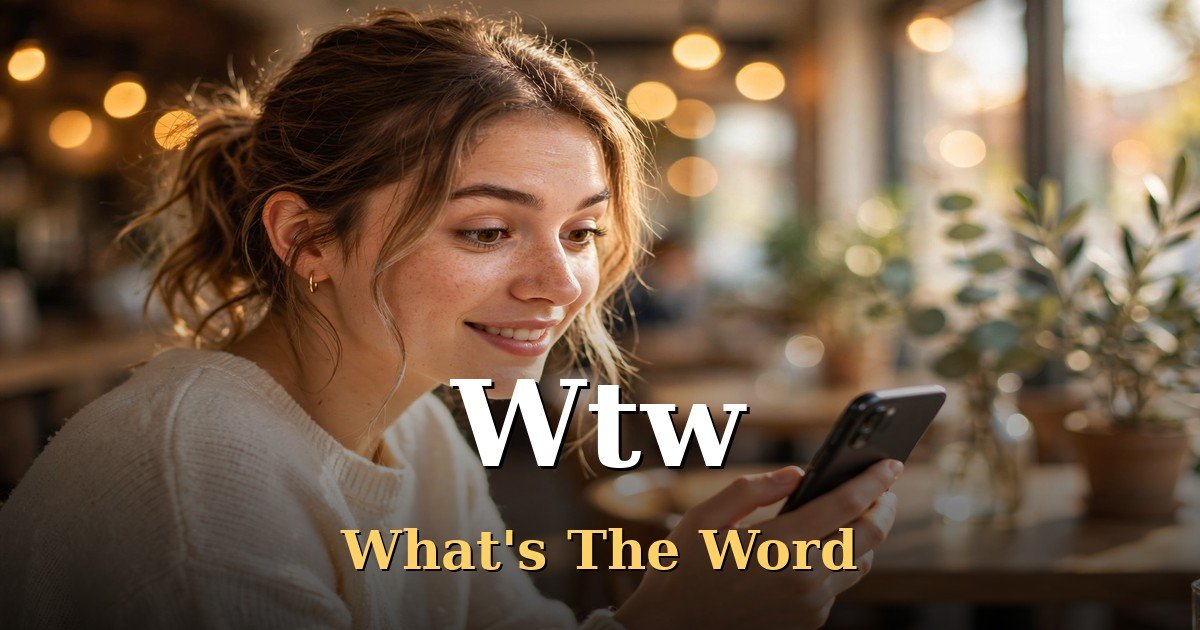
Picture this: your phone buzzes, you glance down, and all it says is “wtw?” No context, no emoji, just three letters staring back at you. If your first thought was is that a typo?, you’re not alone.
WTW stands for “what’s the word” – a casual, friendly way of asking “what’s up?” or “what’s going on?” It’s a conversation starter, a check-in, and sometimes a low-key invitation to make plans, all packed into one tiny abbreviation. Let’s break down exactly what WTW means, where it came from, and how to use it like you invented it. 👋
WTW means “what’s the word?” – a casual way to ask “what’s up?” or “what’s the news?” It’s a friendly check-in used in texts and DMs.
Abbreviation of: “What’s the word?”
Meaning: What’s up / what’s new
Origin: AAVE and hip-hop culture; shortened in the 2010s
Used on: Texts, Snapchat, Instagram DMs, TikTok
Best reply: “nm, just chilling, wbu?”
What Does WTW Mean in Texting?
WTW = “what’s the word?” It’s the digital equivalent of walking up to a friend and asking “hey, what’s happening?” The person texting you wants an update, a plan, or just a quick check-in – nothing deep, nothing formal.
The word “word” here doesn’t mean vocabulary. It means news – the latest information, the gossip, the update. “What’s the word?” is really asking “what’s the news with you?” That framing makes the slang click instantly.
Nine times out of ten, a standalone “wtw?” is just a greeting. The correct response is short and honest: “nm, just chilling, wbu?” Nobody expects a paragraph. The whole point of WTW is keeping things light and low-pressure.
WTW Meaning on Snapchat and Instagram
WTW is native to Snapchat and Instagram DMs, and the platform shapes the meaning slightly. On Snapchat, “wtw” often arrives as a reply to your Story – it’s someone’s way of reacting and reopening a conversation without committing to a topic. Streak culture loves WTW because it keeps the chat alive with zero effort.
On Instagram, WTW shows up in DMs the same way, but in comments it can lean more playful – “wtw with this fit 🔥” is a compliment disguised as a question. On TikTok, you’ll see it in captions and comments as an engagement prompt rather than a real question.

Where Did WTW Come From?
“What’s the word?” has roots in African American Vernacular English (AAVE) and hip-hop culture, where it was a common greeting long before smartphones existed – think “what’s the word on the street?” meaning “what’s happening out there?”
As texting took over in the 2000s and 2010s, the phrase got compressed into WTW, the same way “what are you doing” became “wyd.” It floated around chatrooms and early Twitter, then went mainstream around 2018 as meme culture and short-form video made quick slang more valuable than ever. Today it’s a staple of Gen Z texting worldwide.
How to Use WTW: Real Conversation Examples
WTW is flexible. Here it is doing different jobs in real chats:
Jay: “yo, wtw?”
Sam: “nm just gaming, you?”
The classic check-in. Simple greeting, simple reply.
Mia: “wtw tonight? 👀”
Leo: “nothing yet, wanna grab food?”
Fishing for plans. The 👀 does half the work.
Alex: “wtw, heard there’s a party Saturday”
Jordan: “yup! starts at 9, you in?”
Opening with news, inviting a response.
Notice the pattern: WTW opens the door, and the other person decides how far to walk through it. That’s the beauty of it – no pressure on either side.
When to Use WTW (and When to Skip It)
Use WTW when:
- You’re texting friends, classmates, or anyone you’re casual with.
- You want to start a conversation without a specific topic.
- You’re fishing for plans: “wtw this weekend?”
- You’re replying to a Story and want to keep the streak going.
Skip WTW when:
- You’re messaging a boss, teacher, or anyone in a professional context.
- The conversation is serious – “wtw?” after someone shares bad news sounds tone-deaf.
- You’re texting someone who doesn’t know internet slang. They’ll just be confused.
- You actually need a specific answer. “Wtw with the project?” is vague – ask directly instead.
Is WTW Flirty? Reading the Tone
WTW itself is friendly, not flirty – but context can change everything. A plain “wtw?” from a friend at 2pm is just a check-in. That same “wtw? 👀” from your crush at 11pm? That’s an invitation, and you know it.
The tone clues to watch: timing (late-night WTW leans flirty), emojis (👀😏🔥 add spice; 🙂 keeps it friendly), and punctuation (“WTW?!” with energy leans toward “what the what?!” – surprise, not a greeting). When in doubt, read the message before it. WTW after a surprising screenshot means shock; WTW out of nowhere means “let’s talk.”
One more meaning worth knowing: in rare cases WTW can mean “what the what?” (a softer “wait, WHAT?”) or “what’s the wave?” (what’s the plan?). Both are uncommon, but if “what’s the word?” doesn’t fit the conversation, one of these probably does.
WTW vs WYD vs WYA vs WYO: What’s the Difference?
These four get mixed up constantly. Here’s the cheat sheet:
| Slang | Stands For | What It’s Really Asking |
|---|---|---|
| WTW | What’s the word? | What’s up / what’s the news? (general check-in) |
| WYD | What you doing? | What are you doing right now? (this exact moment) |
| WYA | Where you at? | What’s your location? (logistics, meetups) |
| WYO | What you on? | What are your plans? (availability, vibe check) |
The nuance: WYD asks about the moment, WTW asks about the vibe. “WYD?” wants to know what you’re doing at 9pm. “WTW?” wants to know what’s going on with you generally. Pick the one that matches your actual curiosity.
WTW Synonyms and Alternatives
If WTW isn’t your style, these do the same job:
- “Sup” / “What’s up” – the timeless classic
- “What’s good?” – slightly more energetic (see WSG meaning)
- “What’s happening?” – the full, spelled-out version
- “What’s new?” – when you genuinely want updates
- “Yo” – the minimalist opener
And the opposites – when you want to end a conversation instead of starting one: “gtg” (got to go), “brb,” or the classic read-and-reply-later.
WTW FAQs
What does WTW mean in a text from a girl or guy?
It means the same thing regardless of who sends it: “what’s the word?” – a casual check-in. Whether it’s flirty depends on context: late-night timing and 👀😏 emojis suggest interest; a daytime “wtw?” is just friendly.
How do you reply to WTW?
Keep it short and honest. “nm, just chilling, wbu?” is the gold standard. If they asked about plans (“wtw tonight?”), answer with your actual availability. Matching their casual energy is the whole game.
What does WTW mean on Snapchat?
On Snapchat, WTW is usually a Story reply or streak-keeper – someone reacting to what you posted and reopening the chat. It’s casual, friendly, and low-commitment by design.
Is WTW rude?
No, WTW is friendly and neutral. It’s one of the safest slang terms out there. The only way it lands wrong is using it in a serious or professional conversation where casual slang doesn’t belong.
What’s the difference between WTW and WTM?
WTW (“what’s the word?”) is a general check-in – what’s up, what’s new. WTM (“what’s the move?”) specifically asks about plans. WTW opens a conversation; WTM tries to make one happen.
Can I use WTW at work?
Only in very casual team chats with coworkers you’re friendly with – and even then, sparingly. In emails or messages to managers, stick to “what’s the update?” or “how’s it going?”
Key Takeaways
- WTW = “what’s the word?” – a casual way to ask “what’s up?” or “what’s going on?”
- It’s a friendly, low-pressure conversation starter, huge on Snapchat and Instagram.
- Roots in AAVE and hip-hop culture; shortened for the texting era in the 2010s.
- Reply short and honest – “nm, wbu?” never fails.
- Rare alternate meanings: “what the what?” (surprise) and “what’s the wave?” (plans).
So next time your phone buzzes with a mysterious “wtw?”, you’ll know exactly what’s being asked. Now go answer it – someone wants to know your news. 😄

Hi, I’m Mia Walker, a Content Research Writer at Hublioo.com with 3+ years of experience in creating educational language content.
I enjoy breaking down complex words, internet slang, abbreviations, and everyday expressions into clear, practical explanations that anyone can understand.
My focus is on delivering original, easy-to-read, and well-organized content that helps readers expand their vocabulary and use English with greater confidence.