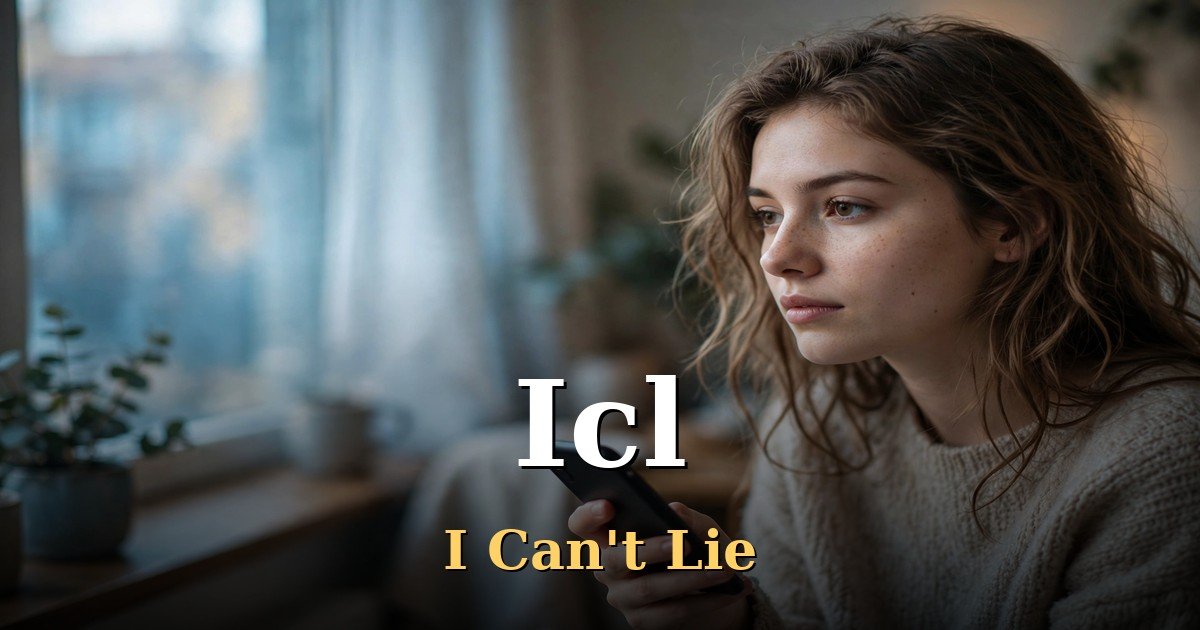
ICL Meaning: The Honest Truth in Three Letters
- Stands for: “I can’t lie”
- Used for: flagging honest opinions, confessions, and compliments in texts and chats
- Origin: early 2020s internet slang; exploded on TikTok and Snapchat around 2022-2023
- Tone: sincere and slightly vulnerable; heavier than NGL, warmer than TBH
- Formal use: no, keep it in casual chats, DMs, and comments
What Does ICL Mean?
ICL = “I can’t lie.” When someone types it, they are doing more than claiming honesty, they are adding emphasis, like saying “I am about to be very real with you, so pay attention.” At its core is the simple idea of being honest, stamped onto whatever comes next.
It works as a verbal highlighter. “That was the best pizza in town” is an opinion. “ICL, that was the best pizza in town” is an opinion with a sincerity stamp on it. The letters tell the reader: this is not small talk, I actually mean this.
ICL meaning in one line: a three-letter promise that the next sentence is the unfiltered truth. It is the warmer, more emotional cousin of TBH, and it hits harder than a plain “honestly.”
ICL Meaning in Texting: Why People Say It
Texting strips away tone of voice and facial expressions, which makes sincerity hard to convey. ICL fills that gap. It is a shortcut that says “trust me on this one” without typing a whole sentence about your intentions.
People reach for ICL in four classic situations:
- Hot takes: “ICL that new album is not as good as everyone says.” (bracing for disagreement)
- Confessions: “ICL I still get nervous before every presentation.” (a little vulnerable)
- Compliments: “ICL that color looks amazing on you.” (proving it is genuine, not polite)
- Disagreements: “ICL I don’t think that plan will work.” (softening bluntness with honesty)

Where Did ICL Come From?
ICL is a baby by slang standards. It started gaining traction in the early 2020s, first bubbling up in British internet slang and then exploding across TikTok, Twitter/X, and Snapchat around 2022-2023. By 2024 it had settled into everyday Gen Z texting vocabulary.
It evolved naturally from spoken filler phrases. People had been saying “not gonna lie” (NGL) and “honestly…” for years; ICL is just the faster, punchier text-native version. It filled a gap: NGL felt casual and light, while ICL carries a touch more emotional weight, better for confessions and things that actually matter to the speaker.
The ICL Tone Decoder: How Placement Changes Everything
This is the part most guides skip. The same three letters hit completely differently depending on how they are typed:
At the start, with a comma: sincere
“ICL, I have been rethinking my career lately.” The comma creates a pause, like a deep breath before honesty. This is ICL at its most genuine.
Buried mid-sentence: casual
“That concert was, ICL, actually amazing.” Tucked inside, it reads as an offhand honesty marker, lighter, almost throwaway.
All caps: intense
“ICL YOU LOOKED INCREDIBLE LAST NIGHT.” Caps lock turns sincerity into emphasis. This is not just honest, it is emphatically honest.
Before a joke: playful
“ICL I only came for the free food.” Here it is doing comedy, not confession. The “honesty” is the punchline, and everyone knows it is a bit.
Before criticism: bracing
“ICL that presentation needed more work.” The reader instinctively tenses up, because ICL before a critique signals this might sting, but it is true.
ICL in Real Conversations
Riya: “did you like the movie?”
Dev: “ICL, it was better than I expected tbh”
Softening a positive surprise, honest without gushing.Chris: “be honest, does this jacket look okay?”
Sam: “ICL… maybe try the blue one instead”
The ellipsis says it all: honesty incoming, brace yourself.
- “ICL fr, that decision made no sense.”
- “ICL I am kinda stressed about tomorrow.”
- “icl you were right and I was wrong”
- “ICL, this is the best day I have had in weeks.”
ICL often travels with other texting shortcuts. If you stack acronyms in your chats, you may also want to know what WTW means before your next group chat.

When to Use ICL (and When to Avoid It)
Use ICL when:
- You are texting friends, family, or anyone you are relaxed with.
- What follows is genuinely sincere, a real opinion, confession, or compliment.
- You are writing a caption or comment where tone could be misread without it.
- You want to sound conversational and real, not stiff.
Avoid ICL when:
- Writing professional emails, academic work, or anything formal.
- Talking to people who do not know internet slang, it just confuses them.
- The “honesty” is actually an insult in disguise (“ICL you are annoying” is just rude with extra steps).
- You would not stand behind the statement without the acronym.
ICL vs NGL vs TBH vs FR: The Honesty Squad
These four all flag honesty, but they run at different emotional temperatures:
| Slang | Stands For | Tone | Best Used Before… |
|---|---|---|---|
| ICL | I can’t lie | Sincere, slightly vulnerable | A genuine feeling or confession |
| NGL | Not gonna lie | Light, often self-deprecating | A funny admission (“ngl I ate the whole thing”) |
| TBH | To be honest | Neutral, conversational | A mild opinion or gentle critique |
| FR | For real | Emphatic, agreeing | Confirming something (“fr, exactly”) |
The practical difference: ICL and NGL both precede admissions, but NGL is lighter. Reach for ICL when the truth has feelings attached.
ICL Synonyms and Antonyms
Other ways to signal honesty:
- “Honestly…”: the full-word classic
- “Real talk”: the conversational equivalent
- “No cap”: Gen Z for “no lie,” same energy
- “TBH” / “NGL”: the sibling acronyms
Antonyms, the opposite energy:
- “Capping” (lying) is the direct opposite of ICL energy
- “Sarcasm”: saying the opposite of what you mean, deliberately
- “Lowkey”: downplaying instead of declaring
And when someone else’s “honesty” makes you shake your head instead, that reaction has a name too: SMH.
ICL FAQs
What does ICL mean in texting?
ICL means “I can’t lie.” It is used to introduce an honest, unfiltered statement, from hot takes to confessions to compliments.
Is ICL the same as NGL?
Close, but not identical. Both introduce honest statements, but NGL (“not gonna lie”) feels lighter and more casual, while ICL carries more emotional weight and sincerity.
Can ICL be rude?
ICL itself is not rude, but it can deliver rudeness: “ICL you are wrong” hits harder than “you are wrong,” because the acronym frames the insult as brave honesty. Never use it as a shield for insults.
What does ICL mean on TikTok?
On TikTok, ICL appears in captions and comments as a sincerity marker: “ICL this is the best series I have watched all year.” It tells viewers the praise is genuine, not hype.
Is ICL formal or informal?
Completely informal. Keep it in texts, DMs, comments, and casual chats. In professional or academic writing, write “honestly” or “frankly” instead.
How do you reply to ICL?
Take it at face value, the person is being real with you. Acknowledge the honesty: “respect for saying that” or “appreciate the honesty.” Then respond to the actual statement.
Key Takeaways
- ICL = “I can’t lie”, a signal that honest, unfiltered words are coming.
- It adds sincerity and emphasis to opinions, confessions, compliments, and disagreements.
- Placement, caps, and punctuation reshape its tone, from vulnerable to playful to bracing.
- Heavier than NGL, warmer than TBH: pick the honesty marker that fits the moment.
- Keep it casual; never use it as a shield for insults.
ICL is three letters that say trust me, I mean this. Use it when you do, and mean it when you do.

Hi, I’m Claire Morgan, a Senior Language Content Specialist at Hublioo.com. I have 5+ years of experience creating clear and easy-to-understand content about word meanings, slang, acronyms, phrases, and modern English usage. My goal is to simplify complex language and help readers understand words with confidence through accurate, well-researched, and reader-friendly explanations.