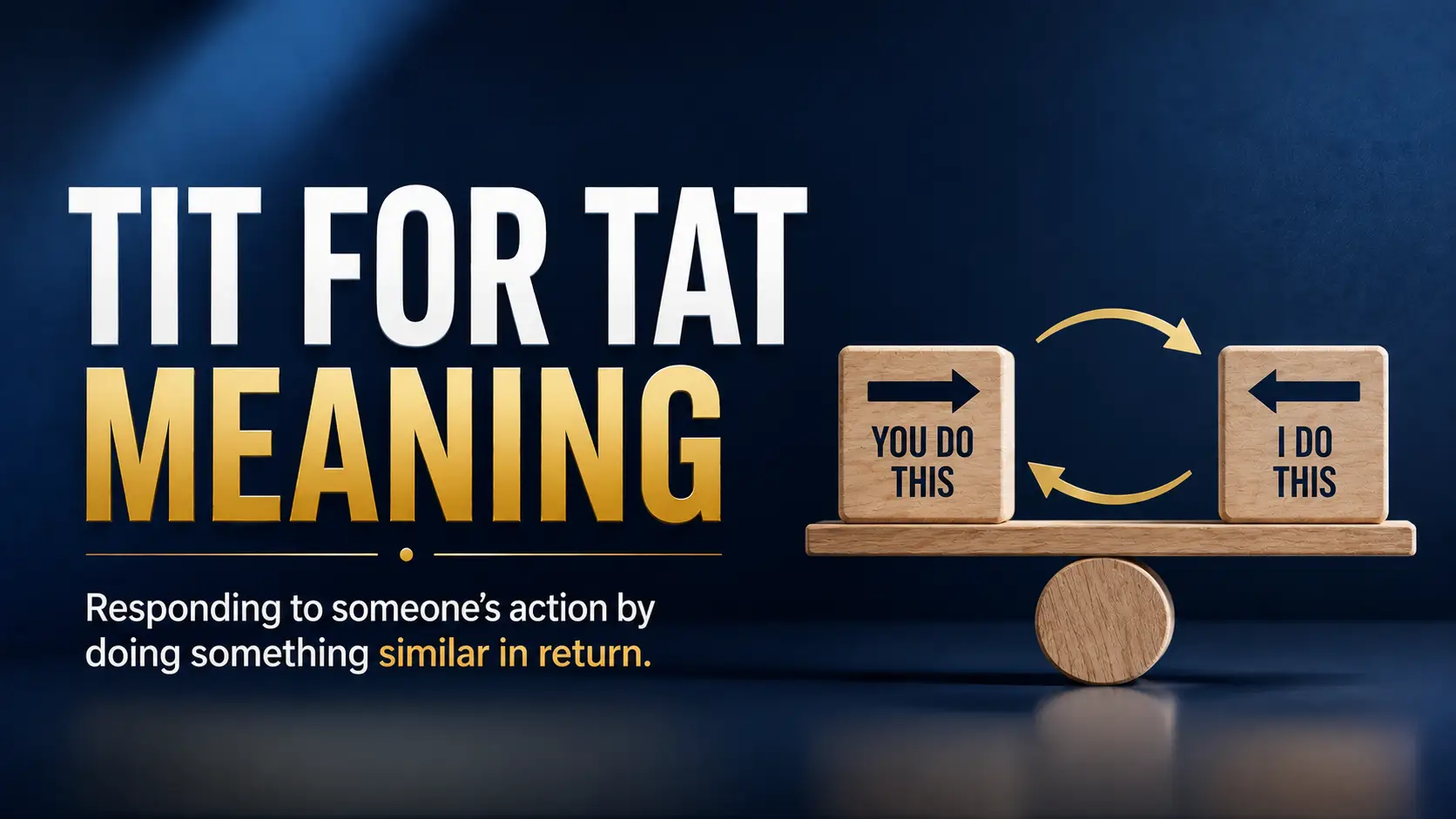
Quick Answer: Tit for tat means repaying someone’s action with a similar one in return – usually retaliation: you hurt me, so I’ll hurt you back. It describes equal, back-and-forth payback, from playground spats and sibling rivalries to tariffs and trade wars.
| Quick Fact | Detail |
|---|---|
| Term | Tit for tat |
| Type | Idiom / set phrase |
| Core meaning | Equivalent retaliation – returning like for like |
| Tone | Informal; slightly disapproving |
| Common contexts | Arguments, rivalries, politics, game theory |
Where Did “Tit for Tat” Come From?
The phrase dates to the 1500s, likely evolving from the earlier expression “tip for tap” – meaning a light blow given in return for a light blow received. (“Tip” and “tap” both described small strikes.) Over time, “tip for tap” morphed into the catchier “tit for tat,” and the meaning broadened from literal blows to any equivalent exchange.
It’s a lovely example of how idioms are born: a vivid physical image (trading taps) becomes a metaphor for all reciprocal behavior. By the 1700s, writers were already using it for verbal sparring and political retaliation – the same uses we have today, four centuries on.
What Does “Tit for Tat” Mean?
In simple English: you do to me what I did to you. The phrase almost always implies retaliation or payback – responding to a negative action with a matching negative action.
Classic scenarios:
- Siblings: She hid his game controller, so he hid her headphones. Pure tit for tat.
- Neighbors: He parked across her driveway; she “accidentally” blocked his. Tit for tat.
- Politics: One country imposes tariffs; the other imposes matching tariffs. Economists literally call these “tit-for-tat tariffs.”
- Workplace: She took credit for his idea, so he stopped sharing ideas with her. Quiet tit for tat.
The phrase can occasionally describe positive reciprocity (“they exchanged favors tit for tat”), but that’s rare. By default, listeners hear retaliation. If you mean friendly exchange, “give and take” is the safer phrase.
How Do You Use “Tit for Tat” in a Sentence?
- “Their argument devolved into childish tit for tat.”
- “She refused to engage in tit-for-tat insults with her ex.”
- “The two companies are locked in a tit-for-tat price war.”
- “He scratched my car, so I keyed his – pure tit for tat, and I’m not proud of it.”
- “The debate became tit for tat, with neither side listening.”
- “Diplomats warned against tit-for-tat sanctions.”
Grammar note: as a noun phrase it stands alone (“it was tit for tat”); as an adjective it takes hyphens (“tit-for-tat retaliation”). Both are standard.
Is “Tit for Tat” Positive or Negative?
Overwhelmingly negative – or at least disapproving. The phrase frames the behavior as petty, childish, or escalating. Nobody says “their beautiful tit-for-tat generosity.” When someone labels an exchange “tit for tat,” they’re usually criticizing both sides for acting like children.
There’s one fascinating exception: game theory. In the famous prisoner’s dilemma tournaments, the “tit for tat” strategy – cooperate first, then simply mirror whatever the other player did last – proved remarkably successful. Computer scientist Robert Axelrod’s tournaments in the 1980s showed it beating far more complex strategies. So in mathematics, tit for tat is elegant and effective; in real life, it’s usually just exhausting.
“Tit for Tat” vs. “Eye for an Eye”: What’s the Difference?
- Tit for tat = informal, everyday retaliation. Petty spats, insults, pranks, tariffs. The tone is “playground justice.” It suggests ongoing back-and-forth rather than a single act.
- Eye for an eye = biblical, grave, about serious wrongs and formal justice. It comes from ancient law codes (Hammurabi, the Old Testament) and carries moral and legal weight.
You’d describe siblings hiding each other’s stuff as tit for tat; you’d describe a legal philosophy of proportional punishment as “eye for an eye.” One belongs to the playground, the other to the courtroom – though both warn that retaliation cycles rarely end well. A travesty of justice, some would argue, is what “eye for an eye” becomes when taken literally.
What Are Common Mistakes With “Tit for Tat”?
- Spelling it “tit for tad.” It’s tat, twice. (“Tad” means “a little bit” – different word entirely.)
- Using it for one-sided actions. Tit for tat requires an exchange – action and response. A single insult isn’t tit for tat; the insult-plus-comeback is.
- Using it positively. For mutual generosity or healthy exchange, say “give and take” or “reciprocity.” Tit for tat defaults to retaliation in listeners’ ears.
- Confusing it with “payback.” Payback is one-directional revenge; tit for tat is the cycle – back and forth, round after round.
And a pronunciation note: it’s “tit for TAT” with light, equal stress – saying it too heavily makes you sound like you’re announcing a boxing match, which, to be fair, sometimes fits. Sacrilege among siblings, perhaps, but they’ll survive.
Read More Articles
🔮Brick and Mortar Meaning: Definition, Examples & Business Guide
🔮Intricate Meaning: Definition, Intricate vs Complex & Beautiful Examples
Frequently Asked Questions
What does “tit for tat” mean in simple words?
Doing back to someone what they did to you – usually as retaliation. If they insult you and you insult them back equally, that’s tit for tat.
Is “tit for tat” formal or informal?
Informal. You’d use it in conversation, journalism, and commentary – but probably not in a legal brief or academic paper, where “reciprocal retaliation” or “proportional response” would fit better.
What is an example of tit for tat?
One country raises tariffs on imports; the other country raises matching tariffs in response. On a personal level: a coworker excludes you from a meeting, so you exclude them from yours.
What is the origin of “tit for tat”?
It likely evolved in the 1500s from “tip for tap” (a light blow for a light blow). The modern spelling and broader “equivalent retaliation” sense were established by the 1700s.
Is tit for tat a good strategy?
In game theory, famously yes – it won Robert Axelrod’s prisoner’s dilemma tournaments. In real relationships, usually no: retaliation cycles escalate and leave both sides worse off. See the dictionary entry for the full definition.
Key Takeaways
- Tit for tat means repaying like with like – usually retaliation.
- It likely comes from 16th-century “tip for tap” (a blow for a blow).
- The tone is informal and disapproving – it frames behavior as petty or escalating.
- Tit for tat = everyday payback; eye for an eye = grave, legalistic justice.
- In game theory it’s a celebrated winning strategy; in real life it’s usually a trap.

Hi, I’m Claire Morgan, a Senior Language Content Specialist at Hublioo.com. I have 5+ years of experience creating clear and easy-to-understand content about word meanings, slang, acronyms, phrases, and modern English usage. My goal is to simplify complex language and help readers understand words with confidence through accurate, well-researched, and reader-friendly explanations.